
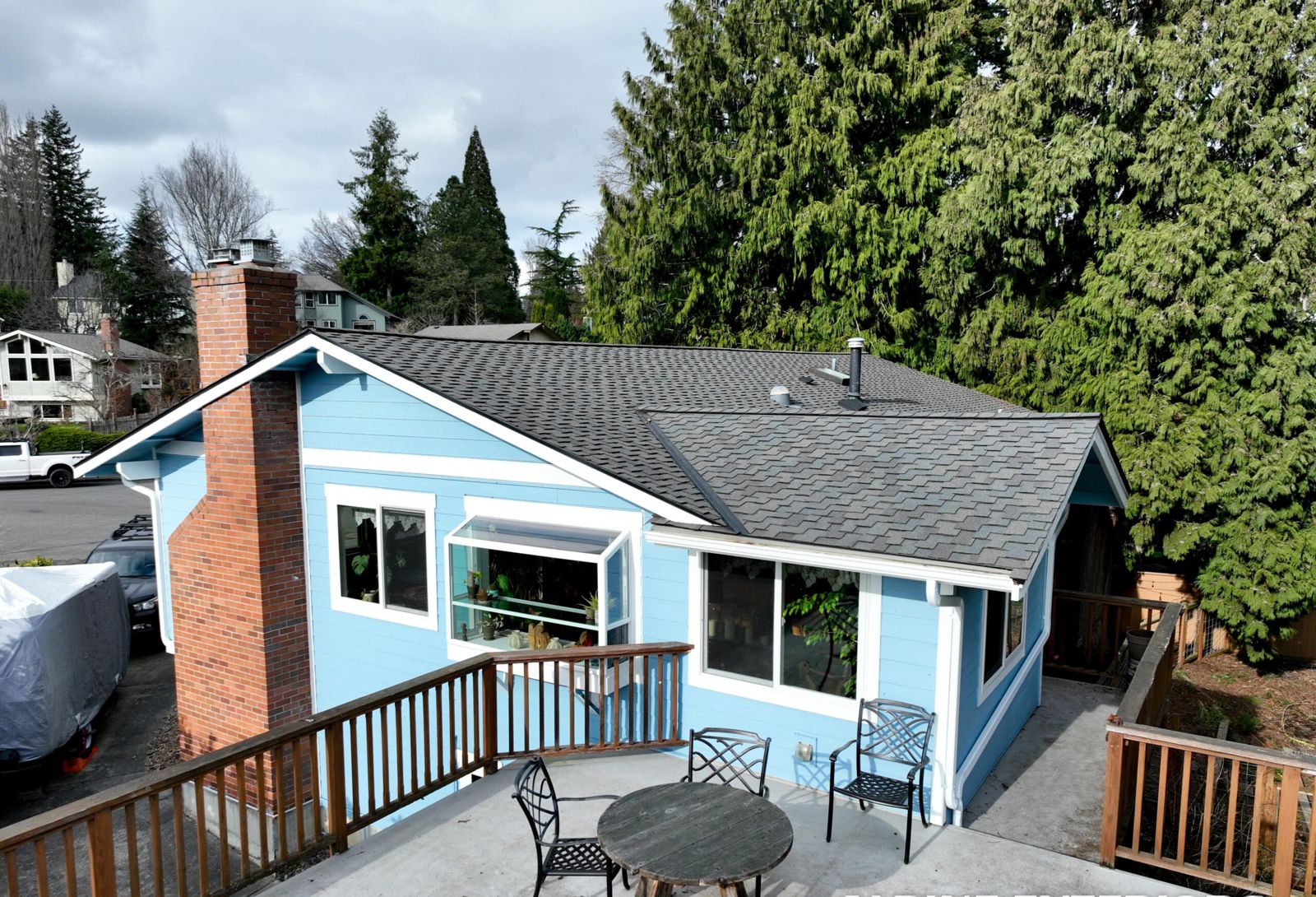
Glacier sits at the end of Mt. Baker Highway (SR 542), tucked under a heavy conifer canopy at higher elevation than Bellingham or the lowland towns closer to the water. Homes and cabins here deal with a different set of pressures than the rest of Whatcom County: deep shade that keeps siding wet for days after a storm, freeze-thaw cycling as temperatures swing through the foothills in fall and spring, and decades-old wood or T1-11 siding that has finally reached the point of no return. If you're pricing James Hardie fiber cement siding for a home in Glacier, the numbers below are meant to give you an honest, defensible range — not a quote. Every property up here is different, and the only way to get a real number is a site visit.
Most Glacier-area fiber cement siding projects land in a broad range once you account for tear-off, substrate repair, the Hardie product line chosen, and site access. Full-house re-sides on modest cabins and single-story homes tend to sit toward the lower end of that range, while larger two-story homes, homes with extensive trim, or homes that need significant sheathing repair after years of moisture exposure push toward the higher end. Per-square-foot installed pricing for fiber cement siding in this part of Whatcom County generally runs in the low-to-mid teens per square foot, with the total project cost shaped heavily by the factors in the table below.
| Cost Factor | Low End | High End |
|---|---|---|
| Removal & disposal of existing siding | Single layer of vinyl or hardboard, easy haul-off | Layered siding, lead-paint-era materials, or difficult disposal access |
| Sheathing & wood rot repair | A few spot repairs at corners or window sills | Extensive OSB or plywood replacement behind chronically wet walls |
| Hardie product selection | HardiePlank lap siding, standard width | HardieShingle, board-and-batten, or mixed-profile designs |
| Factory finish | Primed panels finished with field paint | Factory-applied ColorPlus finish with matching fasteners |
| Trim, fascia & soffit | Reuse of sound existing trim | Full HardieTrim package around all openings and corners |
| Site access & grade | Level lot, paved driveway, easy staging | Long gravel driveways, steep foothill grades, limited equipment access |
| Permits & code-required upgrades | Standard county permit only | Added house wrap or insulation upgrades to meet current energy code |
Treat these as directional ranges, not a calculator. The only way to turn this into a real number is a walk-around of the house with a contractor who will actually pull siding at a few spots to check what's underneath.
A handful of conditions specific to Glacier and the surrounding foothills tend to swing a quote more than anything else:
A written estimate that's actually usable for comparison should spell out more than a bottom-line number. At minimum, look for:
Alpine Exteriors writes quotes this way on purpose: a homeowner in Glacier deciding between a full ColorPlus job and a primed-and-painted option should be able to see exactly what's different in the number, not just two lump sums.
The biggest mistake homeowners make when comparing siding bids is lining up the bottom-line totals without checking whether the scope is actually the same. A lower bid that skips sheathing inspection, uses a thinner or non-factory-finished product, or reuses trim that should be replaced isn't actually cheaper — it's a different (and often lower-quality) project wearing the same name. When you're comparing bids for a Glacier home specifically, ask each contractor:
It's worth getting more than one estimate. A second or third opinion, especially from a contractor who will actually get on a ladder and open up a test section of siding, tells you more than any phone quote ever will.
Many siding contractors, including Alpine Exteriors, offer financing options or can point homeowners toward third-party financing programs for larger re-siding projects — worth asking about directly, since terms and availability change and shouldn't be assumed from a web page. If the project is being driven by storm or moisture damage rather than routine wear, it's also worth a call to your homeowners insurance carrier before work starts. Some policies cover water intrusion damage to sheathing or framing depending on the cause, but coverage for the siding replacement itself and for pre-existing rot varies a lot by policy and carrier, so get that answer in writing before assuming any portion of the project will be reimbursed. Keep photos of the damaged siding and any exposed rot from the tear-off stage — that documentation is what an adjuster will actually want to see.
Fiber cement holds up differently than vinyl under sustained shade and moisture, and it doesn't warp or become brittle the way some vinyl products can after years of freeze-thaw exposure in the foothills. It costs more up front than vinyl, and that's a legitimate tradeoff to weigh against your budget and how long you plan to own the home — there's no universal right answer, and a straightforward conversation with a contractor about your specific house is more useful than a general rule.
Access is usually the biggest factor — long gravel driveways, steep grades, and limited staging area near the house all add time and effort that a flat in-town lot doesn't require. Wood rot discovered during tear-off is also more common on shaded, chronically damp lots, and that repair work is priced separately from the siding installation itself.
Depending on the scope of the project and how much of the wall assembly is being opened up, re-siding can be an opportunity to add or upgrade house wrap and insulation to better meet current Washington State Energy Code targets, even when it isn't strictly required for the permit. It's worth asking your contractor whether your project falls under any code-triggered upgrade requirements before work starts, since that affects both the price and the long-term performance of the wall.
Timelines depend heavily on home size, weather windows, and how much rot repair turns up once old siding comes off — a contractor who won't commit to at least a rough range once they've seen the house in person is a red flag. Glacier's wetter, shadier microclimate can also mean more weather-dependent delays than a project in a drier, more open part of the county, so build some flexibility into your expectations from the start.
Ranges are a starting point, not a quote. If you're weighing James Hardie siding for a home or cabin in Glacier — or anywhere else in Whatcom County, from Bellingham and Ferndale to Lynden, Blaine, Birch Bay, Sudden Valley, or the islands — Alpine Exteriors can walk the property, check what's actually happening behind the existing siding, and put together a written estimate that spells out exactly what's included. That's the only way to turn a range like the ones above into a number you can actually plan around.