Best Siding for Columbia Neighborhood Homes in Bellingham, WA
Updated August 2026 · Alpine Exteriors · WA contractor license ALPINI751OW
If you own a home in Bellingham's Columbia neighborhood, chances are you're dealing with one of two situations: a pre-1940s bungalow or foursquare with its original wood siding failing at the joints, or a newer infill build where the builder-grade siding is already showing algae streaks after a few wet winters. Either way, the material question comes down to the same set of local conditions: steady rain most of the year, wind that picks up off Bellingham Bay and funnels through the Columbia waterfront blocks, shaded lots under mature maples and firs that stay damp longer than open yards, and a state energy code that now expects continuous insulation on most re-siding jobs. Below is an honest rundown of the siding options we install and repair most often on Whatcom County homes, with the trade-offs spelled out rather than glossed over.
The Short Answer
For most Columbia homes, fiber cement siding is the strongest all-around choice because it resists the rot and moisture problems that show up fastest in this climate, holds paint well between repaints, and pairs cleanly with the continuous insulation strategies the Washington State Energy Code favors. Engineered wood siding, such as LP SmartSide, is a reasonable step-down in cost that still outperforms solid wood on rot resistance, as long as the installer seals every cut end. Cedar remains the right call when matching a historic bungalow's original look matters more than minimizing upkeep, but go in knowing it needs the most attention. Vinyl has a place on rental properties and tight budgets, though it is not our first recommendation for homes exposed to the wind-driven rain that comes off the bay. Metal panel siding is worth a look on modern infill and accessory dwelling units but is a stylistic mismatch for most of the neighborhood's older housing stock. Alpine Exteriors installs all five of these systems across Whatcom County and can walk through which one fits your specific lot, sun exposure, and budget.
How We Judged Siding for This Part of Whatcom County
We weighed each material against the conditions that actually show up on Columbia neighborhood homes, not generic marketing claims. The criteria that mattered most:
- Rain exposure and wind-driven moisture, especially on west- and north-facing walls that catch gusts funneling off Bellingham Bay and the Strait of Georgia
- Moss and algae growth on shaded walls under the neighborhood's mature street trees, where surfaces stay damp for days after a storm
- Wood rot risk at grade, sill areas, and butt joints, which shows up faster on older homes with minimal foundation clearance
- Freeze-thaw resilience, a bigger factor for Whatcom County homeowners up in the foothills around Sudden Valley and Lake Whatcom than for Columbia's near-sea-level lots, but still worth knowing if you're comparing notes with family or neighbors further inland
- Compliance with the Washington State Energy Code, which now pushes most re-siding and remodel permits toward continuous insulation and careful house wrap and drainage plane detailing
- Realistic long-term maintenance, meaning what an average homeowner will actually keep up with, not what a spec sheet assumes
- Installed cost range, since the right material for a budget rental is not always the right material for a century-old bungalow
Fiber Cement Siding
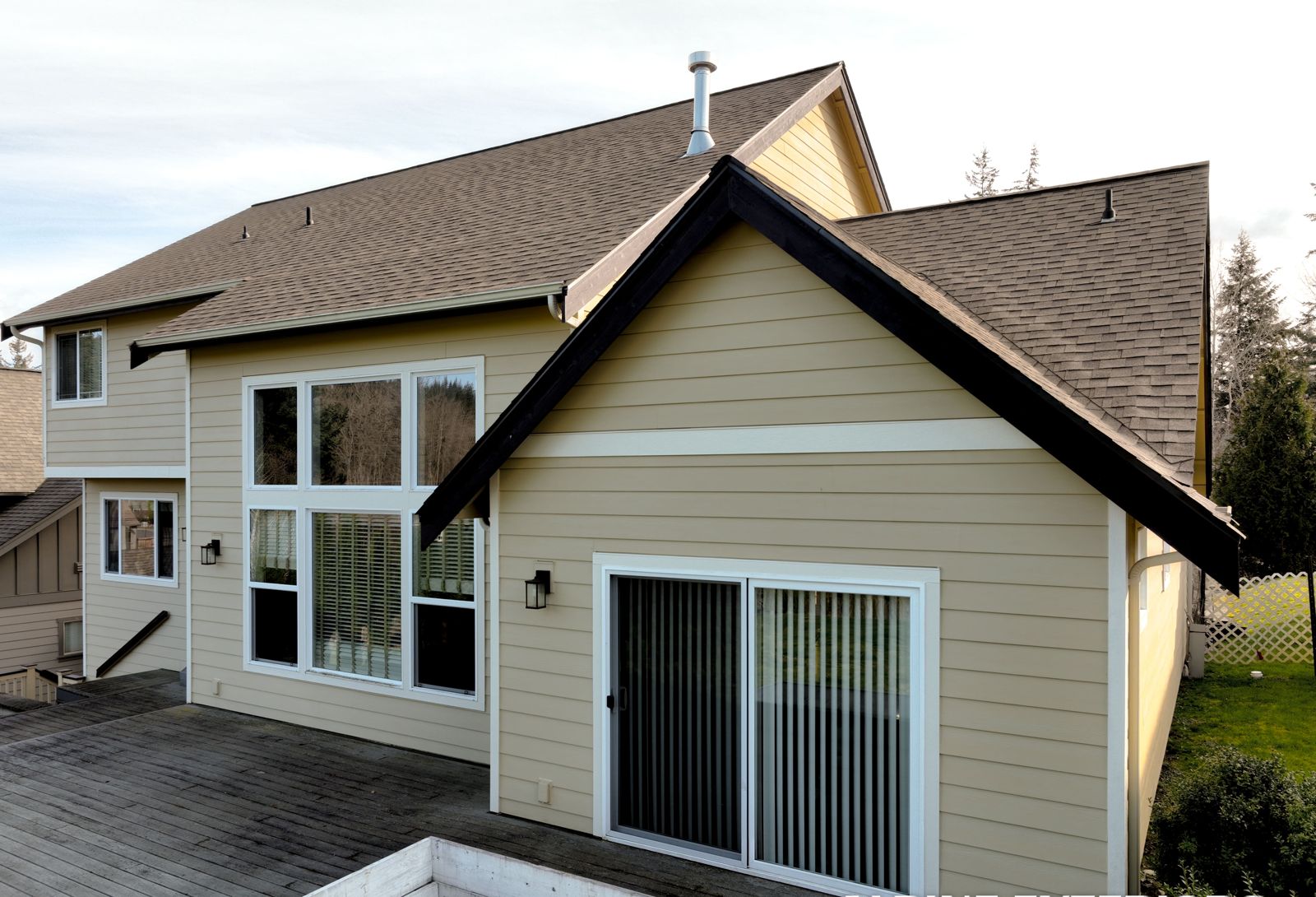
Fiber cement is a blend of cement, sand, and cellulose fiber formed into planks or panels, usually factory-primed or pre-finished. It has become the most common re-side material we install in Whatcom County, and for good reason in a climate like this one.
Pros
- Dimensionally stable through the wet-dry cycling typical of a Pacific Northwest winter, so it does not swell, cup, or split the way solid wood can
- Resists rot even at grade lines and sill areas, which matters on older Columbia lots where the foundation sits close to the ground
- Holds paint for many years between repaints compared to wood
- Non-combustible core
- Available in lap profiles that closely match the look of original Craftsman and foursquare wood siding, which matters for maintaining a historic streetscape
Cons
- Heavy material that requires correct fastening patterns and more labor time than vinyl or engineered wood
- Cutting produces silica dust and requires proper site controls
- Higher upfront cost than vinyl
- Brittle enough to crack on hard impact, such as a ladder or thrown object
- Caulked joints at trim and window returns still need periodic inspection, particularly on walls that take direct wind-driven rain
As a rough planning range, expect fiber cement installed to run somewhere in the neighborhood of $9 to $14 per square foot depending on trim complexity and whether the underlying sheathing needs repair.
Vinyl Siding
Vinyl is the budget option, and it is not without merit on the right project. We install it most often on rental properties and value-focused remodels where upfront cost outweighs other considerations.
Pros
- Lowest material and installation cost of the common options
- Does not rot, since it is not wood-based
- Little to no repainting required over its service life
- Fast installation compared to fiber cement
Cons
- Water can work its way behind panels at the laps in sustained, wind-driven rain, which is a real consideration on the more exposed, bay-facing blocks of Columbia rather than a sheltered inland lot
- Does not provide continuous insulation on its own, so meeting the Washington State Energy Code's insulation targets usually requires an added foam layer underneath, which adds back some of the cost savings
- Algae and moss will still colonize the surface on shaded walls, and vinyl is harder to wash aggressively without risking cracked panels
- Becomes brittle in cold snaps, making repairs trickier in winter
- Aesthetically, flat vinyl lap reads as generic next to the neighborhood's original wood trim details, which can matter for resale on a historic-character block
Rough planning range: roughly $4 to $9 per square foot installed, with the low end reflecting basic profiles and the high end reflecting insulated or thicker-gauge panel options.
Engineered Wood Siding (LP SmartSide and similar)
Engineered wood siding is made from wood strands bonded with resin and treated with zinc borate for moisture and insect resistance, then primed at the factory. It sits between vinyl and fiber cement on both cost and performance, and it is a common pick for owners who want a wood look without solid wood's rot rate.
Pros
- Lighter than fiber cement, which speeds up installation
- Accepts paint well and can match traditional lap and trim profiles found on bungalow-era homes
- Better rot resistance than solid wood when installed and sealed correctly
- Middle-of-the-road cost point
Cons
- It is still a wood-based product, so any cut end, nail hole, or caulk joint that is not properly sealed at installation becomes a moisture entry point over time
- More vulnerable than fiber cement in the shaded, consistently damp microclimates found under Columbia's mature trees
- Manufacturer warranties typically require a maintenance schedule, including repainting and caulk inspection, that some owners let slide after a few years
Planning range: typically $6 to $10 per square foot installed, though this depends heavily on trim detail and installer experience with proper sealing.
Cedar Wood Siding
Cedar is the traditional Pacific Northwest siding material, and it is still the right answer for owners restoring or maintaining a historic Columbia bungalow where authenticity matters more than minimizing maintenance.
Pros
- Matches the original look of early-1900s Craftsman and foursquare homes better than any manufactured alternative
- Individual boards can be repaired or replaced rather than tearing off an entire wall section
- Ages well and develops a genuine patina when properly maintained
- A renewable material, which appeals to some owners on principle
Cons
- Highest maintenance of the common options, needing regular refinishing, staining, or repainting on a cycle most manufactured sidings do not require
- Most susceptible to rot and to moss and algae staining in shaded, damp spots, which describes a good share of Columbia's tree-lined lots
- Butt joints and end grain need careful back-priming and lapping to resist the wind-driven rain coming off the bay; skip that step and water intrusion follows
- Among the more expensive options once you count both installation and the ongoing cost of upkeep over the life of the siding
Rough planning range: often $10 to $16 per square foot installed for quality material and workmanship, before factoring in refinishing costs down the road.
Metal Panel Siding
Steel and aluminum panel systems show up more often on modern infill construction and accessory dwelling units than on the neighborhood's older housing stock, but Bellingham's push for more ADUs has brought more of it into Columbia in recent years.
Pros
- Does not rot and resists moss better than wood-based products, though algae can still streak at seams and fastener points
- Very low maintenance once installed
- Handles wind-driven rain well when panels and seams are properly lapped and flashed
- Suits contemporary architecture and clean-lined additions
Cons
- Can dent from hail, falling branches, or accidental impact
- Expansion and contraction with temperature swings requires correct fastening detail, which is also relevant if you are comparing options with someone dealing with the sharper freeze-thaw cycling near Sudden Valley or the Lake Whatcom foothills
- Higher material cost than vinyl or engineered wood
- Stylistically, it is a poor match for most of Columbia's historic-character homes unless paired thoughtfully with wood or fiber cement trim
- Some panel profiles transmit more sound during heavy rain, a minor but real comfort consideration
Planning range: commonly $8 to $13 per square foot installed, with cost climbing for standing-seam or heavier-gauge profiles.
What to Avoid Here and Why
A few choices consistently cause problems on Whatcom County homes, and they are worth calling out directly.
- Vinyl siding installed without a proper drainage plane behind it, especially on the more wind-exposed, bay-facing blocks of Columbia. Water that gets behind the panels has nowhere to go, and the sheathing behind it can sit wet for weeks at a time.
- Older synthetic stucco (EIFS) systems without a drainage gap. These barrier-style systems were never well suited to a climate with this much sustained rainfall, and we still see moisture damage behind them on remodeled homes that never got the drainage retrofit.
- Unfinished or poorly back-primed wood siding installed with butt joints close to grade. Combined with minimal foundation clearance on many older Columbia lots, this is a fast track to rot at the base of the wall.
- Re-siding jobs that simply strip and replace like-for-like without addressing the continuous insulation and drainage detailing the Washington State Energy Code now expects on permitted work. Skipping this step can mean redoing the job later or running into trouble at inspection.
- Assuming any siding material is maintenance-free on a shaded, north-facing wall. Every product on this list will pick up moss or algae under the right conditions; the difference is how easily it washes off and how much damage it does if you let it sit.
FAQ: Siding Choices for Columbia Neighborhood Homes
Does fiber cement really need less maintenance than cedar in this climate?
In most cases, yes. Fiber cement holds paint longer between repaints and does not absorb moisture the way solid wood does, so it is less prone to the swelling, splitting, and rot that show up on cedar in shaded, damp spots. Cedar can still be the right choice when matching a historic look is the priority, but expect a shorter interval between refinishing jobs.
Will vinyl siding hold up to the wind coming off Bellingham Bay?
Standard vinyl can handle typical Whatcom County weather, but on exposed, bay-facing walls that catch sustained wind-driven rain, water can work its way behind the panels at the laps over time. If you are set on vinyl for a bay-exposed elevation, ask your installer about a properly detailed drainage plane and higher-quality panel locks rather than the thinnest available product.
Do I need to worry about freeze-thaw damage on a home in Columbia?
Less than a homeowner up in Sudden Valley or the Lake Whatcom foothills would. Columbia sits close to sea level, where temperatures rarely swing as sharply, but the neighborhood still gets occasional hard freezes, so a material's freeze-thaw tolerance is still worth a passing thought, especially for trim details and caulked joints.
Does re-siding my house trigger Washington State Energy Code requirements?
Often, yes, particularly on permitted work that exposes the wall assembly. Most current re-siding projects are expected to meet the code's continuous insulation and air-sealing provisions rather than simply matching what was there before. It is worth confirming with your contractor and the local building department before assuming a like-for-like replacement is all that is required.
Get a Straight Answer for Your Home
Every lot in Columbia sits a little differently relative to the bay, the tree cover, and the prevailing wind, so the right siding for your neighbor's house is not automatically the right one for yours. Alpine Exteriors is a Washington-licensed contractor, license ALPINI751OW, serving Bellingham, Ferndale, Lynden, Blaine, Birch Bay, Sudden Valley, and the islands. If you want a straightforward walk-through of how your specific home's exposure, siding condition, and budget line up against the options above, reach out to Alpine Exteriors for an assessment.
Want a straight answer for your home? Alpine Exteriors gives free on-site assessments across Bellingham, Ferndale, Lynden, Blaine, Birch Bay, Sudden Valley and the islands.
Call (360) 543-4799 or
request an estimate.