
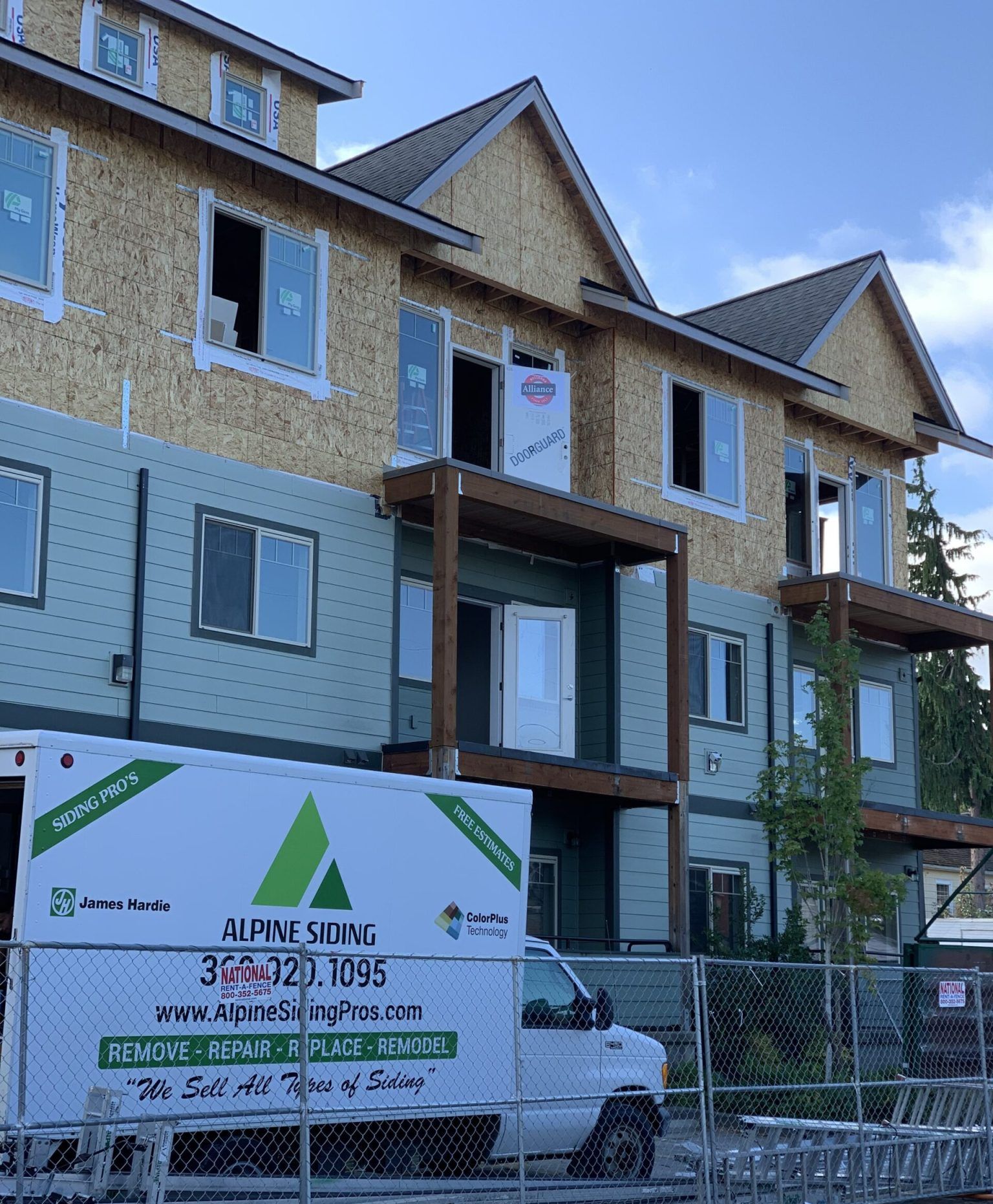
Most single-family homes in Whatcom County take roughly one to three weeks from tear-off to finished trim, with an average 1,800 to 2,800 square foot house needing about 7 to 12 working days of actual crew time. The range is wide because two things drive it more than anything else: how much rot the crew finds once the old siding comes off, and how many dry days in a row the weather gives them.
A siding project isn't one task, it's a sequence, and each step has its own weather and inspection requirements. Tear-off and sheathing inspection usually take a day or two on an average house. This is the step nobody can quote accurately in advance, because until the old siding is off, no one can see what's underneath it. Once the wall is open, the crew installs or repairs the weather-resistive barrier, corrects flashing at windows, doors, and roof-to-wall intersections, and addresses any sheathing that's soft, delaminated, or stained. Only after that is buttoned up does the actual siding go on, followed by trim, caulking, and touch-up paint.
Material choice affects the middle of that timeline more than people expect. Vinyl siding installs quickly because panels lock together and require less on-site cutting. Fiber cement (James Hardie and similar products) takes longer because every board is cut, primed at the cut edge, fastened per the manufacturer's pattern, and caulked with more precision. Cedar and engineered wood products like LP SmartSide fall somewhere in between, with cedar often taking longest if it's being back-primed and hand-fitted around dormers and gable returns. A simple rectangular ranch home sides faster than a house with multiple gables, bump-outs, or a wraparound porch, because trim carpentry — not panel installation — is what eats the clock on complex rooflines.
Whatcom County's climate and geography change the math in ways a contractor working in a drier or more uniform region doesn't have to plan for.
Book earlier than you think you need to, especially if you want a spring or summer start — that's when contractors get the longest dry-weather windows, and calendars fill up months ahead. When you're comparing bids, ask for a written schedule that includes what happens on a rained-out day: a wall that's been opened up and not yet wrapped needs to be tarped properly overnight, and that's a sign of a crew that protects the work rather than pushing through.
Ask directly about the drainage approach for your specific exposure. A wall facing the Strait or sitting close to Birch Bay benefits from a different flashing and rainscreen strategy than a sheltered wall in Lynden or Ferndale, and a contractor who treats every wall the same way isn't accounting for your actual site.
Budget a contingency for sheathing repair before the project starts. No estimate written before tear-off can promise there's no rot behind the siding — it's simply not visible until the old material is off the wall. A contractor who tells you with certainty that there's zero chance of hidden repair costs is guessing, not inspecting.
Verify the contractor's Washington state license before signing anything. Alpine Exteriors holds WA contractor license ALPINI751OW, and any legitimate siding contractor in the state should be able to give you their license number without hesitation.
Here's the honest drawback: even a well-run, experienced crew cannot control the weather, and homeowners who want the fastest possible timeline should know upfront that Whatcom County's rain season adds real schedule risk that a contractor working in a drier climate simply doesn't face. A contractor who promises a fixed completion date regardless of weather in December is telling you what you want to hear, not what's realistic.
Siding itself can sometimes go on in light, intermittent rain once the weather-resistive barrier and flashing are already in place and sealed, but the earlier steps — tear-off, sheathing repair, and house wrap installation — really do need a dry wall to be done correctly. A crew that wraps a wet wall risks trapping moisture behind the siding, which defeats the purpose of the barrier in the first place. Most experienced local crews will pause those specific steps rather than rush them during a wet stretch.
It depends entirely on how much is found, and that varies a lot from house to house. A few soft boards around a window sill or deck ledger might add a day; extensive sheathing replacement across multiple walls, which does happen on older homes in shaded or high-moisture spots, can add several days and a meaningful line item to the budget. This is the single hardest variable to estimate before tear-off, which is exactly why a contingency in both time and cost is worth planning for.
It can, mainly through the wall assembly requirements. If your project's compliance path calls for continuous rigid insulation under the siding, that's an added layer of material, fastening, and seam-taping work compared to siding installed directly over house wrap, and it should be reflected in both the schedule and the quote. Your contractor should be able to explain which compliance path your project is using and what it means for the wall assembly.
Often a bit, yes, mostly due to logistics rather than the labor itself. Ferry schedules and tighter staging areas on some waterfront lots can spread material deliveries across more days, and wind-driven rain exposure on these sites sometimes calls for additional flashing or a rainscreen detail that takes more time to install correctly than a standard interior-lot wall.
Every one of the variables above — the roofline, the wall exposure, what's hiding behind the old siding, the time of year — is specific to your house, which is why a generic timeline only gets you so far. Alpine Exteriors walks Whatcom County homeowners through a site-specific estimate that accounts for your home's exposure, existing siding condition, and the Washington State Energy Code path that applies to your project, so the schedule you're given is one your project can actually meet. Reach out to Alpine Exteriors to get a realistic, written timeline for your Bellingham, Ferndale, Lynden, Blaine, Birch Bay, Sudden Valley, or island-area home.