
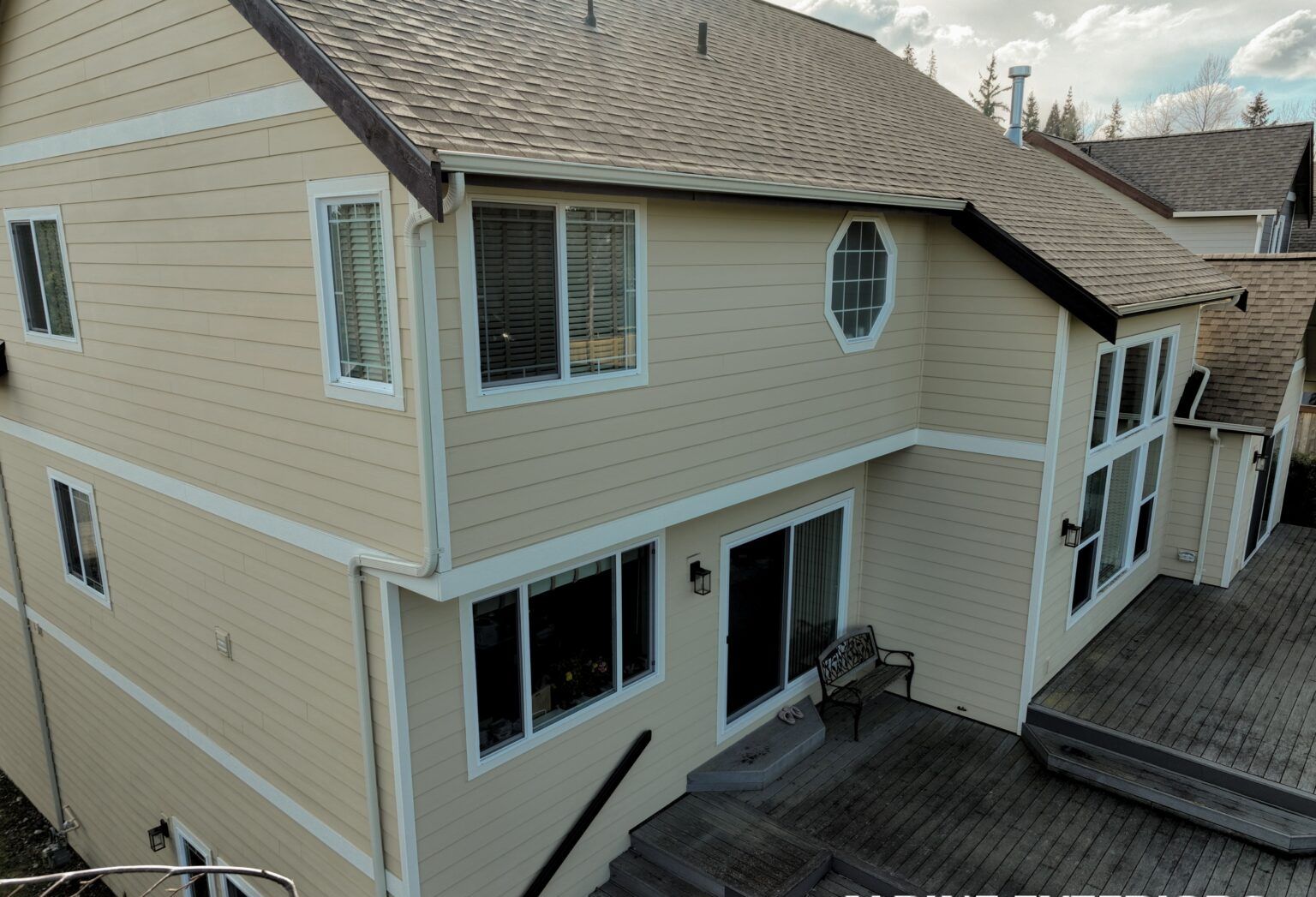
If you own a home in Bellingham, Ferndale, Lynden, Blaine, or Birch Bay, you've probably noticed that the north wall of your house looks different from the rest. Mildew on siding usually shows up first as a dusty gray-green or black film that wipes off partially with a finger, leaving a faint stain behind. It tends to collect in the low spots where trim meets siding, under window sills, and along the bottom few courses near grade, where splashback keeps the material wet longer.
It's worth distinguishing mildew from algae and moss, because homeowners often lump them together and the fixes aren't identical. Algae usually reads as a greenish smear that spreads in broad patches and thrives on the surface film of pollen and dust. Moss is the thick, three-dimensional growth you'll find in shaded corners or gutter overflow paths, and it holds moisture against the wall in a way that plain mildew doesn't. Mildew itself is a surface fungus; it's typically flatter, spreads in blotchy or streaky patterns, and often has a faint musty smell up close. On vinyl and fiber cement siding you'll usually see it as surface staining. On wood siding, mildew is more of a warning sign, since wherever fungus can grow, moisture has been sitting long enough to also threaten the substrate underneath.
North-facing walls in this part of Washington get a specific combination of conditions other elevations don't. They receive little to no direct sun for much of the year, so any moisture that lands on them doesn't evaporate quickly. Whatcom County's rain pattern doesn't help — long stretches of light, persistent drizzle from fall through spring keep exterior surfaces damp for days at a stretch rather than delivering a hard rain that clears out and dries. That's a very different moisture load than a short, intense downpour, and it's the kind of steady dampness mildew spores need to establish and spread.
For homes closer to the water in Blaine and Birch Bay, there's an added factor: wind-driven rain coming off the Strait of Georgia and Birch Bay itself pushes moisture sideways into siding laps and trim joints that would otherwise stay relatively dry. That moisture works behind poorly sealed J-channel or loose caulking, and once trapped there with limited airflow and no sun exposure, mildew can take hold on the backside of the siding where you can't see it until the surface staining outside gives you the first clue.
Tree cover matters too. A lot of Whatcom County lots — especially in Ferndale and Lynden's more wooded neighborhoods — have mature evergreens shading the north side of the house, which compounds the sun problem and adds organic debris that feeds fungal growth. On older homes, especially ones built before more recent Washington State energy code updates tightened wall assembly requirements, insulation and vapor barrier details are sometimes inconsistent. When a wall is under-insulated or missing a proper drainage plane, small amounts of interior humidity or trapped exterior moisture can reach the back of the siding, keeping the assembly damp from both directions instead of just one.
Surface mildew on its own generally isn't an emergency. If it's confined to the outer face of vinyl or fiber cement siding and comes off with cleaning, you're mostly dealing with a cosmetic issue rather than a structural one. What changes the urgency is what's underneath. If you press on the siding near the stained area and it feels soft, notice the siding bowing away from the wall, or see staining that looks worse near seams and fasteners than on the open field of the panel, that points to trapped moisture and possibly wood rot behind it. That's not something to leave for next season.
Wood-based siding and trim deserve extra attention, since a mildewed surface on wood can be a visible symptom of an active moisture problem you can't fully see. Left alone through another wet Whatcom County winter, that kind of hidden damage tends to get worse, not better, and repair costs generally grow the longer it sits. If in doubt, it's worth having someone take a closer look before assuming it's purely cosmetic.
For most north-wall mildew limited to the surface, cleaning and addressing the moisture source is the right first move — full replacement isn't usually necessary just because a wall looks stained. A proper wash, done carefully so it doesn't force water behind the siding, along with trimming back nearby vegetation and improving airflow, often resolves the visible problem for a good while.
Replacement becomes the more honest answer when the siding or wall assembly behind it has actually been compromised — soft or delaminating wood siding, fiber cement cracked at fastener points, or vinyl warped from trapped heat and moisture cycling. Patching over stained material without addressing what's underneath just delays a bigger repair. Alpine Exteriors generally recommends opening a small test section in problem areas before committing to a plan, since it's the only reliable way to know whether you're looking at a cleaning job, a localized repair, or a section needing new siding and possibly new sheathing. Not every mildew case needs a contractor at all — plenty of homeowners handle routine surface cleaning themselves and only call for help once they suspect something structural.
Because north walls will always get less sun here, prevention is mostly about limiting how long moisture sits and making sure it has somewhere to go. Trimming back trees and shrubs so they're not shading or dripping onto the wall makes a real difference over a wet season. Keeping gutters clear so water isn't overflowing down the siding face matters just as much, particularly in neighborhoods with heavy tree cover around Lynden and Ferndale.
None of this eliminates mildew risk entirely — a persistently shaded, rain-facing wall in this climate will always need more upkeep than a south-facing one — but it keeps growth manageable and reduces the odds of it becoming a moisture problem behind the siding.
Exterior surface mildew is generally more of a maintenance and cosmetic concern than a health hazard, since it's outdoors and not circulating through indoor air. That said, if moisture has worked its way inside the wall assembly, it's worth having it checked, since ongoing dampness inside walls is a different situation than surface growth outside.
You can, but high pressure aimed directly at siding seams and laps can force water behind the panels, which creates the exact problem you're trying to avoid. A lower-pressure rinse with an appropriate cleaner, applied carefully around trim and joints, is usually safer than a straight pressure-washer blast.
It comes down to sun exposure and airflow. The north wall dries out more slowly after rain than walls that get afternoon sun, and in Whatcom County's drizzly, overcast stretches that difference adds up over months, not days.
New siding resets the clock and can come with better drainage details, but it doesn't change the climate. A north-facing wall in Bellingham or Birch Bay will still need more regular cleaning and upkeep than other elevations, regardless of what siding material is on it.
If you're seeing mildew on the north side of your home and aren't sure whether it's a quick cleaning job or something more, Alpine Exteriors can take a look and tell you plainly what's going on before recommending any work. We serve homeowners throughout Whatcom County, including Bellingham, Ferndale, Lynden, Blaine, and Birch Bay, and we'd rather point you toward a simple cleaning than sell you a replacement you don't need.