
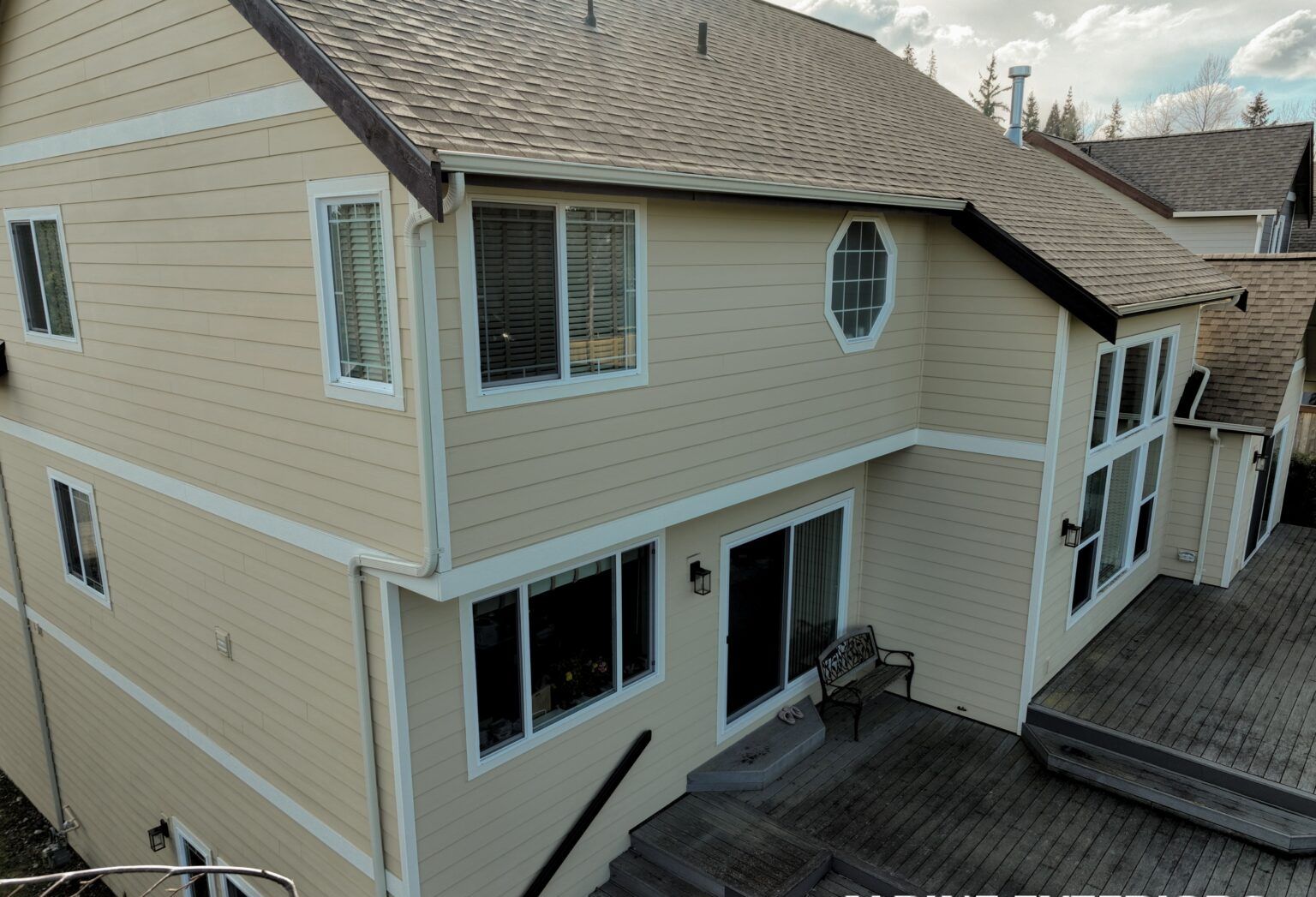
Most homes in Bellingham and the surrounding Whatcom County towns need their gutters cleaned twice a year — once in late fall after the leaves and needles finish dropping, and again in late winter or early spring before the heaviest stretch of rain arrives. Homes tucked under a lot of conifer cover, which describes a large share of properties from Lynden to the Birch Bay shoreline, often need a third cleaning in early summer to keep up with cedar and fir debris.
That's a starting point, not a rule. The right frequency for any given house depends on tree cover, roof pitch, gutter size, and how exposed the home is to wind. A one-story rambler under an open sky in Ferndale can go longer between cleanings than a two-story home in a wooded pocket near Lake Whatcom.
Whatcom County doesn't get dramatic downpours very often. What it gets instead is a long, steady rain season that runs from roughly October through April, with drizzle and light-to-moderate rain spread across many days rather than concentrated into a handful of storms. That pattern matters for gutters because it means they're rarely given a dry stretch to sit empty and get a visual check. A clog that starts in October can go unnoticed for months while water backs up behind it every time it rains.
Debris here is also different from what falls in a lot of the country. Instead of large, dry leaves that blow through a gutter fairly easily, Whatcom County homes deal with fir needles, cedar fronds, hemlock debris, and moss fragments. Needles interlock and mat together with moisture, and cedar fronds hold onto roof grit and organic buildup in a way broad leaves don't. Add moss — which grows readily on north-facing and shaded roof slopes in this climate — and gutters can end up half full of a dense, soil-like mixture that doesn't wash out on its own even in a hard rain.
The practical result is that gutters here fill up faster and quieter than in drier climates, and by the time an overflow becomes visible from the ground, the clog has usually been building for weeks.

A few local conditions push gutter maintenance higher on the priority list than it might be elsewhere.
None of this is storm-driven the way it might be in a hurricane-prone region — Whatcom County simply doesn't see that kind of weather. The risk here is slower and less dramatic: chronic dampness, wood decay, and moss creeping into places it shouldn't be.
A twice-a-year cleaning schedule works for most homes, but a few habits make it more effective:
Alpine Exteriors sees a fairly consistent pattern on service calls: gutter neglect rarely shows up as a gutter problem first. It shows up as peeling paint on trim, dark staining on siding, or soft wood at the fascia — and by then the fix is bigger than a cleaning.
Plenty of homeowners handle gutter cleaning themselves on a single-story home with safe roof access. The bigger factor is usually the ladder work and roof pitch, not the cleaning itself. On steeper roofs, two-story homes, or homes near power lines, it's worth having it done professionally — the debris removal is the easy part; safe access is where most injuries happen.
No. Guards cut down on bulk debris like needles and leaves, but fine grit, moss spores, and small debris still get through most designs over time. Guarded gutters typically need less frequent attention, not zero attention.
Look for staining or dark streaks on siding below the gutter line, paint that's bubbling or peeling near the roofline, or soft/spongy fascia board. Any of those suggest water has been sitting somewhere it shouldn't for a while, and it's worth having it looked at rather than just cleaning the gutter and moving on.
Somewhat. Metal roofs shed needles and debris more easily than asphalt shingles, which have a rougher surface that catches grit and organic material. Steeper roofs also tend to self-clear better than low-slope roofs. Roof type doesn't eliminate the need for cleaning, but it can shift how quickly debris builds up.
If it's been a while since anyone looked closely at your gutters, fascia, or the trim around your roofline, it's worth having it checked before the fall rain settles in for the season. Alpine Exteriors works on siding, roofing, and the trim details in between, so a gutter conversation often turns into a broader look at how well the whole exterior is managing water. Reach out to Alpine Exteriors for an inspection if you're anywhere from Bellingham to Ferndale, Lynden, Blaine, or Birch Bay — catching a small moisture problem early is almost always simpler than fixing what it turns into.