
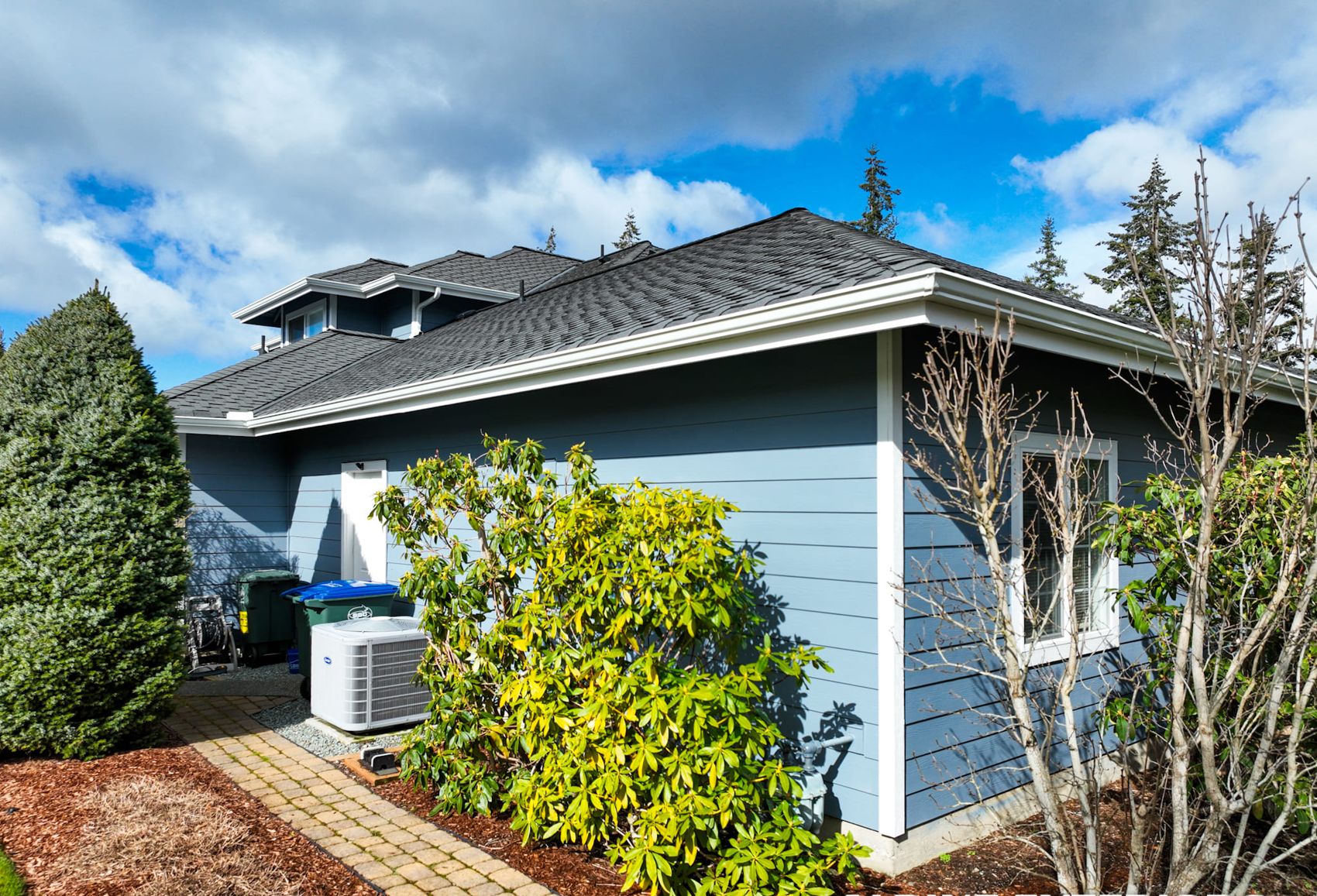
Whether your siding project needs a permit depends less on the material you choose and more on where the house sits and how much of the wall assembly you're touching. Inside Bellingham city limits, the Bellingham Permit Center reviews and issues the permit; in Ferndale, Lynden, and Blaine, each city runs its own building department; and everywhere else in the unincorporated county — Birch Bay, Sudden Valley, Lummi Island, and the rural pockets between towns — the permit runs through Whatcom County Planning & Development Services.
Most jurisdictions in Washington, including Bellingham and Whatcom County, don't require a building permit for a straightforward re-side where the existing sheathing and weather-resistive barrier stay in place and you're installing new siding over what's already a sound, code-compliant wall. The moment the project goes past that — stripping down to the studs, replacing rotted sheathing, adding rigid foam or house wrap, moving or resizing windows and doors, or changing the siding material in a way that affects the wall's fire rating or structural bracing — you're into permit territory almost everywhere in the county. The trigger isn't "siding" as a category; it's scope.
Bellingham's permit center handles this under the city's adopted building and residential codes, which track the state codes with local amendments. Ferndale, Lynden, and Blaine each adopt the same state codes but run their own intake, plan review, and inspection scheduling, so a project that spans a property line between, say, Ferndale city limits and county land can end up needing two separate conversations. Whatcom County's Planning & Development Services office, based in Bellingham but covering everything outside those four city boundaries, is who you'd call for Birch Bay, Sudden Valley, Lummi Island, Point Roberts, and the unincorporated stretches along Lake Whatcom, Lake Samish, and the rural roads north and south of Bellingham. The county and the cities don't share a single online portal, and a permit pulled with one jurisdiction isn't recognized by another — a detail that trips up homeowners who assume "Whatcom County" is one office.
Where siding work does need a permit, the Washington State Energy Code usually enters the picture too, because most re-sides that open the wall are also the moment homeowners add continuous insulation or upgrade the weather-resistive barrier. The energy code sets minimum requirements for wall insulation and air sealing on any project that exposes the assembly, and both Bellingham and the county's building departments will check for compliance during plan review or inspection on permitted jobs. This isn't a Whatcom-specific rule — it applies statewide — but it's more likely to actually come up here than in a dry climate, because our wall assemblies are built around managing moisture, not just holding in heat.
Whatcom County's siding decisions are driven by water more than anything else. Bellingham and the lowland towns get a long, steady rainy season, and homes near Bellingham Bay, the Lummi Island shoreline, and the Strait of Georgia take wind-driven rain that pushes moisture sideways into laps, seams, and trim joints that would stay dry in a calmer setting. That's why flashing detail — head flashing over windows and doors, proper kick-out flashing at roof-to-wall intersections, and correct lapping at seams — matters more here than the choice of siding material itself. We've opened up walls on re-side jobs in Birch Bay and along the Lake Whatcom shoreline where the siding looked fine from the street but the sheathing behind it had gone soft from years of wind-driven moisture finding a gap in the flashing.
Persistent damp also means moss and algae growth on north-facing and shaded walls, especially under mature trees in older Bellingham and Sudden Valley neighborhoods. That's mostly a cosmetic and maintenance issue rather than a permit issue, but it's often the first visible sign that leads a homeowner to look closer and find rot underneath — which is when a simple re-side turns into a sheathing repair that does need a permit. Up toward the foothills — Deming, the Mount Baker corridor, and the higher parts of Sudden Valley — winters bring more freeze-thaw cycling than you see right on the water, which stresses caulked joints and can accelerate cracking in brittle or poorly-installed siding over a few seasons. None of this is hurricane country, and we don't design or price for wind uplift the way a coastal Gulf or Atlantic contractor would; the engineering concerns here are moisture management, drainage planes, and code-minimum insulation, not storm rating.
Before you get a quote, figure out which jurisdiction your address falls under — city limits for Bellingham, Ferndale, Lynden, or Blaine, or unincorporated county for everywhere else including Birch Bay, Sudden Valley, and the islands. That single fact determines who you call, what forms you fill out, and how long review takes. From there:
We've walked homeowners through both sides of this line — city permits in Bellingham and Ferndale, county permits in Birch Bay and Sudden Valley — and the honest drawback is that the county process can take longer during busy building seasons simply because Planning & Development Services covers more ground with a smaller staff than a city permit counter. It's not a reason to skip a permit that's actually required; it's a reason to build the timeline into your project plan rather than be surprised by it. Alpine Exteriors handles the permit conversation as part of the estimate, but we're upfront that we don't control how fast a jurisdiction's queue moves.
In most cases, no — if the sheathing and weather-resistive barrier underneath are sound and staying in place, both Bellingham and Whatcom County generally treat that as a like-for-like re-side that doesn't trigger a building permit. The exception is if inspection reveals rot or damage once the old siding is removed, which shifts the project into repair territory and usually does require one.
City limits don't always match the mailing address or the name people use for a neighborhood — plenty of "Bellingham" addresses are actually unincorporated county land, and the reverse is also true near annexed areas. The most reliable way is to check with the jurisdiction directly or look up the parcel on the county's GIS mapping tool before assuming which office handles your permit.
If the project doesn't require a permit because the wall assembly isn't being opened, the energy code generally doesn't come into play. Once a permit is required — because sheathing, insulation, or the weather barrier is being altered — the energy code's minimum requirements for wall insulation and air sealing apply, and the permitting jurisdiction will check for that during review.
A straightforward re-side over sound sheathing typically runs in a lower cost range per square foot than a project that involves sheathing replacement, which adds materials and labor once walls are opened. Given how much wind-driven rain and prolonged dampness this region sees, especially near the bay and the islands, we recommend homeowners budget a contingency range rather than treat the initial quote as a hard ceiling until the old siding is off and the sheathing is actually visible.
If you're weighing a siding project anywhere in Whatcom County — Bellingham, Ferndale, Lynden, Blaine, Birch Bay, Sudden Valley, or the islands — Alpine Exteriors can walk the property, tell you honestly whether your project is likely to need a permit, and explain which jurisdiction you'd be working with before you commit to a scope. Reach out to Alpine Exteriors for a straightforward assessment and a written estimate that accounts for what we actually find once we're looking at the wall, not just what the siding looks like from the curb.