

Between the rain that settles in for weeks at a time, the wind-driven moisture that comes off Bellingham Bay and the Strait of Georgia, and the freeze-thaw cycles that show up in the foothills around Sudden Valley and the higher parts of Lynden, siding in Whatcom County takes on more water exposure than most homeowners realize. Most of the time the siding itself sheds that water fine. The problem shows up behind it, where trapped moisture can sit against the sheathing and framing for months without anyone noticing until the wood has already started to break down. Catching the signs early is the difference between a patch repair and a full wall rebuild.
None of these signs prove rot by themselves, but any one of them is a reason to look closer, especially on the north and west-facing walls that take the worst of our weather.
Press a gloved hand or the butt end of a screwdriver against the siding. If it flexes or gives where solid wall should feel firm, water has likely been sitting against the back side of that panel or the sheathing behind it long enough to soften the fibers. This is most common at the bottom courses of a wall, near ground splash-back, and around old fastener holes that were never properly sealed.
Tannin bleed and mineral staining are normal on cedar and some fiber cement products, but a stain that's dark, growing, or tracking from a single point — a nail head, a butt joint, a flashing seam — usually means water is finding a path behind the siding at that spot and running down the back side before it ever reaches the surface.
Paint failing evenly across a whole wall is usually just age and UV exposure, which is a normal maintenance item here given how much gray, wet weather this county gets. Paint failing in one isolated patch, especially if it bubbles rather than just chalks or fades, points to moisture pushing out from underneath the siding rather than weather wearing it down from the outside.
Wood rot and the mold that tends to accompany it both produce a distinct musty smell. If that smell shows up inside near an exterior wall — often in a closet, behind furniture, or along a baseboard — it usually means the moisture problem has been going on long enough to work its way through the wall assembly, not just sit behind the siding.
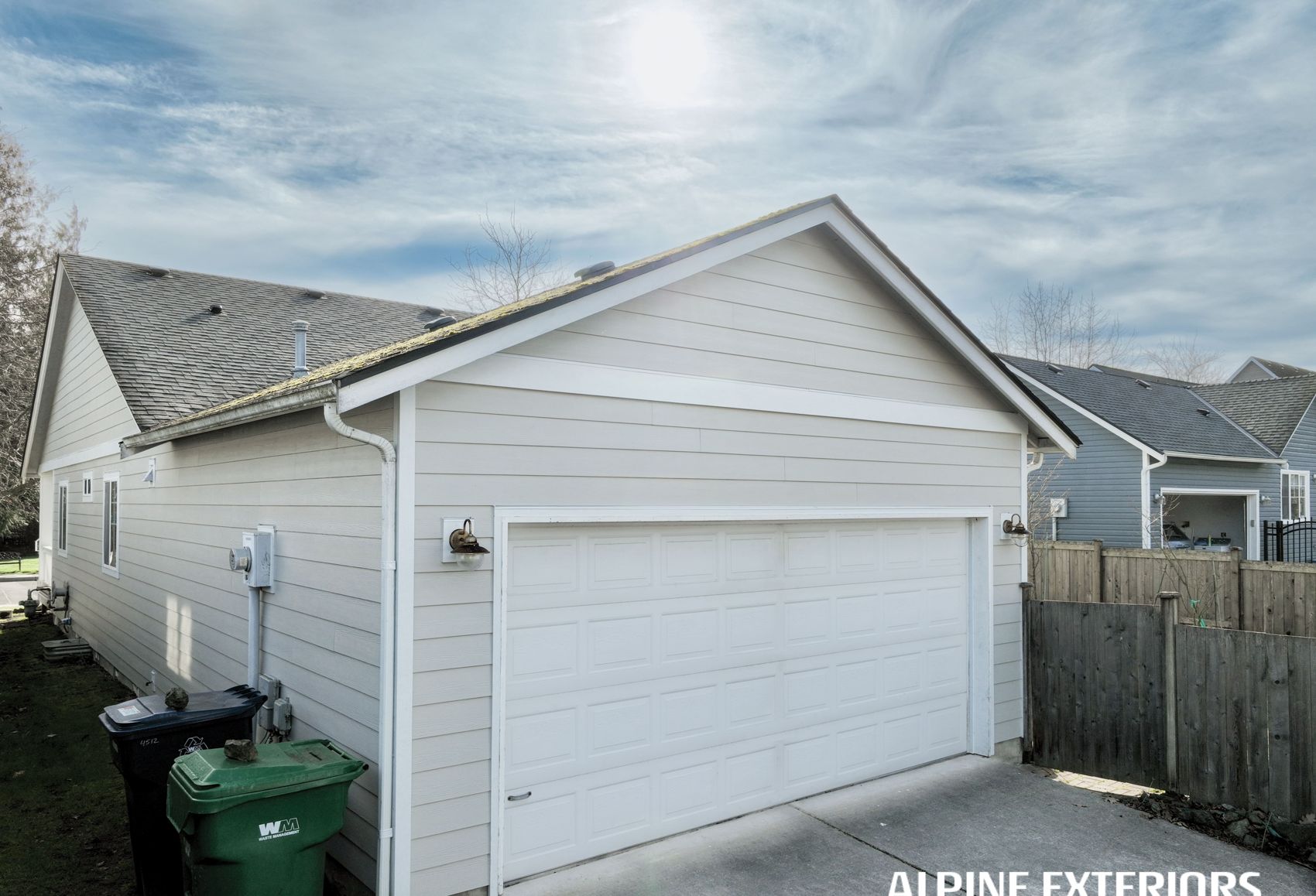
Moss and algae on siding are close to unavoidable in this climate, especially on shaded north walls under mature trees in Bellingham and Ferndale, and light moss on its own doesn't mean rot. What's worth a closer look is moss that's noticeably heavier at one seam, corner, or butt joint than the rest of the wall — that's often a sign water is lingering there instead of draining, which is exactly the kind of spot rot develops behind.
Trim pieces are usually the first thing to go because they sit at horizontal surfaces and end grain, both of which soak up water instead of shedding it. Window sills, corner boards, and the bottom of door casings are worth checking with a probe every year or two, particularly on homes on Birch Bay or the islands where wind-driven rain hits harder and more directly.
Not every sign on this list means calling someone today. The distinction that matters is whether water is still actively getting in.
Treat as urgent: a screwdriver sinking into wood with light pressure, a musty smell that's gotten stronger, visible sagging or waviness in the wall plane, water intrusion showing up inside during or after a storm, or rot found near a window or door where framing could be compromised. These situations tend to get worse fast, especially heading into our wet season, and waiting typically turns a repair into a rebuild.
Can wait for a scheduled inspection: isolated moss growth with no softness underneath, minor tannin staining, and small areas of peeling paint on siding that still feels solid when pressed. These are worth noting and checking again in a few months, ideally during a dry stretch when it's easier to get an accurate read.
Start with a simple probe test using a screwdriver or awl at the spots that concern you, pressing gently rather than jabbing, since sound wood shouldn't give at all. A moisture meter reading, if you have access to one, adds more certainty but isn't required to justify a closer look. Take photos and note the location, since that record is useful whether you're tracking the problem yourself or bringing in a contractor.
Beyond that point, the most reliable way to know what's actually happening is to remove a section of siding and look at the sheathing directly — something that's hard to do without damaging more siding if you're not used to the fastening pattern underneath. Alpine Exteriors does this kind of exploratory inspection regularly across Whatcom County, and it's usually the fastest way to find out whether you're looking at a spot repair or something that affects a larger section of wall. Whatcom County building permits, when the repair involves opening up exterior walls or replacing a meaningful area of siding, can also trigger review under the Washington State Energy Code for the weather-resistive barrier and insulation at that wall — worth asking about before work starts rather than after.
Once the extent of the damage is known, the honest range is wide: a single soft board or a small patch of compromised sheathing might be a repair measured in a few hundred to low thousands of dollars, while rot that's spread across a wall section, especially if it's reached the framing, can run into the tens of thousands once you're re-siding and rebuilding structure. There's no way to give an accurate number without seeing the wall open, and any contractor who quotes a repair price without doing that is guessing.
Yes, though it's less common. Rot that's still early or that's developing behind a rigid siding material like fiber cement can be hidden longer than it would be behind wood or vinyl. Musty odors and unexplained increases in energy bills are sometimes the only early clues in those cases, which is part of why periodic probe checks at vulnerable spots — trim, seams, low walls — are worth doing even without an obvious sign.
Not by itself. Moss and algae growth on siding is common across Whatcom County, especially on shaded, north-facing walls in Bellingham, Ferndale, and around Sudden Valley, and a lot of it is purely cosmetic. It becomes a more meaningful sign when it's noticeably heavier at one seam or joint than everywhere else, since that pattern usually points to water sitting there rather than draining off.
Repainting and caulking are fine as routine maintenance on siding that's actually sound, but they don't fix trapped moisture and can sometimes make it worse by sealing water in rather than letting it out. If a probe test shows softness underneath, caulking over it just delays finding out how far the damage has spread.
It can. If the repair opens up a section of wall down to the sheathing, that work is generally expected to meet current Washington State Energy Code requirements for the weather-resistive barrier and wall insulation at that section, even if the rest of the house was built to an older code. Your local building department can confirm what applies to your specific project before work starts.
Rot behind siding rarely gets better on its own, and in a climate that stays wet as much of the year as Whatcom County does, a small problem this fall can be a much bigger one by next spring. If you're seeing any of the signs above on a home in Bellingham, Ferndale, Lynden, Blaine, Birch Bay, Sudden Valley, or the islands, Alpine Exteriors can take a look, open up the area if needed, and give you a straight answer about what's actually going on before recommending any work. Alpine Exteriors is licensed in Washington under contractor license ALPINI751OW.