
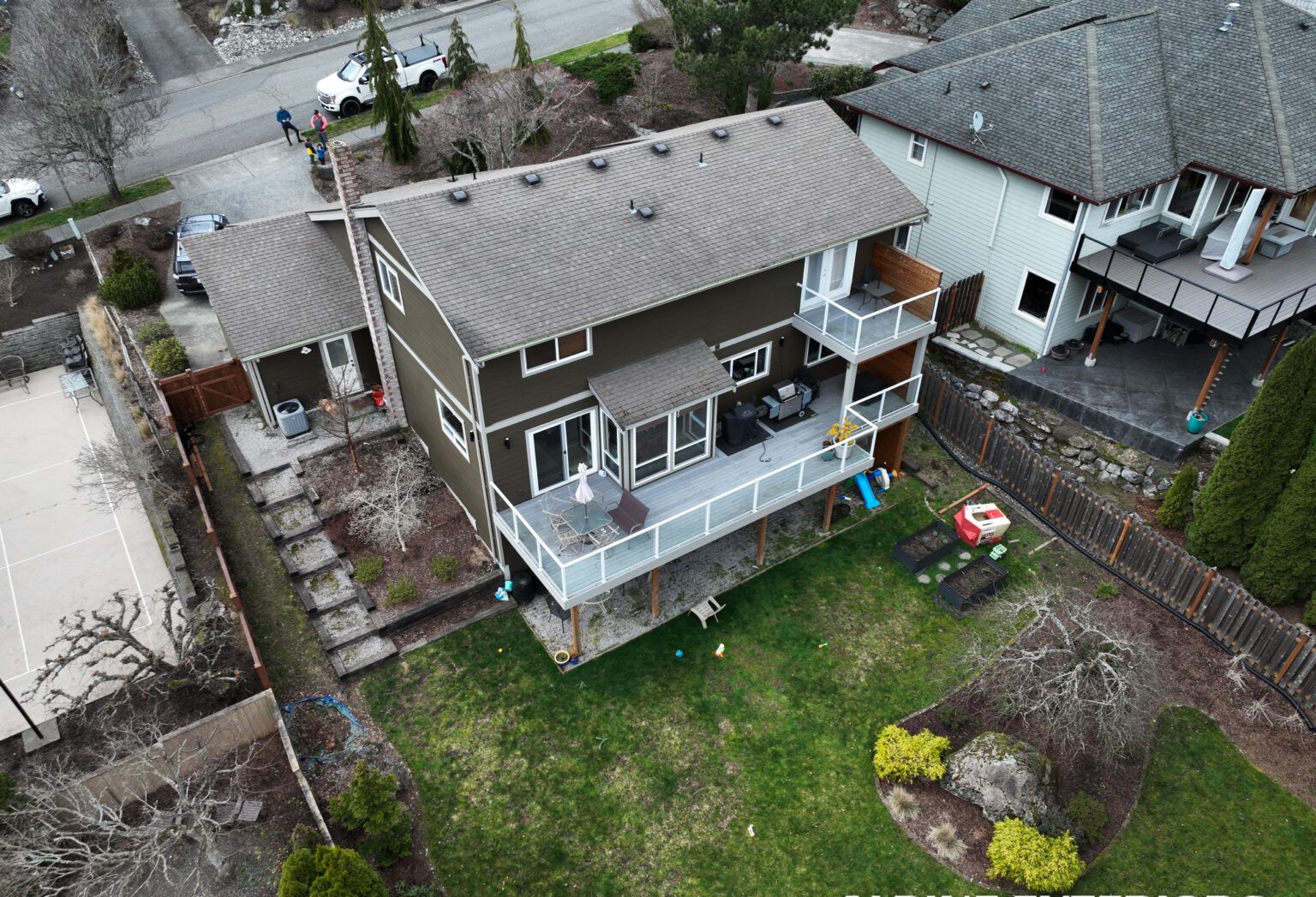
If the lowest few inches of your siding look thicker than the rest, feel spongy when you press on them, or have started to bow away from the wall, you're looking at a swollen bottom edge. It's one of the most common siding complaints we see on homes from downtown Bellingham out to Lynden and Blaine, and it's rarely random bad luck — it's almost always a sign of how water is moving around your home's lower walls. This page walks through how to identify it, why it happens so often here, whether it needs attention right away, and what your realistic options are.
Swelling at the bottom edge of siding shows up differently by material, but the pattern is the same: water gets into the bottom inch or two of a board or panel and the material expands, because that edge holds moisture longer than any other part of the wall.
A useful test: press firmly along the bottom edge with your thumb or a flathead screwdriver tip. Sound material resists; compromised material feels mushy or gives easily. If the tip sinks in without resistance, moisture has already broken down the fibers or wood structure, not just the paint film.
Swollen bottom edges are a climate-driven problem, and Whatcom County has a specific mix of conditions that makes the lower courses of siding the first place to fail.
The biggest factor is simply how much time siding here spends wet. Bellingham and the surrounding lowlands get long stretches of persistent, low-intensity rain rather than short heavy downpours, so water has more chance to work into seams and laps and less time to dry between events. Bottom edges are the last part of the wall to dry, since gravity carries runoff down and holds it there against the foundation or trim.
Wind direction matters too. Homes exposed to wind-driven rain off Bellingham Bay, the Strait of Georgia, or the Strait of Juan de Fuca — think waterfront properties in Blaine, Birch Bay, Point Roberts, and the west-facing islands — take rain sideways into laps designed to shed water falling straight down. That drives moisture up under the bottom edge of the course above, exactly where swelling starts first.
Splash-back off patios, walkways, and gravel or bark beds is another big one. Siding installed too close to grade gets hit twice: once from rain falling on it directly, and again from rain bouncing back up off the ground. We see this often on older homes in Ferndale and Sudden Valley where landscaping has crept up over the years and buried what used to be proper clearance.
Moss and algae growth compound the problem rather than just being cosmetic. A mossy bottom edge holds water against the material like a sponge, extending how long the siding stays saturated well beyond what a clean, dry surface would see in the same storm.
Up toward the foothills around Kendall, Deming, and the Mount Baker corridor, freeze-thaw cycling adds mechanical stress on top of the moisture problem. Water already soaked into a swollen edge expands when it freezes overnight, prying open cracks and seams that were only hairline the day before. A foothill home can deteriorate faster over a winter than a similarly exposed home in town.
Finally, a lot of what we find is installation-related: missing or improperly lapped weather-resistive barrier behind the siding, a starter strip installed without the correct kick-out angle, caulk used where a flashing or drip cap should have been, or house wrap that wasn't extended down over the foundation properly. Problems like this are almost always a combination of exposure and detailing, not one single cause.

It depends on how far the damage has gone, but this isn't something to set aside for someday. Swelling at the bottom edge means water has already gotten past the paint or coating and into the material itself — at that point it's a question of how fast it spreads, not if.
Treat it as urgent if you notice soft or spongy material that gives under a fingertip, staining or dampness on the interior wall behind the area, a musty smell nearby, visible fungal growth, or swelling that has crept up past the bottom edge into the body of the board. Any of those point toward moisture reaching the sheathing or framing, which is a structural concern, not just cosmetic.
It's less urgent, though still worth scheduling, if the swelling is confined to a short run of boards, the material still feels firm, and there's no sign of moisture inside. You have some time to plan the repair, but the window closes faster during our wet season — swollen material left through a full fall and winter tends to fail badly by spring.
This is genuinely a judgment call, and any contractor who tells you "just replace everything" before looking closely should make you a little skeptical.
Repair or spot-replacement makes sense when the swelling is limited to a handful of boards or one wall elevation, the framing and sheathing behind it test dry, and the rest of the siding is in reasonably good shape. That means cutting out and replacing the affected courses, correcting whatever caused it — flashing, grade clearance, a caulk joint that should have been a drip edge — and repainting to match. Expect a repair like this to run in the low thousands of dollars, depending on siding type, accessibility, and how much of the wall needs to be opened up.
Full replacement is the more honest call when swelling shows up on multiple elevations, when the house wrap or weather barrier is failing broadly, when the siding is an older product that's hard to match, or when moisture has reached the sheathing in more than one spot. At that point, patching individual boards is a short-term fix on a wall system failing more broadly, and you'll likely pay for repeat repairs within a few years. Full replacement costs more up front, but it lets us correct the water-management details across the whole wall at once.
We'll tell you honestly which category your home falls into, including when the answer is "this is a repair, not a replacement job."
Most of the swelling we see is preventable with a handful of maintenance habits and correct original detailing.
You can, but it's usually a short-term fix, not a real repair. Cutting the visibly swollen material without addressing why it got wet in the first place — missing flashing, poor grade clearance, a failed weather barrier — just delays the same damage showing up again a season or two later. Have someone check what's happening behind the siding first.
Usually not. Most homeowner policies treat gradual water intrusion and resulting rot as a maintenance issue rather than a sudden, covered loss. Coverage sometimes applies if the entry point ties to a specific covered event, like wind damage, so it's worth a call to your agent, but don't count on it.
There's no fixed timeline — it depends on the material, how much water exposure it's getting, and whether it fully dries between rain events. In our climate, a bottom edge that stays wet through a full fall and winter can go from cosmetic swelling to compromised material within a single wet season, especially on wood-based products.
Yes. Many of our repair calls are on homes with siding products that are no longer manufactured or hard to match. We'll tell you honestly whether a close match is realistic for a spot repair or whether the wall is better served by full replacement.
Swollen bottom edges rarely fix themselves, and the real cost of waiting usually isn't the siding — it's what's happening to the wall behind it. Alpine Exteriors inspects the affected areas, checks moisture levels where needed, and gives you a clear repair-or-replace recommendation, whether you're in Bellingham, Ferndale, Lynden, Blaine, Birch Bay, Sudden Valley, or out on the islands. Alpine Exteriors is licensed in Washington under ALPINI751OW — reach out for an inspection and an honest read on what your siding actually needs.