
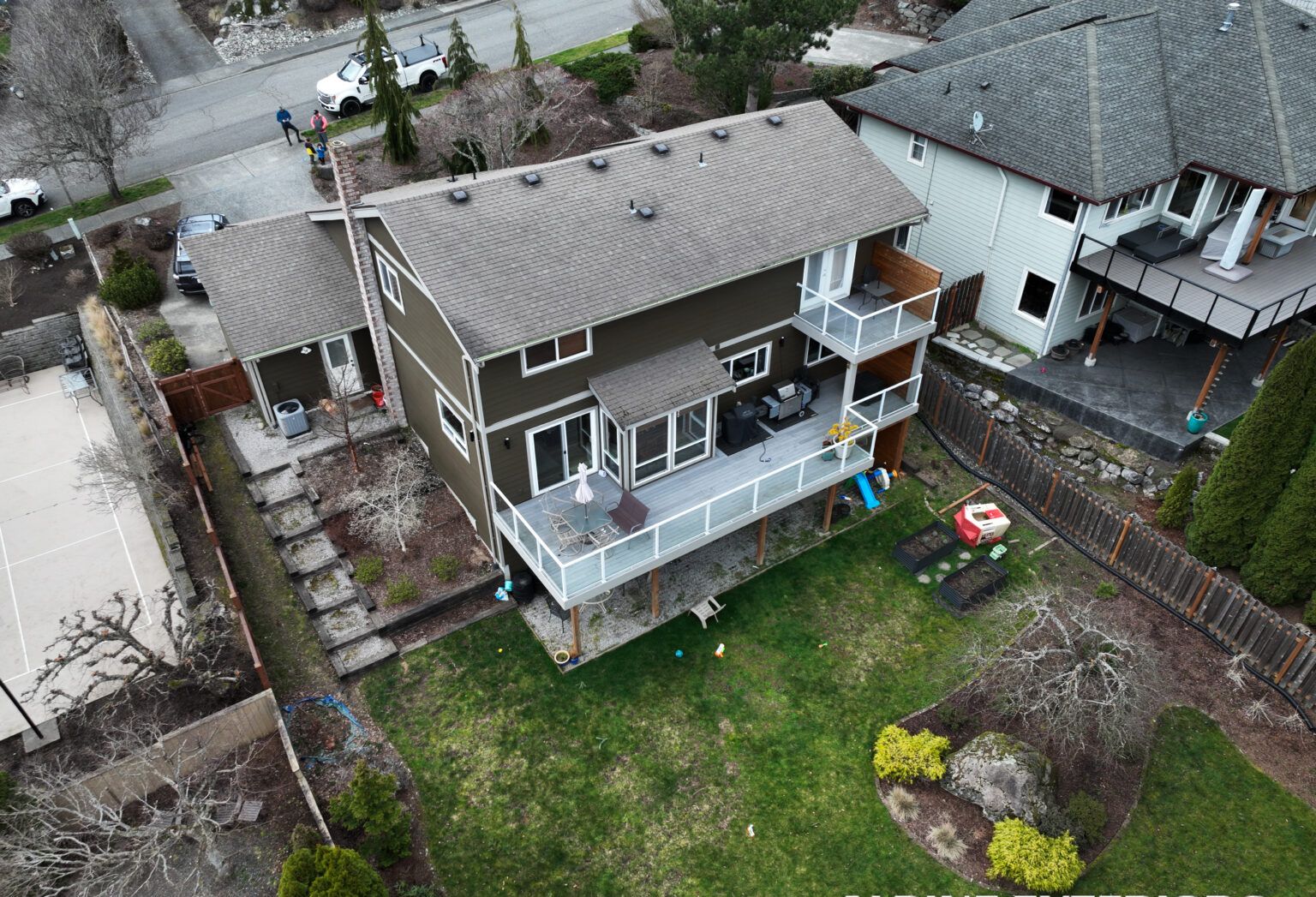
If you've ever walked around to the north wall of your Bellingham, Ferndale, or Lynden home and found it looking like a different color than the rest of the house, you're not imagining things. North-facing siding in Whatcom County grows moss and algae faster than any other elevation, and it's one of the most common calls Alpine Exteriors gets from homeowners in Sudden Valley, Blaine, and out toward Birch Bay. Most of the time it's a maintenance issue. Occasionally it's a sign of something happening underneath the siding that's worth catching early. This page walks through how to tell the difference.
Moss on siding usually starts small and easy to miss. Here's what to look for, roughly in the order it tends to appear:
On fiber cement and vinyl siding, moss is almost always surface-level and cosmetic. On wood siding, cedar shakes, and untreated wood trim, moss and algae hold enough moisture against the substrate that they can eventually contribute to rot, especially where caulking or flashing has already failed.
Moss needs three things to establish itself: shade, moisture, and time. North-facing walls in Whatcom County check all three boxes for most of the year.
Our region gets persistent, low-intensity rain through fall, winter, and spring rather than the short intense downpours some other climates see, and wind off Bellingham Bay and the Strait of Georgia drives that rain sideways into exterior walls more than people expect. A north wall that never gets direct sun simply doesn't dry between rain events the way a south or west wall does. In neighborhoods with mature tree cover — parts of Sudden Valley, the wooded lots around Lynden and the county's rural roads — the shade problem compounds, since tree canopy blocks what little low-angle winter sun would otherwise hit the wall.
Homes closer to the water in Blaine and Birch Bay deal with an added wrinkle: salt-laden air and wind-driven moisture keep surfaces damp longer even between rain events, which gives algae and moss more windows to take hold. Up in the foothill areas east of Bellingham, freeze-thaw cycling through the colder months can widen tiny cracks in caulk or siding laps, giving moss spores more places to grip and more entry points for water once it's established.
None of this is unusual or a sign of a bad house. It's simply what a north wall does in a marine climate with this much annual rainfall. The question isn't whether moss will show up — on most homes here, eventually it does — it's whether it's being managed before it causes damage underneath.
Most moss and algae growth on siding is not an emergency. A surface film of algae or a light moss coating on fiber cement or vinyl siding is a cosmetic issue that can wait for a scheduled cleaning. That said, a few situations move this up the priority list:
If what you're seeing is even, surface-level discoloration across an otherwise sound wall, it's a maintenance item, not a crisis. If you're seeing any of the signs above, it's worth having someone look at the wall assembly, not just the siding surface.
The right call depends almost entirely on what's happening under the moss, not how the moss itself looks.
Cleaning is usually the right first step when the siding material and the sheathing behind it are still sound. A soft wash with an appropriate cleaning solution — not a pressure washer aimed directly at lap seams, which can force water behind the siding and cause the exact problem you're trying to prevent — removes moss and algae without damaging fiber cement, vinyl, or intact wood. This runs cheap relative to any repair option and, paired with the prevention steps below, can keep a wall clean for a few years at a time.
Spot repair makes sense when moss has been sitting on a small section of wood siding or trim long enough to soften the material, but the surrounding boards and the sheathing behind them test dry and solid. Alpine Exteriors typically pulls the affected boards, checks the housewrap and sheathing underneath, replaces anything compromised, and re-flashes before installing new material — patching over rot without checking what's behind it just hides the problem for a season or two.
Full section or full-wall replacement becomes the honest recommendation when moisture has tracked into the sheathing over a wide area, when the siding material itself (older wood siding especially) has reached the end of its practical service life, or when repeated moss problems trace back to a design issue — inadequate roof overhang, missing kickout flashing, grade sloped toward the foundation — that will keep causing the same damage no matter how many times a section gets patched. This is the more expensive path, and it's worth getting a second opinion on scope before committing to it. A reputable contractor should be able to show you the rot or moisture evidence, not just tell you it's there.
None of these steps eliminate moss on a north wall in this climate entirely, but together they slow it down substantially and catch problems before they become expensive ones:
Zinc or copper strips installed just below the roofline can also help on wood or shake siding, since rainwater running over the metal picks up trace amounts that inhibit moss growth on the courses below. It's not a complete fix on its own, but it's a low-cost addition worth discussing if you're already having work done on that wall.
Not necessarily. Moss on fiber cement or vinyl siding is almost always cosmetic, since those materials don't absorb moisture the way wood does. On wood siding or trim, moss increases the risk of rot the longer it sits there, but it doesn't guarantee it — the only way to know for sure is to check for soft spots or have someone pull a board and look at the sheathing behind it.
You can, but a pressure washer aimed directly at horizontal laps or vertical seams can force water behind the siding, which creates the moisture problem you're trying to solve. A soft wash with a garden-hose attachment and an appropriate cleaning solution, applied downward in the direction of the laps, is safer for most siding types.
Sun exposure. A south or west wall in Whatcom County dries out between rain events because it gets direct sunlight for at least part of the day. A north wall often doesn't, especially in the shorter days of fall and winter, so moisture lingers on the surface long enough for moss and algae to take hold and spread.
For most homes, every one to two years on shaded or north-facing walls keeps moss from establishing deep growth. South and west walls that get more sun typically need it less often. Homes closer to the water in Blaine or Birch Bay, or under heavy tree cover, may need it closer to annually.
If you're not sure whether what you're looking at on your north wall is a cleaning job or something that needs a repair, Alpine Exteriors can take a look and tell you plainly which one it is — including pulling a board to check the sheathing if that's what it takes to be sure. We work throughout Whatcom County, from Bellingham and Ferndale to Lynden, Blaine, Birch Bay, Sudden Valley, and the islands, and we hold Washington contractor license ALPINI751OW. Reach out to Alpine Exteriors for a straightforward look at your siding before a cosmetic problem turns into a repair bill.