
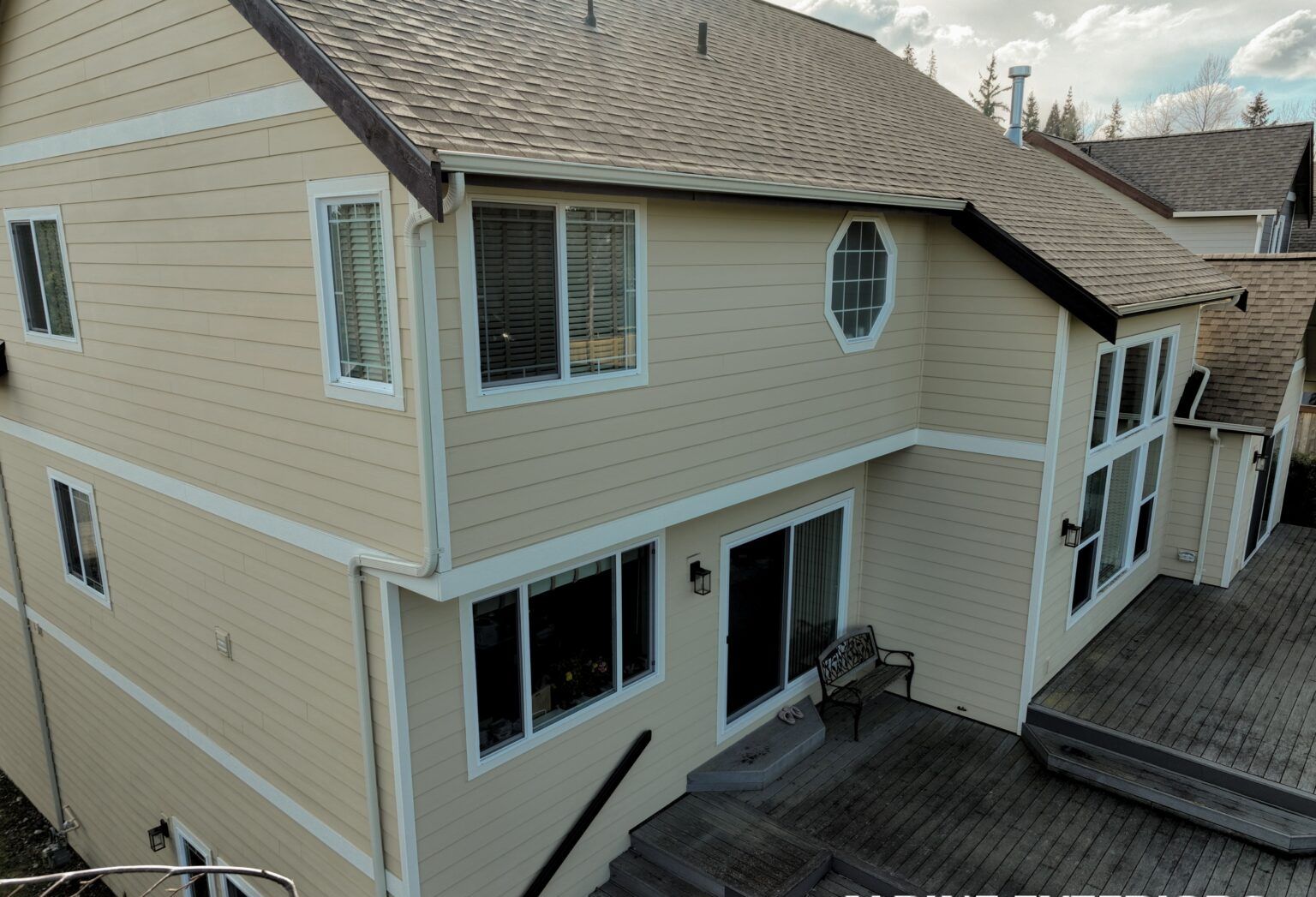
Roosevelt is one of Bellingham's older, leafier neighborhoods — a mix of early-1900s bungalows, craftsman cottages, and mid-century infill tucked under bigleaf maple and Douglas fir canopy near Whatcom Falls Park. That canopy is a blessing for shade and character, but it also means a lot of Roosevelt homes sit in dappled shadow for much of the year, which changes how a siding color actually performs compared to an open lot in Ferndale or a waterfront property in Blaine. Color choice here isn't just an aesthetic decision. In a county that gets a long, wet fall-through-spring season, sees regular wind-driven rain off Bellingham Bay and the Strait of Georgia, and grows moss and algae on almost any north-facing wall that stays damp, the color you pick interacts directly with how the siding ages, how often it needs cleaning, and how well it hides the grime that's inevitable here. This guide walks through the colors that hold up best across Roosevelt, Bellingham proper, Ferndale, Lynden, Blaine, Birch Bay, Sudden Valley, and the islands, with honest tradeoffs for each.
For most Whatcom County homes, the safest long-term picks are warm grays and greiges, deep forest or hunter green, and weathered cedar-toned browns. These three families share a common trait: they're forgiving of the pollen, dust, and light moss film that settles on siding between cleanings, they read naturally against a backdrop of conifers and gray winter skies, and they tend to sail through most HOA and architectural review committees in this area without objection. Charcoal and near-black work well as accent trim or on a shaded gable but are a harder sell as a full-field color once you factor in fading and heat absorption. Soft white and cream still look excellent on Roosevelt's craftsman homes, but they demand the most maintenance discipline of any option on this list, and we say that plainly rather than glossing over it. If you want one answer: a mid-tone warm gray or greige in a low-gloss finish is the option we'd point most Whatcom County homeowners toward first, then adjust from there based on your home's style, sun exposure, and neighborhood context.
We're not ranking these on trendiness. The criteria below are the ones that actually separate a color that looks good for two years from one that still looks good after a decade of Whatcom County weather.
Warm gray and greige (a gray with a brown or beige undertone) are the closest thing to a default in this region, and for good reason. They sit naturally against wet asphalt, evergreen backdrops, and the flat gray light we get for a good chunk of the year, which means the house doesn't look out of place under a November sky. Greige is also genuinely good at hiding the fine particulate and light algae film that accumulates between cleanings — it doesn't show dirt the way a pure white does, and it doesn't show sun-bleaching the way a saturated color does.
Pros: forgiving of moss and dust, wide HOA acceptance, pairs with almost any trim or roof color, ages gracefully with minimal visible fade.
Cons: it's common enough that a Roosevelt or Ferndale street can start to look uniform if several neighbors land on nearly the same shade; true greige is a narrow band and it's easy to end up with something that reads slightly purple or slightly green depending on light.
Charcoal has become popular on newer builds and remodels across Bellingham and Lynden, especially paired with black-framed windows. Done as a full-field color on a well-shaded lot, it can look sharp and modern. Where it gets complicated is heat and fade: darker pigments absorb more solar energy, and under a WA Energy Code-compliant continuous insulation and rainscreen assembly, that extra heat load has to be managed by the ventilation gap, not by the color itself. Over years, dark colors on fiber cement and vinyl also tend to fade and chalk more visibly than mid-tones, because the contrast between fresh and weathered pigment is more obvious.
Pros: striking, modern, hides shadow-cast staining on covered porches and eaves.
Cons: highest heat absorption of any option here, most visible fading over a 10-15 year horizon, shows dust and pollen (a fine yellow-green film in spring) more than a mid-gray does, and some island and HOA covenants restrict near-black as a primary color even when they allow it as trim.
Green is arguably the most underrated option in Whatcom County, because it's the one color family that actually blends with the landscape rather than contrasting against it. A muted forest or hunter green on a Roosevelt bungalow or a wooded Sudden Valley lot doesn't fight the Douglas fir and cedar backdrop — it recedes into it. It also does a reasonable job masking the early stages of moss growth, since the tones are already in the same family.
Pros: blends naturally with conifer tree lines, forgiving of early moss growth, reads as classic rather than trendy so it won't date quickly.
Cons: a poorly chosen green can look institutional or drift toward olive as it weathers; it's a harder color to accessorize with warm-toned stone or brick accents; some review boards limit it to specific approved shades rather than green as a category.
Brown and cedar-toned siding, whether it's an actual wood-look fiber cement plank or a warm taupe-brown, has a long history in this part of the Pacific Northwest and still suits a lot of Whatcom County homes, particularly craftsman and farmhouse styles common in Lynden and Ferndale. These tones are excellent at hiding dirt, pollen, and mild moss streaking, and they photograph well against green lawns and cedar fencing.
Pros: hides grime and light staining extremely well, complements natural wood accents and stonework, timeless rather than trend-driven.
Cons: if the underlying material is real wood rather than fiber cement or vinyl, brown tones can visually mask early wood rot longer than a lighter color would, delaying discovery of a problem that's already underway — this is a real concern in a climate with our rainfall totals, and it's one more reason we favor fiber cement or well-installed vinyl over unprotected wood siding in this county.
White and cream siding still looks excellent on Roosevelt's older craftsman homes and on farmhouse-style builds throughout the county, and it's a color HOAs almost never object to. The honest tradeoff is maintenance. White shows every streak of algae, moss spore, and roof runoff staining far more visibly than any color on this list, and under shaded, damp conditions like much of Roosevelt sees, that streaking can show up within a single wet season on a north wall. White also shows fine hairline dirt buildup that a gray or greige simply absorbs visually.
Pros: classic on craftsman and farmhouse styles, brightens a shaded lot, universally accepted by architectural review boards.
Cons: shows moss, algae, and roof-runoff staining faster and more visibly than any other option here; requires a real annual or biennial wash-down commitment to keep looking crisp, especially on north- and west-facing walls under tree cover.
For waterfront and near-waterfront properties in Blaine, Birch Bay, and the islands, a muted blue-gray or slate tone is a nice nod to the water without being a novelty color. It sits comfortably between the neutrality of greige and the character of a full color statement.
Pros: complements water views without looking themed or gimmicky, moderate fade performance, reasonably good at hiding light moss.
Cons: a poorly matched blue can skew teal or purple-gray as light shifts through the day, which is more noticeable under our overcast conditions than in bright sun; fewer trim and roof colors pair well with it compared to gray or brown.
A few choices consistently cause regret in this specific climate and landscape, and we'd rather say so directly than let a homeowner find out the hard way.
Color doesn't change how fast moss and algae actually grow — that's driven by shade, moisture, and airflow around the wall — but it changes how visible that growth is. Light colors like white show green-black streaking almost immediately, while mid-tone grays, greens, and browns absorb that staining visually so it takes longer to become an eyesore. Either way, the growth itself needs to be addressed with cleaning and, ideally, siding and trim details that let walls dry out between rain events.
Yes, though more slowly than in a sunnier climate. Our UV exposure is lower and more diffuse thanks to persistent cloud cover, but it's still present, and pigments in vinyl and factory-finished fiber cement break down gradually over years. Darker, more saturated colors show this fading more noticeably than mid-tones because the contrast between the original and weathered shade is larger.
In most planned communities and several island neighborhoods in this county, yes — architectural review boards typically require color approval before installation, and some maintain a specific approved palette. It's worth checking your covenants or contacting your HOA before ordering material, since a rejected color can mean a costly reorder.
They should complement each other rather than match exactly. A common approach in Whatcom County is pairing a warm gray, greige, or green siding with a darker charcoal or brown roof, which reads as intentional rather than accidental and still gives you flexibility with trim and door colors. Bringing a physical siding sample outside under our actual overcast light, rather than judging it indoors or on a sunny showroom day, is the best way to confirm it works with your roof and surroundings before committing.
Picking a siding color in Roosevelt or anywhere else in Whatcom County is easier when you can see real samples against your own home, your own tree line, and our own gray-sky light rather than a swatch card in a showroom. Alpine Exteriors, licensed in Washington under contractor license ALPINI751OW, works with homeowners across Bellingham, Ferndale, Lynden, Blaine, Birch Bay, Sudden Valley, and the islands to match siding color and material to how each property actually sits — sun exposure, tree cover, HOA requirements, and all. If you're weighing colors for a new install or a re-side, reach out to Alpine Exteriors for an on-site look and a straight answer about what will hold up on your specific home.