
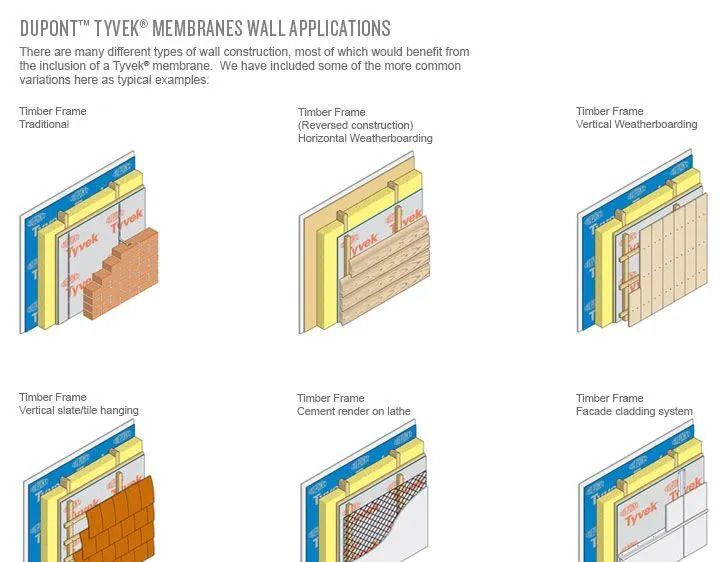
A properly built rainscreen assembly in Whatcom County — the drainage gap, the water-resistive barrier, and the flashing behind the cladding — will typically outperform and outlast the siding installed over it, often working well for 40 years or more once it's built correctly. The cladding itself is usually what gets replaced first, with realistic service life ranging from roughly 20 to 50 years depending on the material, while the drainage plane and framing behind it can keep doing their job for decades longer if the details were right the first time.
A rainscreen assembly is really three systems working together: a water-resistive barrier (WRB) applied over the sheathing, a set of vertical furring strips or a drainage mat that holds the cladding off that barrier by roughly 3/8 to 1 inch, and the cladding itself fastened to the furring. That air gap is the whole point. Wind-driven rain that gets past the outer layer of siding — and on this coastline, some always will — drains down the gap and dries out through ventilation at the top and bottom of the wall instead of sitting against the sheathing. Flashing at windows, doors, and the base of the wall directs that water out rather than letting it pool.
Each piece of that system ages differently:
The weak points in almost every rainscreen assembly aren't the big components — they're the small ones: fasteners, sealant joints, and flashing laps. A single reversed flashing lap or a run of corroding fasteners can undercut an otherwise well-built wall long before the framing or cladding would have failed on its own.
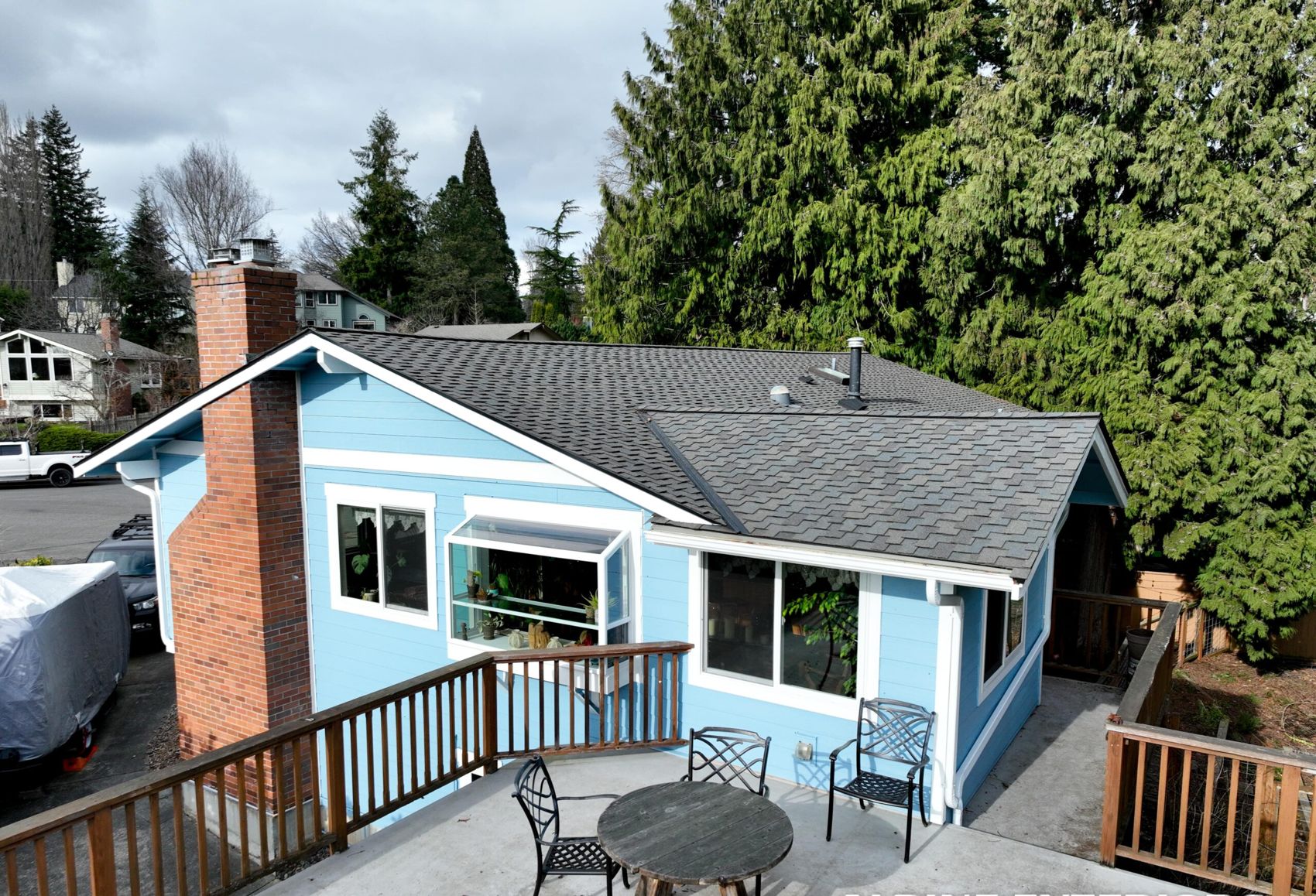
Whatcom County doesn't get extreme individual storms the way some parts of the country do — there's no hurricane exposure here, and that's not what a wall assembly in Bellingham needs to be built for. What it needs to handle instead is duration: long stretches of steady, persistent rain across fall, winter, and spring, with damp conditions that can sit for days at a time rather than blow through in an afternoon. A rainscreen matters here specifically because it gives that moisture somewhere to go and time to dry between wet spells, instead of letting it sit against the sheathing for weeks on end.
Wind-driven rain off Bellingham Bay, the Strait of Georgia, and the Strait of Juan de Fuca is a real factor for homes with exposed west- and southwest-facing walls — this shows up along the Blaine and Birch Bay shoreline, on Lummi Island, and on waterfront lots around Bellingham Bay, where rain gets pushed sideways under laps and around trim more forcefully than it does a few miles inland. Those elevations deserve extra attention to flashing continuity and gap detailing, since they take more direct wetting over the life of the assembly than a sheltered wall in, say, downtown Lynden.
Moss and algae growth is another local reality, particularly on shaded, north-facing walls under the fir and cedar canopy common in Bellingham, Ferndale, and Sudden Valley neighborhoods. It's mostly cosmetic, but a wall that stays damp and shaded long enough to grow moss is also a wall that's slower to dry, and left alone that moss and algae can hold moisture against the cladding surface and accelerate coating failure or rot at the lowest courses and butt joints.
Wood rot is the failure mode that rainscreen construction is specifically designed to prevent. A lot of older housing stock in this county was built with siding nailed directly to the water-resistive barrier, no drainage gap at all — and when that approach traps incidental moisture, from a failed caulk joint or wind-driven rain past a lap, it has nowhere to go. That's the rot Whatcom County contractors see behind old siding fairly often, and it's the specific problem a gapped, drained, and vented rainscreen assembly is built to avoid.
Freeze-thaw cycling is a smaller factor here than in the Cascades proper, but it isn't nothing, especially at the higher and more inland pockets like Sudden Valley. Moisture trapped behind cladding that freezes and expands is harder on materials, fasteners, and finishes than moisture that simply stays liquid and drains — one more reason drainage and drying matter even in a coastal climate that doesn't see extended deep freezes.
Finally, anywhere close to salt water — Blaine, Birch Bay, Lummi Island, and other shoreline properties — salt-laden air accelerates corrosion on standard fasteners faster than it does further inland. A rusting fastener is a small thing until it isn't: it's a point where water can start working into a wall that otherwise drains just fine.
If you're building new, re-siding, or just trying to figure out whether your current wall assembly is doing its job, a few things make a real difference in how long it lasts here:
It's worth being honest about the tradeoffs, too. A rainscreen assembly costs more up front than siding nailed straight to the wall — the furring strips, extended flashing at every window and door, and more complex trim details all add labor and material. It also only delivers on that longer lifespan if it's installed correctly; a rainscreen with blocked weeps, insulation crammed into the gap, or discontinuous WRB laps isn't meaningfully better than direct-applied siding, and in some cases can trap moisture worse than a simple, well-flashed direct application. The assembly is only as good as the crew that built it. Alpine Exteriors builds these details the same way on every job in Whatcom County — continuous gap, lapped and sequenced flashing, and fastener choices matched to how close the site sits to salt water — because that's what determines whether the 40-plus-year number is realistic for a given house or just a number on paper.
Yes — arguably more here than in a drier climate. In a place with occasional heavy storms but long dry stretches between them, a wall has time to dry out even without a drainage gap. Whatcom County's pattern of sustained, day-after-day rain through fall and winter doesn't give a direct-applied wall that recovery time, which is exactly why a drained and vented gap behind the siding matters more here than it would somewhere with shorter, less frequent wet periods.
The siding material itself may carry a similar rated lifespan either way, but a direct-applied wall is far more likely to see that lifespan cut short by trapped moisture, rot at the sheathing, or coating failure from moisture sitting behind the cladding. A rainscreen assembly doesn't necessarily make the siding material last longer on paper — it makes it much more likely the wall actually reaches that rated lifespan instead of failing early from moisture that had nowhere to go.
Indirectly, yes, in most re-siding or new-build projects. The Washington State Energy Code's building envelope requirements often push toward continuous exterior insulation, and the standard way to install that insulation is to fur it out from the sheathing — which is also exactly how you create a rainscreen drainage gap. In practice, meeting the energy code's continuous insulation approach and building a proper rainscreen tend to happen in the same step, so it's worth planning them together rather than treating them as separate decisions.
From the outside, look for small weep holes or a visible gap at the very bottom of the wall, and check whether the siding sits slightly proud of the trim rather than flush against it — both are signs of furring behind the cladding. Homes built or re-sided more recently are more likely to have one; older Whatcom County homes with original siding often don't. Short of removing a section of siding, the most reliable way to know for certain is to have a contractor check during an inspection, especially before you invest in repainting or restaining siding that might be masking moisture problems behind it.
If you're not sure whether your current siding is doing its job, or you're planning a re-side and want the drainage gap, flashing, and fastener choices matched to your specific spot in Whatcom County — waterfront in Birch Bay, shaded and mossy in Sudden Valley, or anywhere between Ferndale and Lynden — Alpine Exteriors can walk the exterior with you and lay out what's actually going on behind the cladding. Alpine Exteriors holds Washington contractor license ALPINI751OW and works across Bellingham, Ferndale, Lynden, Blaine, Birch Bay, Sudden Valley, and the surrounding islands. Reach out for a straightforward look at your siding and an honest read on what it needs next.