

Dry rot in Whatcom County usually shows up first as wood that looks fine on the surface but gives way when you press on it — soft, spongy, or crumbling under a screwdriver tip, most often near window sills, roof-to-wall junctions, deck ledger boards, and the bottom few inches of siding closest to grade. Catch it at that stage, before the decay works into structural framing, and the fix is typically a localized trim or siding repair. Wait longer and the same problem can mean tearing out and rebuilding whole sections of wall.
"Dry rot" is a bit of a misleading name — it's fungal decay, and it needs sustained moisture to start and keep going, generally wood held above roughly 20% moisture content for a stretch of time. The fungus feeds on cellulose in the wood fibers, and as it spreads it can send thin strands — sometimes visible as fine white or gray threading — through cracks and gaps to reach nearby wood that isn't directly wet itself. That's the part that catches people off guard: the decay doesn't stay contained to the one leaky spot. Once established, it can travel along framing members and behind housewrap into areas that look completely dry from the outside. By the time paint is bubbling or trim is visibly discolored, the fungus has usually been active for a while — what you can see is a lagging sign, not an early one.
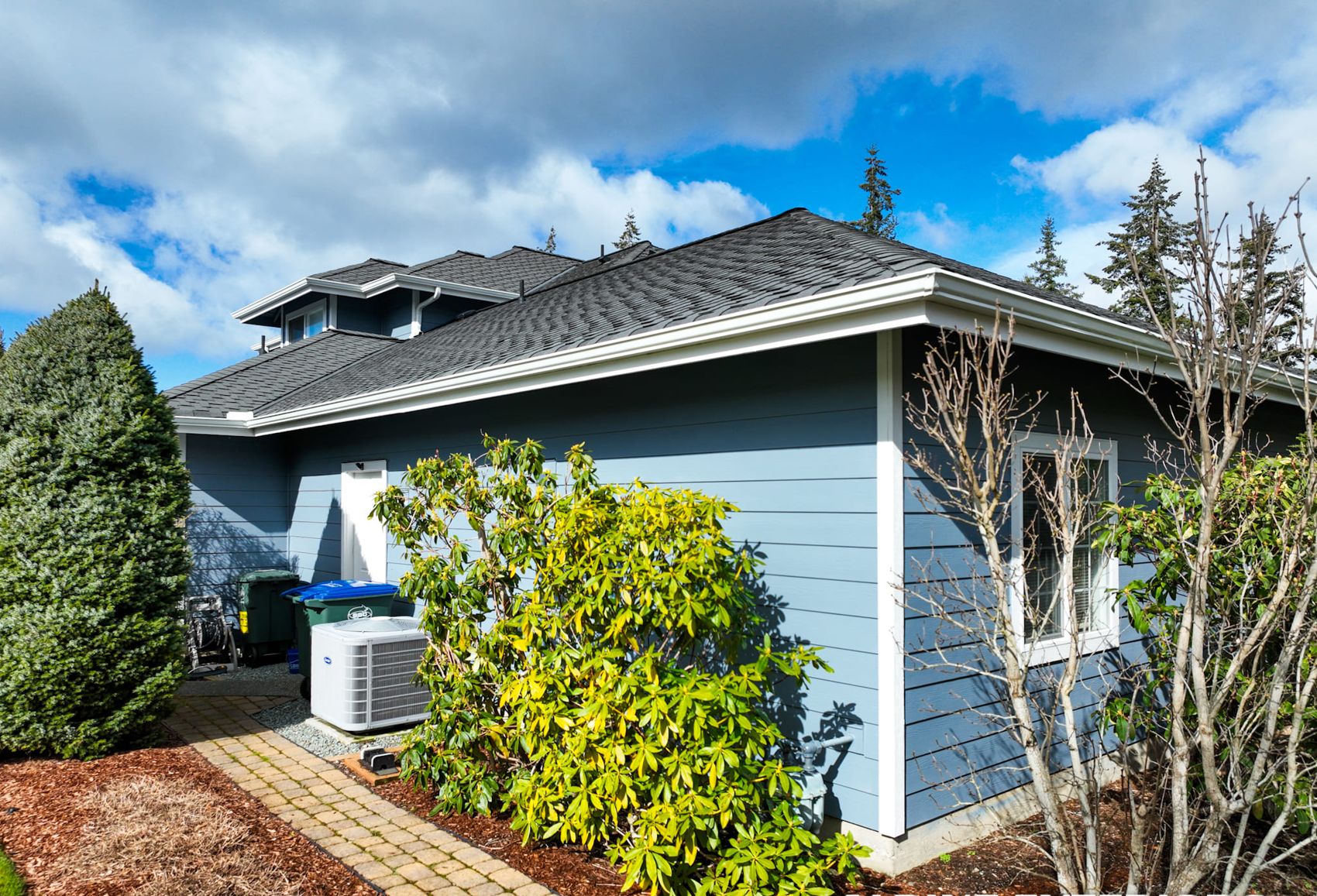
Whatcom County doesn't get hit by one hard storm that tears a roof off; it gets months of low-grade, persistent rain that keeps wood assemblies damp for long stretches, especially from October through April. That sustained dampness, more than any single storm, is what pushes wood past the moisture threshold fungi need to get going. Moss and algae make it worse — they hold water against roofing and siding surfaces even after the rain stops, keeping the material wet longer than a drier climate would allow, and on north-facing walls and shaded eaves around Bellingham and Ferndale that moss layer can sit in place most of the year.
Closer to the water, in Blaine and Birch Bay especially, wind-driven rain off the bay pushes moisture sideways into lap siding, window flashing, and trim joints that were only ever designed to shed water falling straight down. That horizontal, driving rain finds gaps that a calmer rainfall never would.
There's also a building-science wrinkle specific to Washington: the state energy code has pushed toward tighter, better-insulated building envelopes over the years, which is good for heating bills but means a poorly detailed vapor barrier or a missing rainscreen gap can trap moisture inside a wall assembly instead of letting it dry to one side. A wall that would have aired out fine in an older, leakier assembly can stay damp for months in a tightly sealed one if the water-management details behind the siding weren't done correctly.
A few honest, practical habits catch most dry rot before it becomes a structural problem:
The honest limitation here is that a lot of dry rot starts and stays hidden behind siding, behind flashing, or inside a wall assembly, and a visual walk-around plus a screwdriver test won't find that kind of damage. Moisture meters help narrow things down but can give inconsistent readings on pressure-treated or painted wood, and the only way to know for certain in a suspect area is sometimes to pull a section of siding or trim and look. That's a bigger step than most homeowners want to take on a hunch, which is part of why a periodic professional look — from someone who knows what these joints are supposed to look like when they're built and flashed correctly — tends to catch problems earlier than working alone. Alpine Exteriors walks these details as a normal part of siding and roofing work across Bellingham, Ferndale, Lynden, Blaine, and Birch Bay, and knows which spots in this specific climate tend to fail first.
Weathered wood is usually still hard underneath a rough or faded surface, so the screwdriver test tells you the difference quickly — weathered wood resists the point, rotted wood doesn't. Discoloration alone isn't proof of rot, but paired with softness, a hollow sound when tapped, or a musty smell, it's a strong sign decay has already set in.
For a genuinely small, isolated spot — a window sill corner, say — some homeowners do cut out the soft wood, let the area dry, and patch it. The risk is that the visible soft spot is rarely the full extent of the damage, since fungal decay travels along the grain and often reaches further than what feels soft to the touch. A patch over an incomplete removal can look fine for a season and then fail again once the hidden portion keeps spreading.
It can, to a degree. Established fungal growth can extend beyond the immediately wet area into adjoining drier wood, especially where framing members are in direct contact with each other, though it won't keep spreading indefinitely once it reaches wood dry enough to stop supporting growth. That's why a repair limited only to the visibly wet spot sometimes doesn't catch everything.
Twice a year is a reasonable baseline given how long the wet season runs here, but any wall or roof area that stays shaded or moss-covered most of the year deserves a closer look more often, since it's drying out slower than the rest of the house.
If you've found a soft spot, or you're just not sure what you're looking at, it's worth having someone look before deciding whether it's a trim repair or something bigger. Alpine Exteriors serves homeowners across Bellingham, Ferndale, Lynden, Blaine, and Birch Bay and can walk your exterior, tell you honestly what's cosmetic and what's structural, and lay out what a repair actually involves before any work starts.