
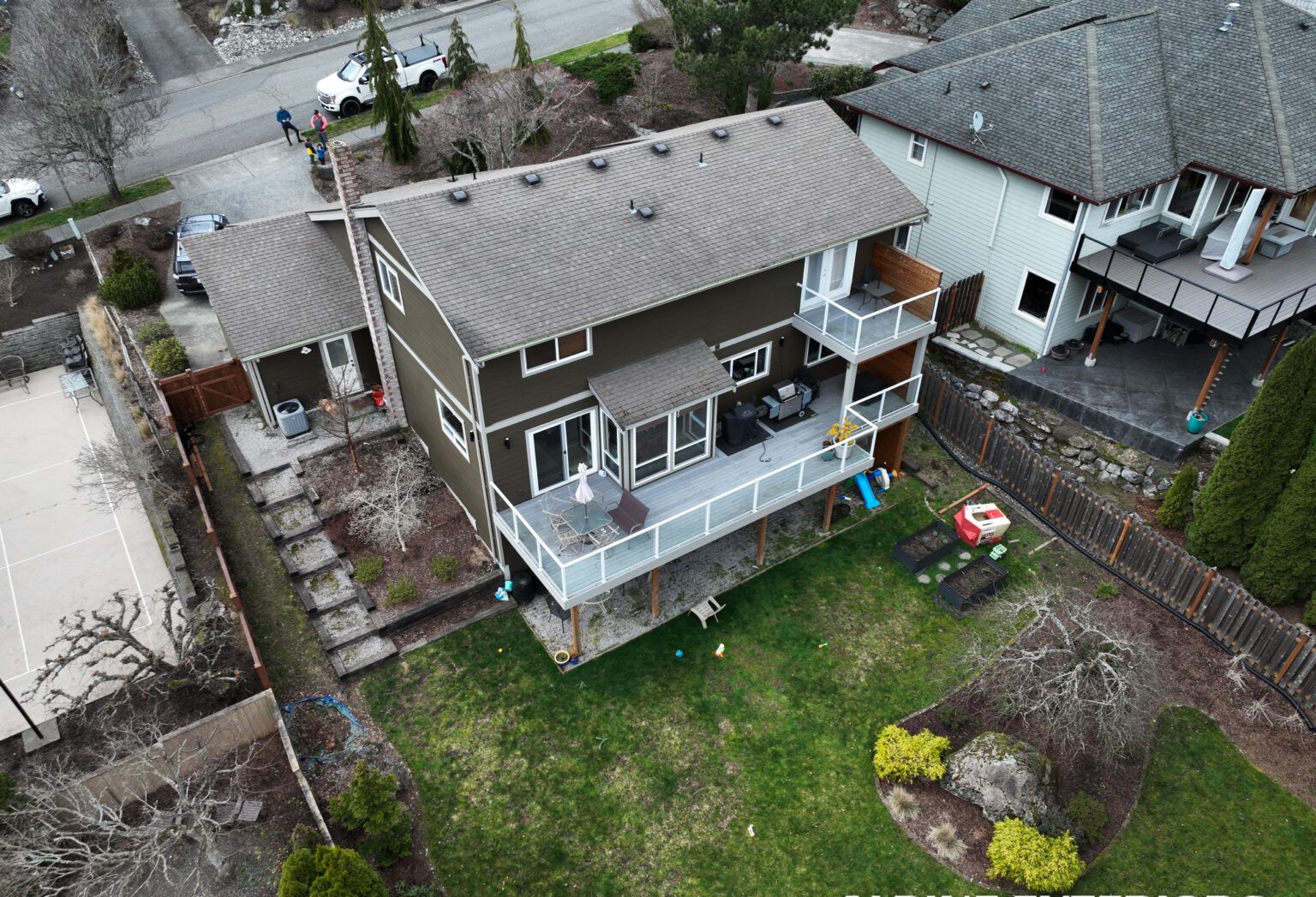
In Blaine, wind coming off the Strait of Georgia and Boundary Bay drives rain sideways into siding joints, corners, and butt seams instead of letting it run straight down the wall the way siding is designed to shed water. That constant lateral pressure is what causes water intrusion, early caulk failure, and rot at penetrations on homes that would hold up fine a few miles inland where the wind has less open water to build speed over.
Lap siding, whether it's vinyl, fiber cement, or wood, is built on a simple assumption: water hits the wall and gravity pulls it down and off. That assumption holds up in still air. It breaks down when wind is pushing the rain into the wall at an angle, because now the water isn't just falling past a lap joint — it's being forced up and under it. On a normal day this isn't a big deal. Blaine's exposure to the open water of the Strait and Boundary Bay means it isn't a normal day fairly often through the fall and winter storm season, when sustained onshore wind and rain arrive together for days at a stretch.
Once wind-driven rain gets past the face of the siding, it's the water-resistive barrier and flashing behind it that decide whether the house stays dry. Where those details are intact, the water runs back out. Where a fastener was overdriven, a J-channel wasn't lapped correctly, or a window flashing was taped in the wrong order, water tracks behind the siding and into the sheathing. Because Whatcom County's rain is more about duration than intensity, this isn't a one-time soaking — the same wall can stay damp for days, which is exactly the condition wood sheathing, trim, and fascia need to start rotting. It's also the condition mold, moss, and algae need to establish themselves on the siding face itself, and you'll see it first on north- and west-facing walls that get wind-driven moisture and the least sun to dry back out.
Up toward the foothills — Sudden Valley and the areas closer to Mt. Baker's lower slopes — there's a second mechanism layered on top of this. Winter temperatures swing across freezing more often than they do right on the water. Moisture that's worked its way into a seam or a piece of trim can freeze, expand, and widen the gap it came in through, which makes the next rain event worse than the last one. On the water in Blaine and Birch Bay, freeze-thaw is a smaller factor than it is inland, but the wind-driven moisture load is bigger, so each area ends up with its own version of the same underlying problem: water getting in somewhere it shouldn't, and not drying out fast enough once it does.
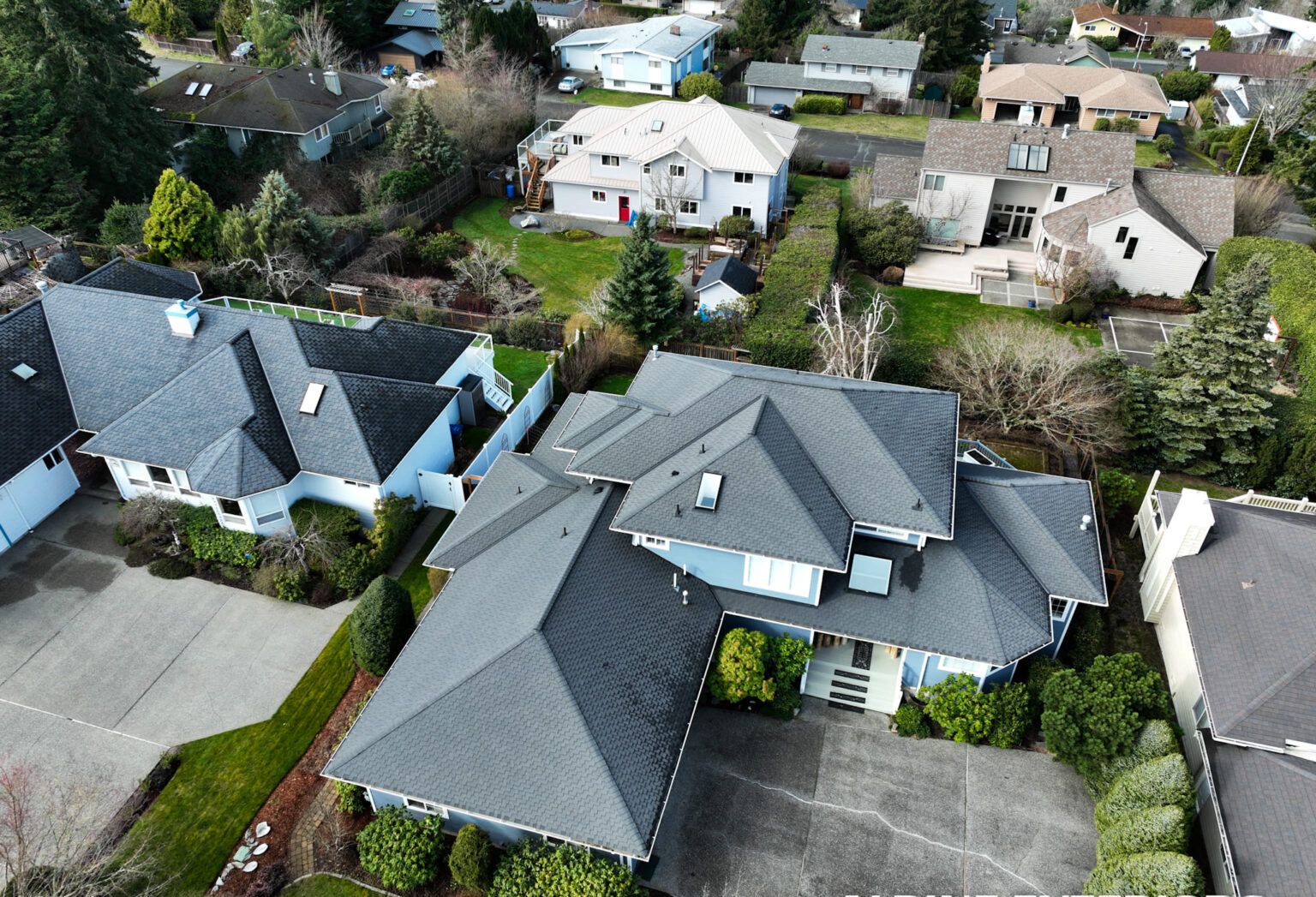
Blaine sits at the far northwest corner of Washington, with open water on two sides — the Strait of Georgia to the west and Boundary Bay to the north, right at the border. There's very little land to slow wind down before it hits a house here, which is different from Bellingham, where Chuckanut Mountain and the San Juan Islands break up some of the fetch, or Sudden Valley, which sits back from open water entirely. Birch Bay has the same problem as Blaine — flat, low-lying, and fully exposed to weather coming straight off the water — while homes on Lummi Island and the other islands deal with wind from multiple directions depending on which side of the island they're on.
The other regional factor is simply how much it rains here relative to how hard. Whatcom County doesn't get the short, violent downpours some other parts of the country deal with. It gets long stretches of steady, moderate rain, often for several days without a real break, paired with wind that doesn't let up either. That combination is harder on a building envelope than an equal amount of rain falling in one hard, brief storm, because the wall assembly never really gets a chance to dry between wet periods. A siding system that would perform fine somewhere with intermittent heavy rain can still fail here simply because it's rarely given time to dry out.
Local building requirements reflect some of this, even if they're not written specifically around wind-driven rain. The Washington State Energy Code governs how exterior walls are insulated and air-sealed on new construction and major remodels in Whatcom County, and the assemblies it pushes builders toward — continuous exterior insulation, careful air-sealing — change how a wall behaves when moisture does get past the siding. A well-sealed, well-insulated wall can actually trap moisture longer if there isn't a drainage gap behind the siding to let it escape, which is one reason a rainscreen gap matters more here than it might in a drier climate.
The fixes here are mostly about installation detail and maintenance discipline, not about buying a fundamentally different product.
On material choice: fiber cement holds up well against wind-driven moisture and doesn't rot, but it depends entirely on correct installation and caulking — a well-installed vinyl job with proper flashing can outperform a poorly installed fiber cement job. Vinyl is more forgiving of minor water contact since it doesn't rot, but its joints can be a weak point for wind-driven rain if J-channel and overlaps weren't done with this specific exposure in mind. Wood siding looks right for the area but needs the most disciplined maintenance schedule of the three, given how long walls here stay wet. None of these is a wrong answer — the installation detail matters more than the brand name on the product.
Alpine Exteriors works on homes across this exposure gradient, from Blaine and Birch Bay's open-water walls to the more sheltered lots around Sudden Valley and Lynden, and the flashing and rainscreen details get adjusted based on which walls actually take the weather. Alpine Exteriors holds Washington contractor license ALPINI751OW, and any siding or flashing repair should be pulled with a licensed contractor regardless of who does the work, since a missed detail here tends to show up as rot two or three winters later rather than right away.
It's the combination. Rain falling straight down mostly just runs off the face of the siding. Wind changes the angle of that rain and adds pressure that pushes water into laps, seams, and penetrations it wouldn't otherwise reach. The wind itself rarely damages siding directly in this area — it's not the kind of sustained extreme wind that pulls panels loose — but it's the mechanism that gets water past the surface and into places that stay wet.
Not inherently. Vinyl doesn't rot and handles incidental moisture better than wood, but its performance in wind-driven rain depends heavily on installation — correct J-channel overlap, proper nailing that allows for expansion, and flashing that accounts for water moving sideways, not just down. A well-installed vinyl system holds up fine here; a rushed one is where problems show up first.
Once a year is a reasonable baseline, with a closer look after any unusually windy storm system. West- and south-facing seams and any caulking around windows and trim take the most weather and are worth checking first. Caulk that's cracked, pulled away from the substrate, or missing in spots should be replaced before the next wet season rather than left through another winter.
Indirectly, yes. The code governs the insulation and air-sealing of the wall assembly behind the siding on new construction and qualifying remodels, and those requirements shape how tightly the wall is built. A tighter, better-insulated wall needs a clear path for any moisture that does get past the siding to dry out — which is part of why a ventilated gap behind the siding matters more here than it would in a milder, drier climate.
If you're dealing with soft trim, peeling paint, persistent moss on one side of the house, or you're just planning ahead of a re-side, it's worth having someone look at which walls are actually taking the wind and rain before deciding on materials or installation details. Alpine Exteriors serves Blaine, Birch Bay, Bellingham, Ferndale, Lynden, Sudden Valley, and the islands, and can walk your home's exposure with you and explain what's driving the wear you're seeing. Reach out to schedule a look at your siding and flashing before the next storm season sets in.