
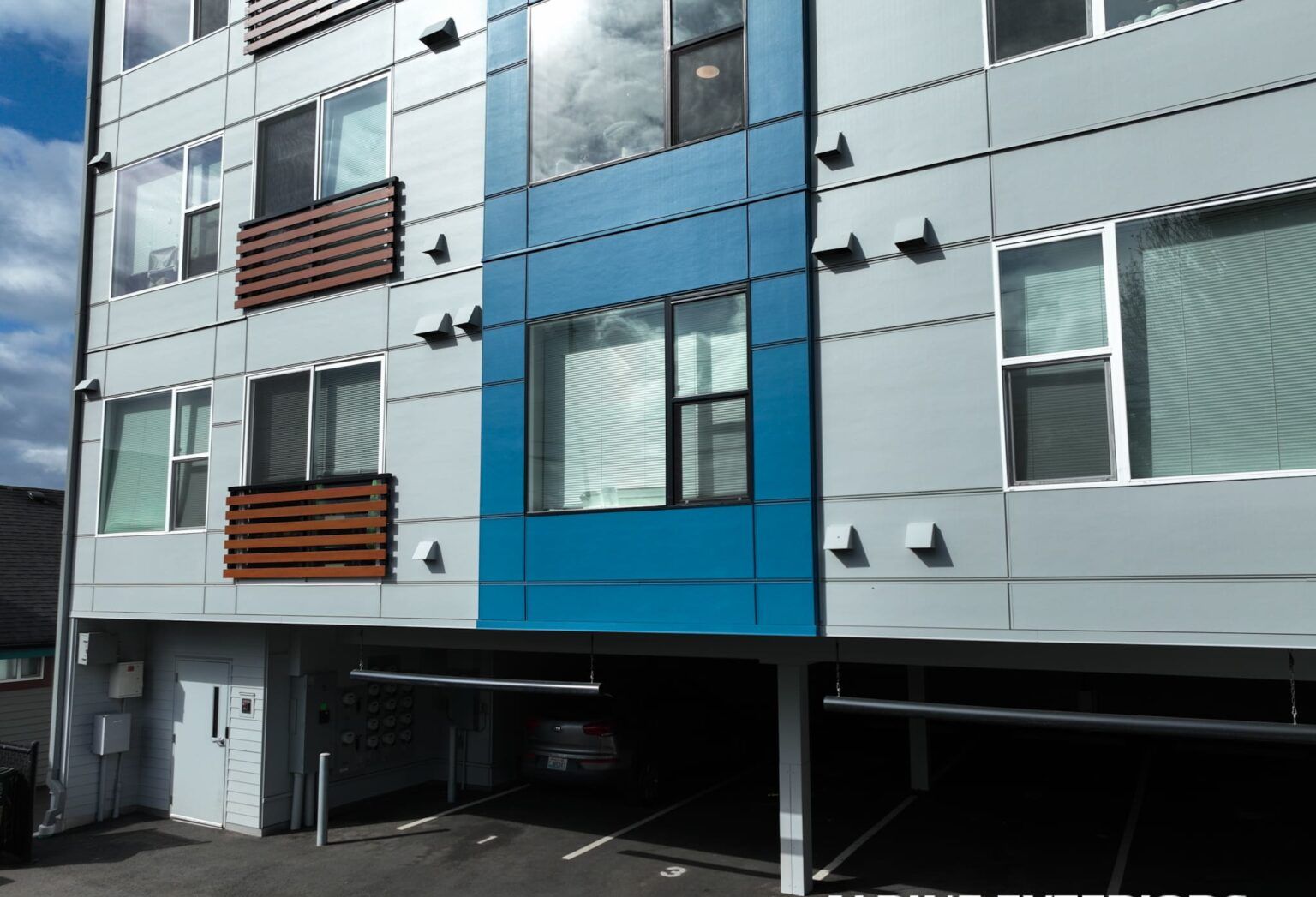
For most homes in Bellingham, Ferndale, Lynden, and the surrounding towns, composite siding is a reasonable middle-ground choice — it costs less than fiber cement, holds up better than vinyl in wind and impact, and comes factory-finished so you are not repainting cedar every five years. It is not automatically the right call for every wall, though, and the walls that take the worst weather here deserve a harder look before you commit.
"Composite siding" in this market almost always means engineered wood composite — strand board or fiber substrate bonded with resin, factory-primed or pre-finished, and sold under brand names most Whatcom County crews recognize on sight. It sits in a specific spot in the market. Vinyl is cheaper and essentially maintenance-free but flexes, fades, and can crack in a hard freeze or a wind gust off the water. Fiber cement is the most weather-resistant option most homeowners consider, and it does not rot because there is no wood fiber in it, but it costs more, it is heavier, and it needs specialized blades and dust control to install correctly. Composite sits between the two: it installs faster and lighter than fiber cement, it takes paint and pre-finish well, and it resists dents and impact better than vinyl.
Composite siding, fiber cement, and vinyl also land in different places on cost, and the ranges are worth knowing before you get quotes. Installed composite siding typically runs somewhere in the middle of the market, often landing in the neighborhood of $6 to $11 per square foot depending on the product line and trim details, while fiber cement tends to run a bit higher, roughly $8 to $14 per square foot installed, and vinyl comes in lower, often $3 to $7 per square foot. Those ranges shift with the complexity of the house — dormers, multiple gables, and extensive trim work all add labor regardless of which material is chosen — so treat any number as a starting point for a conversation rather than a quote.
The trade-off with composite is that it is still a wood-based product. If water gets behind it and stays there — through a failed caulk joint, a missed flashing detail, or an end cut that was never sealed — it can swell, delaminate, or rot in the same way old cedar lap siding did, just more slowly because of the resin binder and factory coating. The quality of the installation matters more with composite than it does with fiber cement or vinyl, because the material's weak point is exactly where installers are most likely to cut corners: seams, butt joints, and the bottom courses near grade.
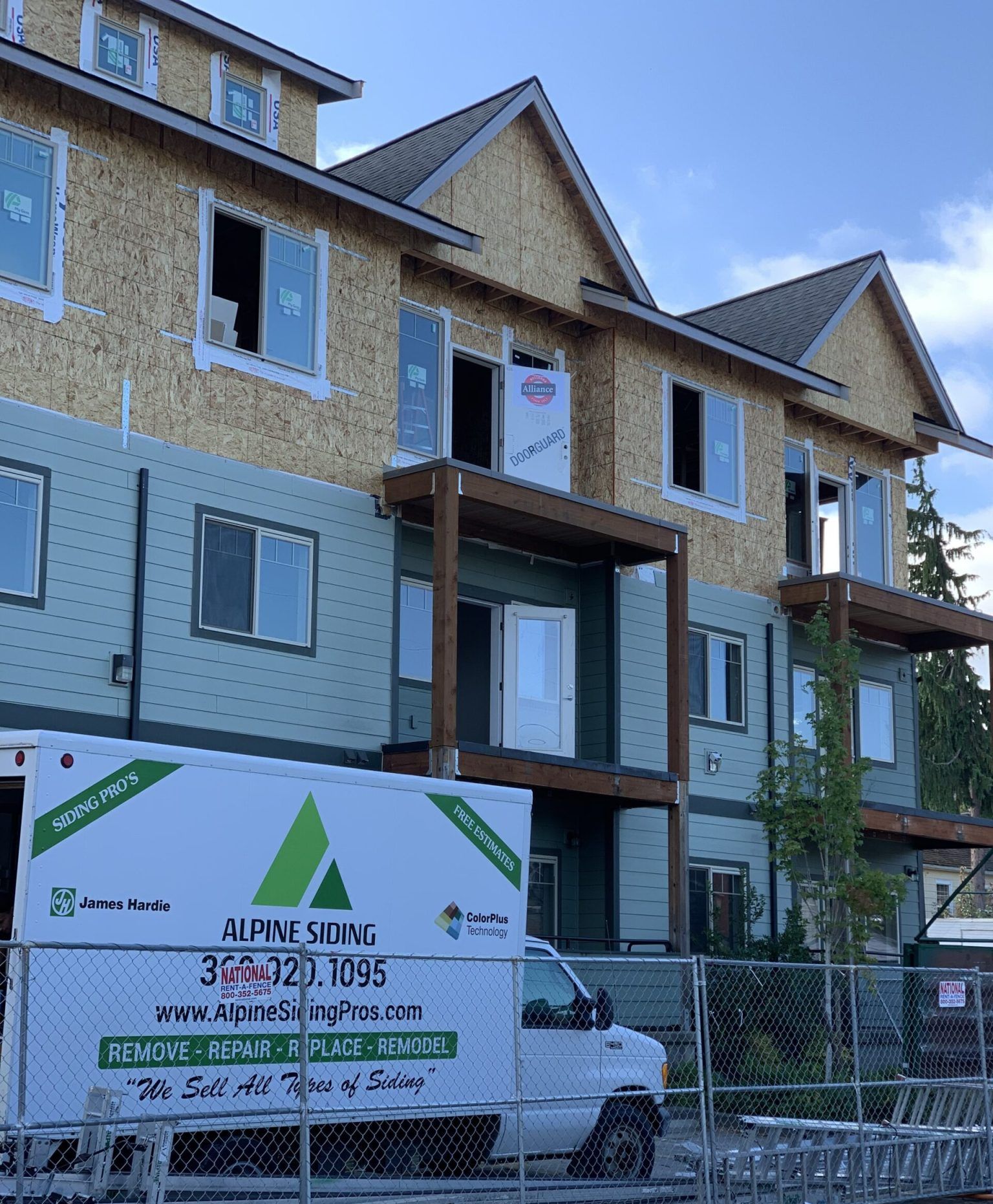
Whatcom County is not a climate where you can install siding once and forget about it, and the details that matter here are specific. Rain is not occasional — it is close to a default condition for eight or nine months of the year, and the wall assembly behind any siding choice needs to shed water reliably during that stretch, not just survive an occasional storm. Persistent damp air, especially on north- and west-facing walls shaded by evergreens, is exactly the condition moss and algae need, and homeowners moving from vinyl or old cedar to composite are often surprised that a factory finish slows moss growth but does not stop it on a wall that never gets direct sun.
Wood rot is the other legacy issue in this area — a lot of older housing stock from Bellingham to Lynden was built with untreated wood trim and siding that has already been repaired once, and any new composite installation is going in on top of a wall that may have hidden moisture history worth checking before the new siding goes up. Wind-driven rain off Bellingham Bay and the Strait of Georgia is a real factor for homes in Blaine, Birch Bay, and on Lummi Island and the other islands — those walls take rain sideways, not straight down, which puts more stress on flashing, corner trim, and butt joints than a sheltered lot in town ever will.
Move inland and uphill toward the foothills near Kendall, Deming, and even the higher elevations around Sudden Valley, and freeze-thaw cycling becomes the bigger concern — water that gets into a seam and then freezes expands and works the joint open a little more each winter. Any siding decision here also has to work with the Washington State Energy Code, which sets prescriptive requirements for continuous insulation and wall assembly performance; composite siding can be installed over rigid foam to help meet those requirements, but the added thickness changes window and trim details and needs to be planned for, not bolted on as an afterthought. Island properties add a logistics wrinkle too — ferry-dependent delivery and scheduling mean that if a repair is ever needed, lead times run longer than they would in Bellingham proper, which is one more reason to get the installation right the first time.
Start with the wall, not the siding brochure. Before removing existing siding, it is worth having someone check for moisture damage and soft sheathing behind it, especially on the sides of the house that face prevailing wind and rain — that tells you whether you are dealing with a cosmetic swap or a wall assembly that needs repair first. Ask any installer specifically how they will handle flashing at windows, doors, and butt joints, and how the bottom edge will be kept clear of grade and hard landscaping, because those two details predict more about long-term performance than the brand of siding chosen.
Choose a factory-finished or pre-primed composite product with a documented substrate warranty, and get the warranty terms in writing rather than taking a verbal assurance, since coverage and exclusions vary a lot between manufacturers. For walls that take the worst of the direct weather — south- and west-facing elevations in Blaine, Birch Bay, and on the islands, or any wall with a long unbroken run facing open water — it is worth pricing fiber cement side by side with composite before deciding, because the extra up-front cost of fiber cement on just the highest-exposure elevations can be cheaper over twenty years than repairing a composite wall that took the brunt of the wind-driven rain. For protected elevations under deep eaves, in town lots with wind buffering from neighboring structures or mature trees, composite is often the more sensible choice.
Finally, plan on a periodic inspection every few years, particularly after the first two or three winters, to catch a failed caulk joint or lifting trim piece before it turns into a rot repair. Alpine Exteriors walks Whatcom County homeowners through this comparison wall by wall rather than defaulting to one product for the whole house, because the right answer on a sheltered Ferndale side yard is often not the right answer on a Birch Bay waterfront elevation.
Fiber cement is the more weather-resistant material overall because it contains no wood fiber and will not rot, which makes it the stronger choice for walls that take direct wind-driven rain, such as waterfront homes in Blaine or Birch Bay. Composite costs less and installs faster, and for sheltered or moderately exposed walls it performs well over its warrantied life, so the right choice often comes down to which elevation of the house is being sided rather than a single answer for the whole property.
A quality factory finish slows moss and algae growth compared to bare or poorly maintained cedar, but it does not eliminate it, especially on shaded north-facing walls under evergreen canopy where the surface rarely dries out. Regular gentle cleaning and keeping nearby vegetation trimmed back to allow airflow will do more to control growth than the siding material choice alone.
Composite siding itself is a cladding choice, not an insulation layer, so code compliance comes from the wall assembly behind it. It can be installed over continuous rigid insulation to help meet the Washington State Energy Code's prescriptive requirements, but that needs to be planned into the window, door, and trim details from the start rather than added after the siding is already up.
Well-installed composite siding on a properly detailed wall can perform for several decades, similar in range to other quality claddings, but its real-world lifespan in Whatcom County depends heavily on installation quality and sun and wind exposure rather than the product alone. A wall with poor flashing or constant wind-driven rain exposure can show problems well before a sheltered wall on the same house does.
If you are trying to decide between composite, fiber cement, and vinyl for a home in Bellingham, Ferndale, Lynden, Blaine, Birch Bay, Sudden Valley, or one of the islands, Alpine Exteriors can walk your specific walls and give you a straight recommendation instead of a one-size answer. Alpine Exteriors is licensed in Washington under contractor license ALPINI751OW — reach out for a wall-by-wall assessment before you commit to a siding product for the whole house.