
On Lummi Island, siding damage after a storm is almost always driven by water getting behind the cladding, not by wind ripping panels off. If you had a blow through Hale Passage or up Rosario Strait, the thing to check first isn't cracked boards — it's loose or lifted seams, gaps around trim, and soft spots low on the wall where wind-driven rain has been forcing its way in for hours at a time.
Most storm-related siding failures out here show up weeks or months later as rot, not as obvious damage the day after the wind dies down. That lag is exactly why a lot of islanders miss the insurance window.
Lummi Island sits fully exposed to water on three sides, with almost no buffer between the shoreline and the bluffs where a lot of homes sit. A southerly or southwesterly storm coming up the Strait of Georgia and funneling through Hale Passage doesn't just bring wind speed — it brings rain that's moving sideways. Wind-driven rain behaves differently than a normal downpour. Instead of running down the face of the siding and off the bottom edge the way it's designed to, it gets pushed horizontally and even upward, finding every lap joint, nail hole, and butt seam that was never meant to handle water arriving from that angle.
Once water gets behind lap siding, fiber cement, or older cedar siding, it sits against the house wrap or, on older homes, against bare sheathing with no wrap at all. Whatcom County's persistent rain means that trapped moisture rarely gets a real chance to dry out between storms. A house on the mainland in Bellingham might see similar rain totals, but a home on Lummi Island facing open water usually takes the wind-driven component harder because there's less terrain and fewer windbreaks between the water and the wall.
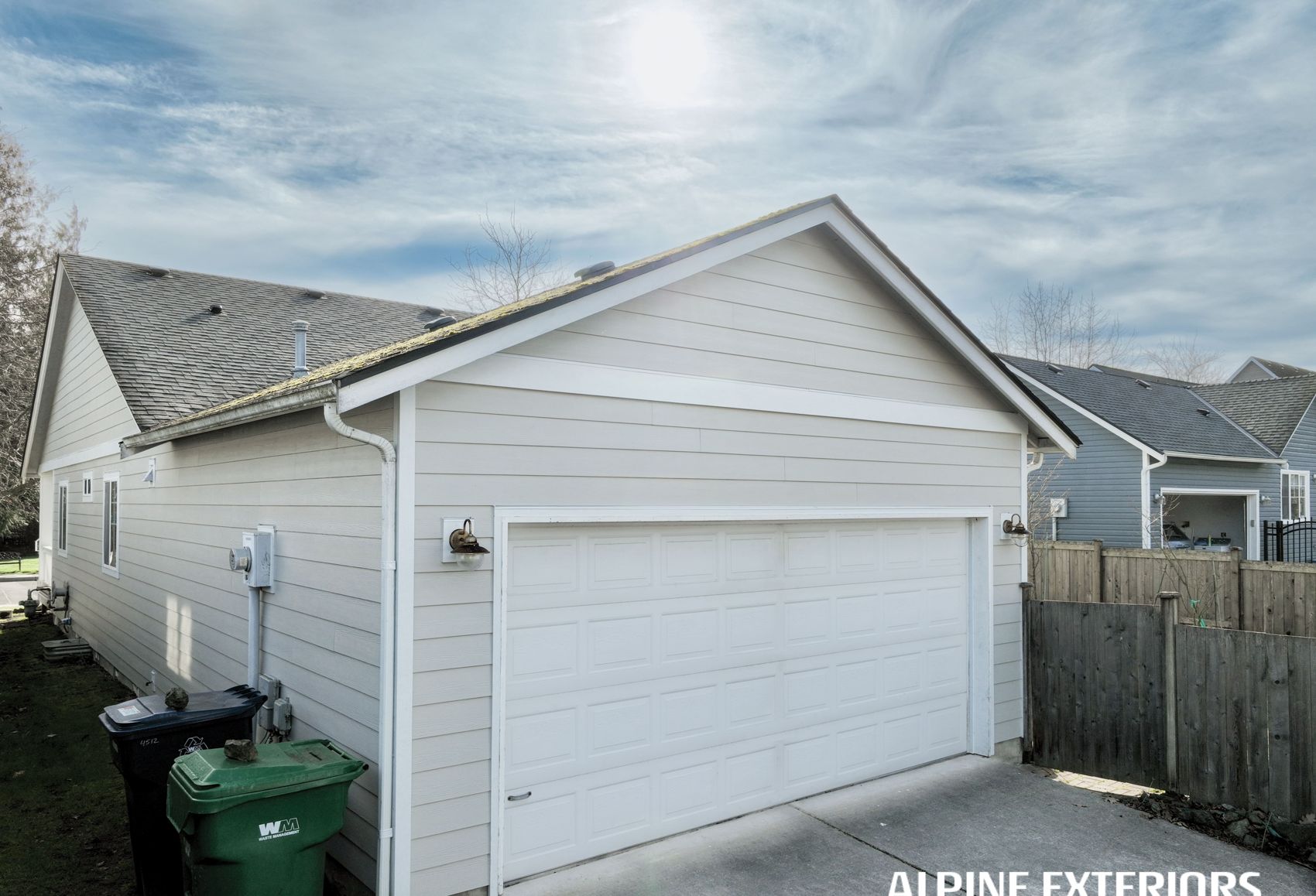
The other slow-motion damage mechanism here is biological, not mechanical. Moss and algae take hold on the shaded, north- and east-facing walls and on any siding under overhanging trees, which describes a lot of the wooded lots on the island. Moss holds moisture directly against the siding surface far longer than the wood or fiber cement would otherwise stay wet, and it works its roots into seams and butt joints, prying them open a little more with each wet season. A storm that loosens a panel edge gives moss and algae an even better foothold on the next dry spell, so damage tends to compound rather than heal on its own.
A few things about Lummi Island and the surrounding Whatcom County coastline change how you should think about storm damage compared to a generic "check your siding after a storm" article written for somewhere inland.
After any storm with sustained wind off the water, walk the exterior and focus on the water-facing and shaded walls first. Look for lifted or separated seams, siding that flexes or feels soft when you press on it near the bottom courses, streaking or dark staining below trim and window edges, and any spot where caulking has pulled away from a joint. On fiber cement and lap siding, pay close attention to inside corners and anywhere two different materials meet — those transitions are where wind-driven rain finds its way in first.
If your home has visible moss or algae growth, don't just pressure-wash it and call it done. Aggressive pressure washing can force water into seams that are already compromised, which turns a cosmetic problem into a moisture problem. A gentler wash combined with an actual inspection of what's underneath the growth is the better move, especially after a storm.
On the insurance side, Whatcom County homeowners' policies generally distinguish between sudden, storm-related damage and gradual deterioration like long-term moss growth or rot that built up over seasons. That distinction is exactly why documentation matters. Photograph the siding as soon as it's safe to do so after a storm, note the date and general wind direction if you know it, and don't wait for a soft spot to become a visible hole before you call your carrier. Because getting an adjuster to the island takes ferry scheduling into account, the sooner you report, the sooner that visit gets on the calendar. If an adjuster attributes damage to "wear and tear" rather than the storm, a written inspection from a siding contractor who can point to the specific mechanism — wind-driven rain intrusion at a seam, for example — is useful supporting documentation for an appeal.
Any siding work on the island, whether it's a storm repair or a full re-side, needs to meet the Washington State Energy Code's requirements for the water-resistive barrier and insulation continuity behind the cladding. That's not paperwork for its own sake — a code-compliant house wrap and properly lapped, sealed seams are what actually keep wind-driven rain from becoming trapped moisture in the wall assembly in the first place. Repairs that skip or damage the underlying wrap tend to fail again in the next storm, sometimes faster than the original damage took to develop.
Alpine Exteriors works throughout Whatcom County, including Lummi Island, Bellingham, Ferndale, Lynden, Blaine, Birch Bay, and Sudden Valley, and we're used to scheduling around the ferry when a job is on the island. When we inspect storm damage, we're looking for the same things described above: seam separation, soft or spongy panels, moss undermining joints, and fastener corrosion on water-facing walls, not just obvious cracked or missing pieces.
Sudden damage tends to be localized — a section of lifted or torn siding on the side of the house that faced the wind, often paired with debris damage nearby. Long-term moisture damage is usually more spread out, concentrated on shaded or water-facing walls, and often shows up as soft, discolored panels with visible moss or algae rather than a clean break. A contractor inspection can usually tell the difference by looking at the wall assembly, not just the surface, and that distinction matters a great deal for how an insurance claim gets categorized.
Coverage depends on your specific policy, but most standard Washington homeowners policies cover sudden, storm-caused water intrusion while excluding damage attributed to gradual deterioration, poor maintenance, or long-term moss and rot growth. Because the line between those two categories can be blurry — a storm can be the event that finally lets water into a joint that was already weakening — documenting the timeline and getting a professional assessment shortly after the storm improves your odds if the claim is questioned.
Shade cover, wall orientation, and airflow all play a role. A lot of Lummi Island lots have more tree cover and less direct sun exposure on at least one or two walls than a typical in-town Bellingham lot, and those shaded, poorly ventilated walls stay wet longer after every rain. Moss doesn't need standing water to take hold — it just needs consistent dampness, which a shaded, storm-battered wall provides for much of the year on the island.
Sometimes, and it depends on the age and condition of the rest of the siding. If the water-facing wall took the brunt of repeated storms and the other walls are in noticeably better shape, a targeted replacement can make sense and cost less than a full re-side. But if the siding is old enough that the other walls are likely a few storms behind the damaged one, patching just the worst wall often means doing the job again in a few years. An in-person inspection of all four walls, not just the obviously damaged one, is the only reliable way to make that call.
If a recent storm has you second-guessing a seam, a soft spot, or a section of moss-covered siding on your Lummi Island home, it's worth having someone look before the next round of wind-driven rain finds the same weak point. Alpine Exteriors is a licensed Washington siding contractor (ALPINI751OW) serving Lummi Island and the rest of Whatcom County, and we can walk your exterior, tell you honestly whether you're looking at a repair or a bigger issue, and help you put together the documentation an insurance claim needs. Reach out to schedule an inspection around your ferry schedule.