
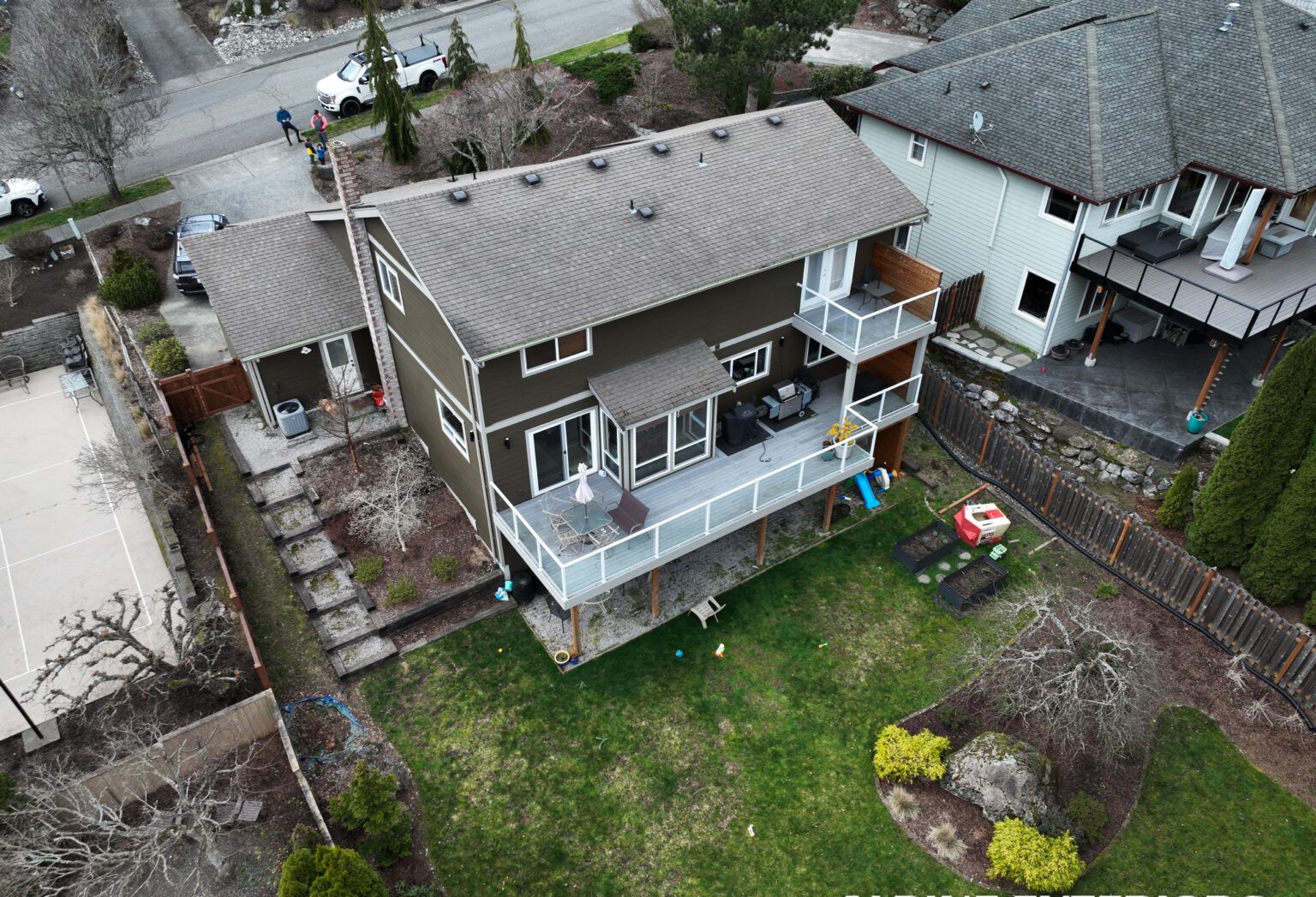
After a wind and rain event moves through Maple Falls, the siding damage that actually matters is usually happening behind the panels, not on the surface. Cracked or lifted lap siding, dark staining at the seams, and soft, spongy trim near corner boards and window sills are the visible clues that wind-driven rain forced water past the outer layer and into the wall assembly.
The tricky part is that siding can look mostly fine from the driveway while water has already worked its way behind a butt joint, around a poorly caulked corner, or under a lifted J-channel. By the time paint is bubbling or a wall feels soft underfoot, the sheathing behind it has often been wet for a while. It also helps to separate two different problems that get lumped together as "storm damage": a single identifiable event — sustained gusts, driving rain, sometimes a burst of small graupel in the foothills — versus the slow damage that ordinary Whatcom County drizzle causes on its own over a season. Both matter to the health of your siding, but insurance treats them very differently, which we'll get to below.
Whatcom County doesn't need a dramatic storm to cause siding problems — it needs persistence. Between the number of wet days in a typical fall and winter, siding here rarely gets a long enough dry stretch to fully shed moisture it's already absorbed at seams, nail holes, and butt joints before the next system rolls in. That baseline dampness is what turns an ordinary storm into a real problem, because the siding is already starting from a disadvantage.
Wind is the other half of the equation. When gusts come off Bellingham Bay and the Strait of Georgia, rain doesn't fall straight down — it gets pushed sideways into west- and southwest-facing walls. Lap siding, fiber cement, and vinyl are all designed to shed water moving downward; they're not designed for water being driven upward and sideways under the laps. That lateral pressure is what forces moisture through nail holes and seams that hold up fine in a normal rain but fail during a wind-driven event.
Moss and algae add a slower kind of damage. Around Maple Falls, fir and cedar canopy keeps a lot of walls shaded most of the day, so north- and east-facing siding stays damp longer than siding in full sun. Moss and algae mats hold water directly against the surface far longer than the material was ever meant to sit wet, which softens wood substrate underneath and breaks down caulking seals from the inside out — often before anything looks obviously wrong from a few feet away.
Once water gets behind or under siding — at corner boards, butt joints, or the bottom course near grade — untreated or under-primed wood starts to rot from the inside out. This can be well advanced before the paint film itself shows any cracking, which is why a visual check alone can miss real damage.
Freeze-thaw cycling is the piece that's easy to overlook if you're used to thinking about coastal Whatcom County weather. Maple Falls sits higher and closer to the Mount Baker foothills than Bellingham, Ferndale, or the coastal towns, and it sees more nights that dip below freezing over the winter. Water that has already worked into a seam, a hairline crack in fiber cement caulking, or a small paint failure expands as it freezes and doesn't fully close back up when it thaws. Repeat that cycle through a foothills winter and a gap that started as cosmetic can become a real entry point for water within a single season.
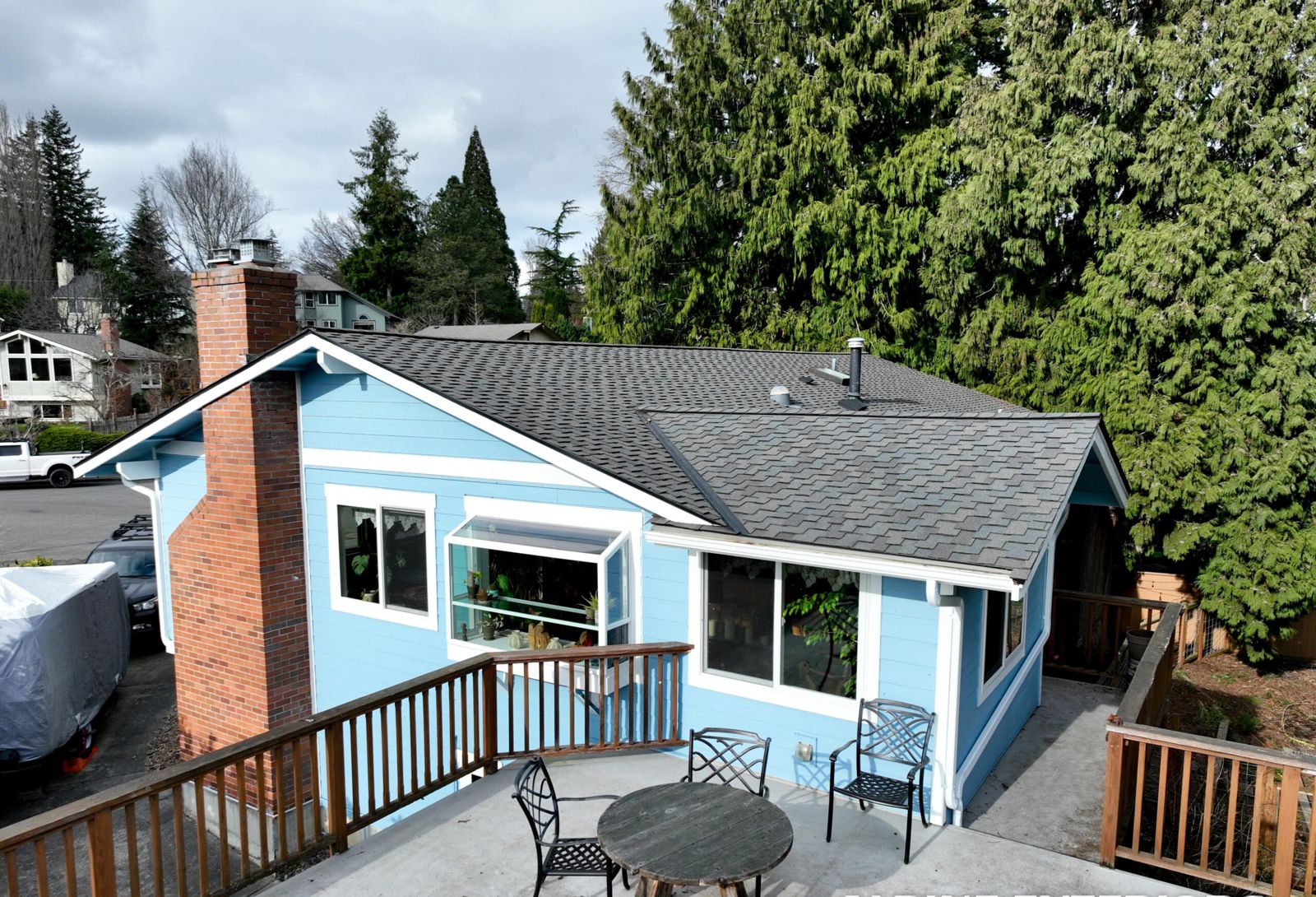
A lot of Whatcom County siding advice is really written for Bellingham, Ferndale, or the coastal exposure of Blaine and Birch Bay, where the main issue is wind-driven rain off open water. Maple Falls and the surrounding foothills deal with a related but distinct set of conditions:
Right after a storm — and really, once or twice a year regardless of storms — walk the perimeter of the house from the ground with a pair of binoculars rather than getting on a wet ladder or roof. Look specifically for:
Take dated photos right after any notable storm, even if nothing looks obviously wrong yet. This matters more than it sounds like it should: insurers want to tie damage to a specific event and date, and gradual deterioration from months or years of moss, algae, or general moisture exposure is almost always treated as a maintenance issue and excluded from coverage — regardless of how bad it eventually looks. A clear before-and-after record is often the difference between a claim that gets paid and one that gets denied as "wear and tear."
If something looks off, get a written inspection from a contractor rather than relying on a visual guess. A moisture meter reading on the sheathing tells you far more than eyeballing the surface — it's the difference between finding a contained issue at one corner and discovering, mid-repair, that moisture has spread along a whole wall. When you do file a claim, read your policy's language carefully: most standard homeowner policies distinguish between sudden, storm-caused water or wind damage and gradual deterioration, and the wording around that distinction is what an adjuster will apply to your specific situation.
One thing worth knowing before you commit to a fix: replacing a section of storm-damaged siding isn't always as simple as swapping boards. If the scope of the repair crosses from a spot patch into re-siding a full wall or elevation, Washington State Energy Code requirements for wall assemblies — insulation continuity and proper weather-resistive barrier installation — can come into play even on a repair that started as storm damage. A licensed contractor should be able to tell you honestly whether your repair is a simple patch or one that needs to meet current code, rather than doing a quick fix that fails the same way again next winter. Alpine Exteriors, licensed in Washington under contractor number ALPINI751OW, makes that call as part of the inspection rather than after the work has started, and pulls whatever Whatcom County permit the actual scope requires.
Usually, if the damage can be tied to a specific storm event — a gust that cracked or tore off a panel, rain driven behind the siding during an identifiable storm. Most standard homeowner policies cover sudden damage from wind or water tied to a covered event. Gradual damage from moss, algae, or years of ordinary moisture exposure is a different story and is typically treated as a maintenance issue, which is excluded on most policies. That distinction is exactly why documenting the siding's condition before and immediately after a storm matters.
Storm damage tends to have a sudden, identifiable cause tied to one date — a cracked or missing panel, fresh staining that wasn't there before a specific wind event, fasteners that popped loose after a gust. Moss and rot, by contrast, develop over months or years, usually starting on shaded north-facing walls or low corners near grade, with no single triggering event. A contractor with a moisture meter can often tell the two apart by checking whether the damp area is isolated near a fresh breach or spread along an older, established rot line.
It depends on the scope of the work. Replacing a handful of damaged boards in matching material is often a minor repair that doesn't require a permit, but re-siding a full wall or elevation, or work that opens up the weather-resistive barrier and insulation, typically falls under Whatcom County building permit requirements and needs to meet Washington State Energy Code standards for the wall assembly. A licensed contractor should determine the actual scope and pull the correct permit rather than guessing at what's required.
Sooner than it may look necessary. Once water has gotten behind siding, Whatcom County's wet winters rarely give a wall assembly enough of a dry stretch between storms to recover on its own, so a small breach in October can become soft sheathing by spring. Temporary measures like tarping an exposed corner are reasonable while you schedule a proper repair, but getting a full assessment done — ideally before the next significant rain event — is what keeps a manageable repair from turning into a sheathing or framing replacement.
If a recent storm left you wondering whether your siding took real damage, or you just want an honest read on how your walls are holding up against another Whatcom County winter, Alpine Exteriors serves Maple Falls and the wider county — Bellingham, Ferndale, Lynden, Blaine, Birch Bay, Sudden Valley, and the islands. An inspection from the ground and, where needed, a moisture check at the wall gives you a clear answer before you decide whether you're looking at a small repair or something bigger, and before winter's freeze-thaw cycle turns a small gap into a bigger one.