
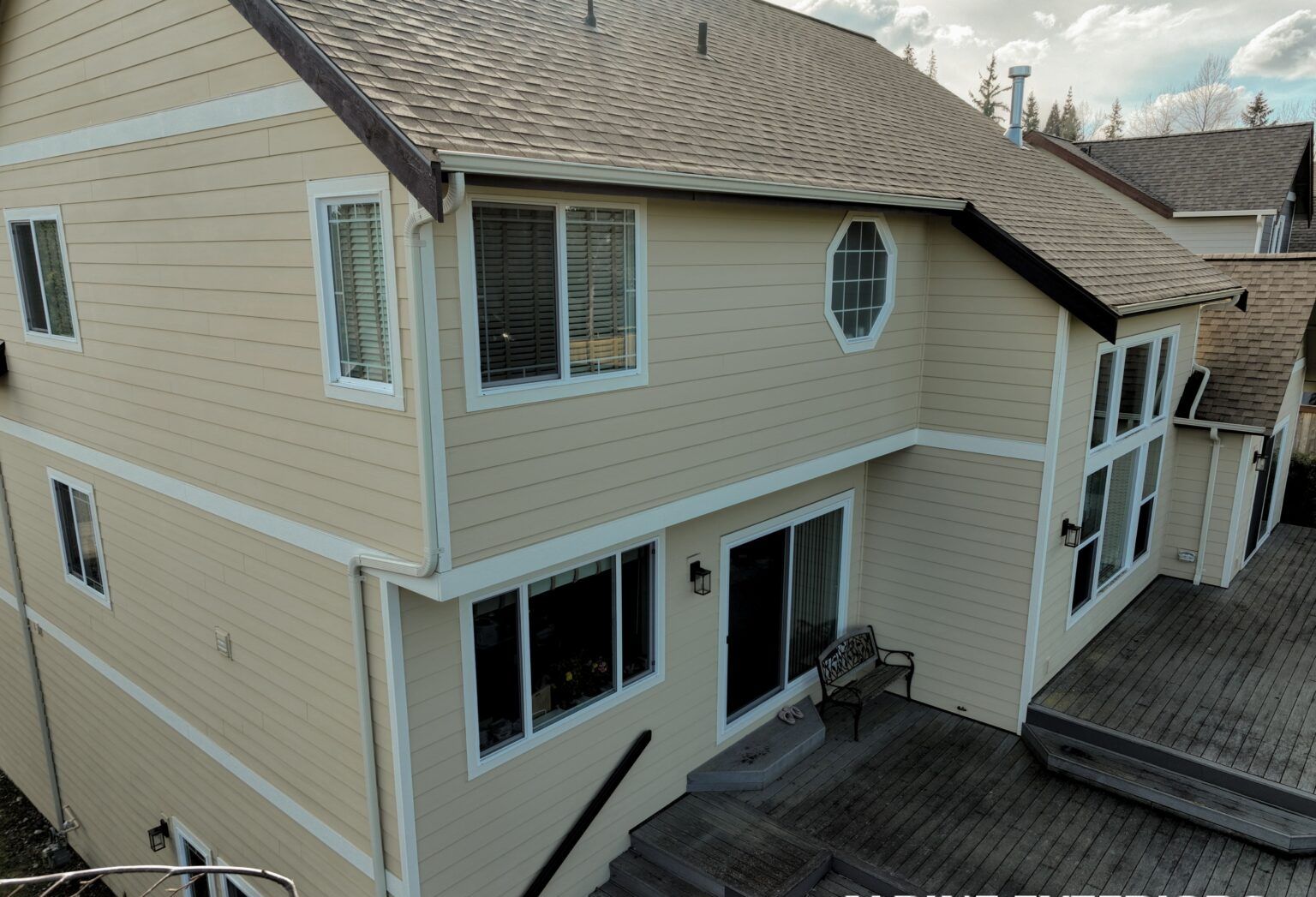
Whatcom County asks more of exterior siding than most parts of the country. Bellingham, Ferndale, Lynden, Blaine, Birch Bay, Sudden Valley, and the islands sit inside a marine climate where rain isn't an occasional event but a season that lasts most of the year. Siding here doesn't just get rained on; it gets rained on sideways. Wind-driven rain off Bellingham Bay and the Strait of Georgia pushes moisture up and under laps, seams, and trim edges that would stay dry in a calmer climate, which is exactly where hidden rot tends to start.
The other regional factor is biology, not weather. Shade from evergreens, high humidity, and long stretches of cloud cover give moss, algae, and lichen everything they need to colonize a north-facing wall or a shaded eave. Left alone, that growth holds moisture against the siding surface far longer than open air would, and that's a slow but steady path to wood rot, especially on older cedar and wood composite siding common in the county's older neighborhoods.
Up in the foothills around Sudden Valley and the outskirts of Lynden, elevation adds freeze-thaw cycling: trapped moisture that freezes overnight and thaws by midday can widen small cracks in caulking, fiber cement, and trim into real gaps over a single winter. And because the Washington State Energy Code sets requirements for continuous insulation and a working air/moisture barrier in the building envelope, siding that's failing to keep water out is also a system failing to do the job the code assumes it's doing. A visual check twice a year, spring and fall, catches most of this while it's still maintenance rather than a structural repair.
Moisture, Rot & Water Intrusion
Moss, Algae & Organic Growth
Panels, Fasteners & Physical Damage
Trim, Flashing & Caulking
Foundation Line & Grade Clearance
Energy Code & Insulation Signs
Not every failed item means a full re-side. A single popped fastener, a patch of moss, or a bead of cracked caulking is routine maintenance: clean growth with a gentle wash rather than a pressure washer aimed at seams, re-caulk with an exterior-grade sealant rated for a wet climate, and re-set or replace the fastener. These are reasonable weekend projects for a homeowner comfortable on a ladder.
Soft or spongy wood, staining that traces under a panel, or warping across more than one or two boards is a different category. The honest answer is that visible damage is usually smaller than what's happening behind it, because rot spreads along the framing and sheathing before it ever shows on the surface. Cutting into a small test area, or having a contractor do it, tells you whether you're looking at a trim repair or a section that needs to come off down to the sheathing. Guessing at the extent of hidden rot from the outside alone is one of the most common ways homeowners under-scope a repair.
Call a licensed contractor when you find soft or spongy siding, staining that reappears after cleaning, more than one warped panel on the same wall, flashing that's rusted through or pulled away from a window head, or any sign moisture has reached interior drywall or framing. These conditions usually mean the water management layer behind the siding needs to be opened up and assessed, which isn't a DIY-safe call once framing or insulation is involved. It's also worth a professional opinion any time you're unsure whether something is cosmetic or structural — a short inspection is cheaper than guessing wrong in either direction.
Alpine Exteriors, licensed in Washington under contractor license ALPINI751OW, inspects siding across Bellingham, Ferndale, Lynden, Blaine, Birch Bay, Sudden Valley, and the surrounding islands and can tell you honestly whether an item on this list is a maintenance fix or something that needs to come apart. Not every inspection ends in a pitch for new siding — sometimes the right answer really is a tube of caulk and a garden hose.
Twice a year is a reasonable baseline — once in early spring after the wettest months and once in fall before winter storms set in — plus a quick visual check after any major windstorm off the Strait, since those events do the most damage to marginal spots like loose trim or open laps.
It's both. The staining itself is cosmetic, but moss and algae hold moisture against the siding surface for days longer than bare siding would after rain, and in this climate that extended dampness is a real contributor to wood rot underneath the growth, particularly on shaded north-facing walls.
Light washing with a hose and a soft brush is generally safe, but a pressure washer aimed directly at panel seams or under laps can force water behind the siding rather than just clean the surface, which creates the exact intrusion problem you're trying to prevent. If you do use one, keep it on a low setting, angled downward, and away from joints.
It depends heavily on scope. A section of localized trim or panel repair might run a few hundred dollars, while a repair that involves opening the wall to address rot in the sheathing or framing behind the siding can run into the low thousands. Full re-siding is a larger investment still, and the only way to get an honest number is a hands-on inspection rather than a phone estimate.
If this checklist turned up more than one or two items, or you'd rather have a second set of eyes before winter, Alpine Exteriors offers siding inspections throughout Whatcom County — Bellingham, Ferndale, Lynden, Blaine, Birch Bay, Sudden Valley, and the islands. A straightforward walk-around assessment now is a lot less disruptive than discovering a moisture problem from inside a wall later. Reach out to Alpine Exteriors to schedule a look.