
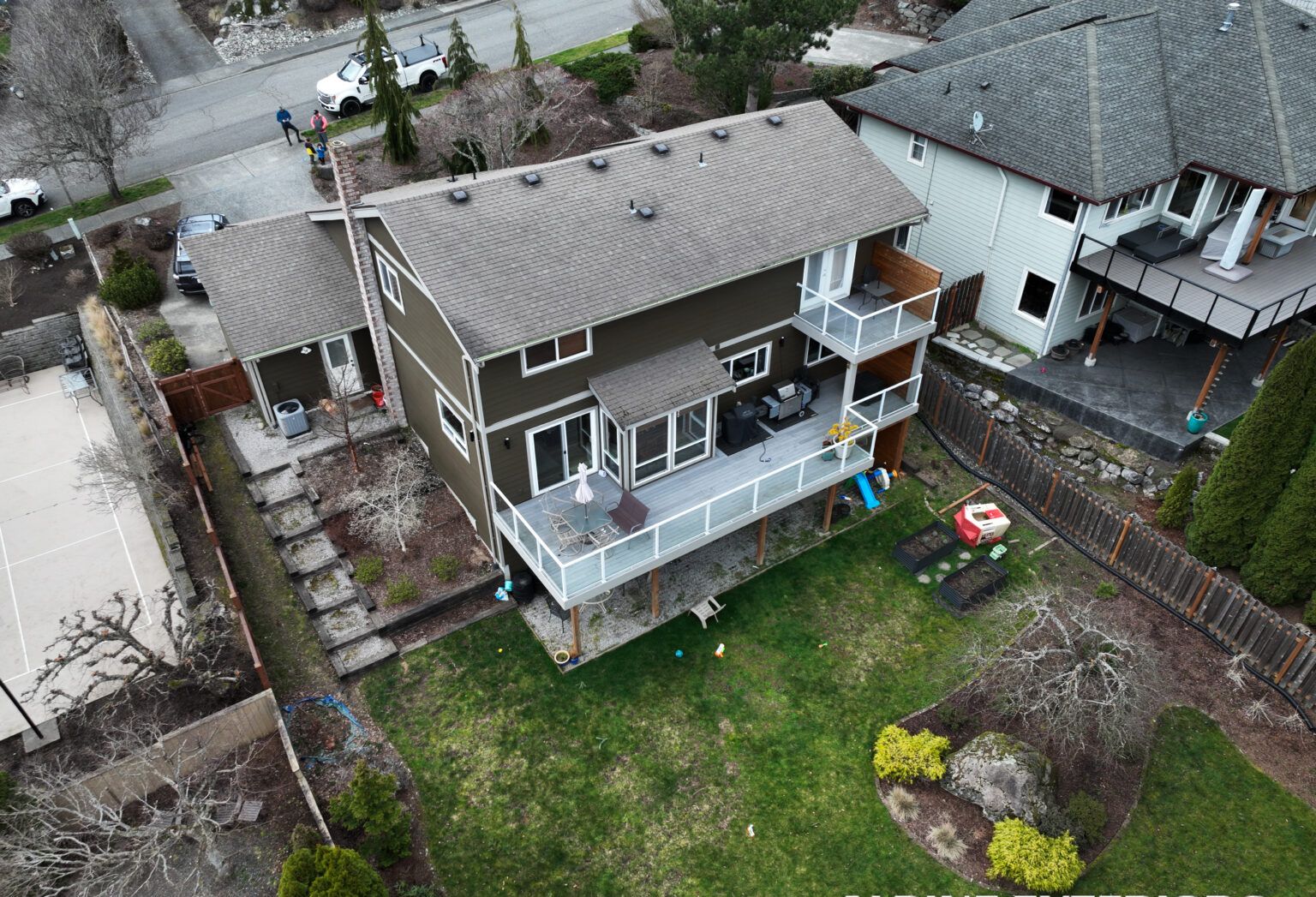
If your home sits along Birch Bay, the siding material matters less than how it's installed. Fiber cement, engineered wood with sealed edges, or vinyl set over a real drainage plane can all hold up here — what actually fails waterfront siding in this part of Whatcom County is skipped flashing, missing weep paths at the bottom of the wall, and caulk used in place of proper lapping.
Birch Bay sits right at sea level on the Strait of Georgia, and the wind that drives rain sideways off the water shapes how a wall performs more than any brand name on the panel. A well-flashed installation on one street can go a long time without trouble, while a poorly detailed job two doors down shows soft trim and rot within a handful of years.
Most siding failures aren't the panel itself giving out — they're water getting behind the panel and having nowhere to go. Wind-driven rain off the bay doesn't just fall straight down; it gets pushed up and under laps, into butt joints, and around window and door trim that isn't flashed with a drip cap and side flashing that actually overlaps the layer below it. Once water gets behind the cladding, capillary action can pull it upward through a joint even against gravity, which is why a house that looks fine from the street can have soaked sheathing at a window sill or corner board.
This is where a rainscreen — a small vented gap between the back of the siding and the water-resistive barrier — earns its keep on a waterfront wall. It lets any moisture that does get past the cladding drain and dry instead of sitting against the sheathing. On homes facing the water directly, we treat that gap as close to non-negotiable rather than an upgrade.
Material choice still matters at the margins. Old-growth cedar lap siding looks right on a Birch Bay cottage, but it needs a maintained paint or stain film and a drainage gap behind it, or it rots from the back before the front ever shows damage. Fiber cement resists moisture and pests well but every cut edge has to be sealed in the field, not just at the factory edge, or it wicks water at every trimmed piece. Vinyl is the least expensive option up front and can perform fine on a waterfront lot, but only if the J-channel, starter strip, and weep holes are detailed correctly — a rushed vinyl job is usually the fastest one to fail because the water intrusion isn't visible until siding comes off. Fasteners deserve their own mention: salt-tinged marine air corrodes standard fasteners faster than it does further inland, so stainless steel or heavy hot-dip galvanized nails and screws are worth the small added cost on any wall within a few hundred feet of the water.
Whatcom County isn't a single climate, and a waterfront lot in Birch Bay isn't the same exposure as a home in Lynden or up in the Sudden Valley foothills. Homes directly on the bay take more direct wind and more sustained wetting, because there's no tree line or terrain to slow rain before it hits the wall. North- and west-facing walls in the shade of a roofline or neighboring structure stay damp longer between storms, and that persistent dampness — not extreme cold — is what feeds moss and algae growth on siding, trim, and roof edges here. It's a cosmetic problem until it isn't: moss holds moisture against the surface and can accelerate rot underneath it if it's left to build up for years.
Salt exposure is real but modest compared to open ocean coastline — Birch Bay is tidal saltwater, and homes right on the water do see faster fastener corrosion and finish fading than homes even a half-mile inland. Combine that with the sheer number of wet days in a typical Whatcom County year and you get long stretches where siding doesn't fully dry out between rain events, which is exactly the condition wood rot needs to take hold in any spot where flashing was skipped or caulk was used as the primary water barrier.
Re-siding also intersects with the Washington State Energy Code more directly than most homeowners expect. Once exterior wall cladding comes off down to the sheathing, it's a natural point to add continuous exterior insulation to meet current prescriptive requirements for the climate zone, rather than treating the re-side as a like-for-like swap. It's worth raising with whoever pulls your permit, since the code path chosen affects both the wall assembly and the depth of trim and flashing details around windows.
Start by finding out what's happening behind the existing siding before picking a replacement. On a waterfront home, especially one with the original siding still on it, that means checking window sills, corner boards, deck ledger connections, and the bottom few feet of wall near grade — the places water collects and the places most re-siding surprises turn up.
None of this makes waterfront siding maintenance-free — no material is, at this exposure. Vinyl can still crack in a hard freeze, fiber cement costs more to install correctly than it does to buy, and wood siding will always ask for more upkeep than either. The honest goal isn't a siding that never needs attention; it's one that fails slowly and visibly instead of quietly rotting the wall behind it.
There's no fixed number, and homes with good flashing and a drainage gap can perform close to what you'd see inland. The real gap shows up on poorly detailed installations — those can develop rot and finish failure years earlier on a direct waterfront lot than the same product would on a sheltered inland site, simply because they take more wind-driven rain with less time to dry between storms.
Not necessarily. Vinyl can hold up fine on the water if the starter strip, J-channel, and weep holes are installed correctly and it's set over a proper water-resistive barrier. The problem is that a rushed vinyl installation hides its mistakes behind the panel, so it's worth paying more attention to installation quality than to which vinyl profile you pick.
That's typically moss and algae growth, and it's common on north- and west-facing walls that stay damp longest between rain events — a normal condition in this climate rather than a sign of failing siding by itself. It's worth removing periodically with a soft wash, because left alone it holds moisture against the surface and can contribute to rot in spots where the underlying flashing is already compromised.
It depends on the scope of the project and how much of the wall assembly gets opened up. Many re-siding jobs are a natural point to add continuous exterior insulation to meet current Washington State Energy Code requirements, and it's worth confirming with your contractor and the local permitting office before materials are ordered, since it affects trim depth and flashing details around windows and doors.
A waterfront lot in Birch Bay is a specific kind of exposure, and it rewards a siding installation that treats water management as the main job, not an afterthought behind whatever material looks best on the sample board. Alpine Exteriors works on homes across Whatcom County, including the wind- and rain-exposed properties right on Birch Bay, Lynden, and the surrounding waterfront communities, and we're happy to walk your specific walls with you before recommending anything. Alpine Exteriors holds Washington contractor license ALPINI751OW — reach out for an on-site look at what's actually happening behind your current siding before you decide what replaces it.