
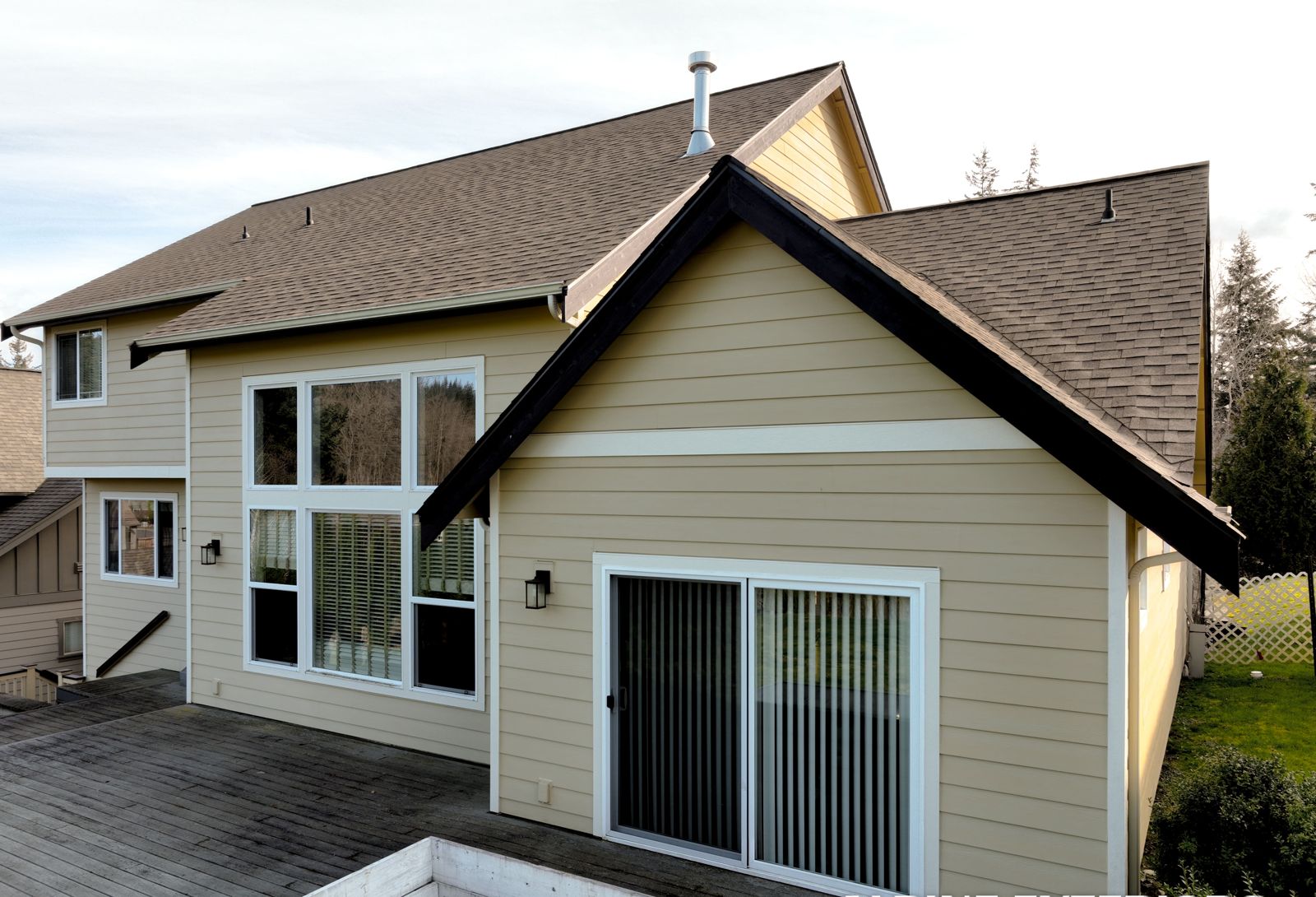
If you've walked around your Lynden property lately and noticed the siding looking a little rougher than it used to — some staining that won't scrub off, a panel that feels soft when you press on it, maybe a musty smell in the spare bedroom — you're not imagining it. Whatcom County is hard on exterior siding in a specific, unglamorous way. There's no hurricane season here, but there is a lot of steady, low-grade moisture: months of drizzle, wind-driven rain that comes in sideways off Bellingham Bay and the Strait of Georgia, shaded lots along the Nooksack that stay damp for days, and freeze-thaw swings once temperatures dip toward the foothills near Mount Baker Highway. None of that is dramatic on any given day. Over ten or fifteen years, though, it finds every gap, every missed flashing detail, and every spot where caulk has shrunk away from a joint.
Below is a practical rundown of what failing siding actually looks like on a Lynden home, why it happens here specifically, and how to sort out what needs attention now versus what can wait for drier weather. Alpine Exteriors works on homes throughout Whatcom County, and the same handful of failure patterns show up again and again — they're rarely mysterious once you know what to look for.
One of these by itself might be cosmetic. Two or three of them clustered near the same window, corner, or downspout usually means moisture has been working its way behind the siding for a while, and it's worth a closer look before it turns into a repair on the sheathing or framing underneath.
Bubbling shows up as raised, puffy spots on the siding face, sometimes with the paint or finish separating from the material underneath. On vinyl siding it can look like the panel has warped slightly outward; on fiber cement or wood, it usually shows as paint blistering first. The underlying cause is almost always trapped moisture — water that got behind the siding through a small gap and then had nowhere to evaporate. With Whatcom County's rain pattern, siding rarely gets a long dry stretch to fully release moisture the way it might in a drier climate, so a small leak here has more time to do damage before anyone notices.
Bubbling is also common where the original installation skipped a rain screen gap or where house wrap was taped incorrectly at a seam. Homes built or re-sided in a hurry — which happened a fair amount during past building booms in this area — sometimes have this problem baked in from day one.
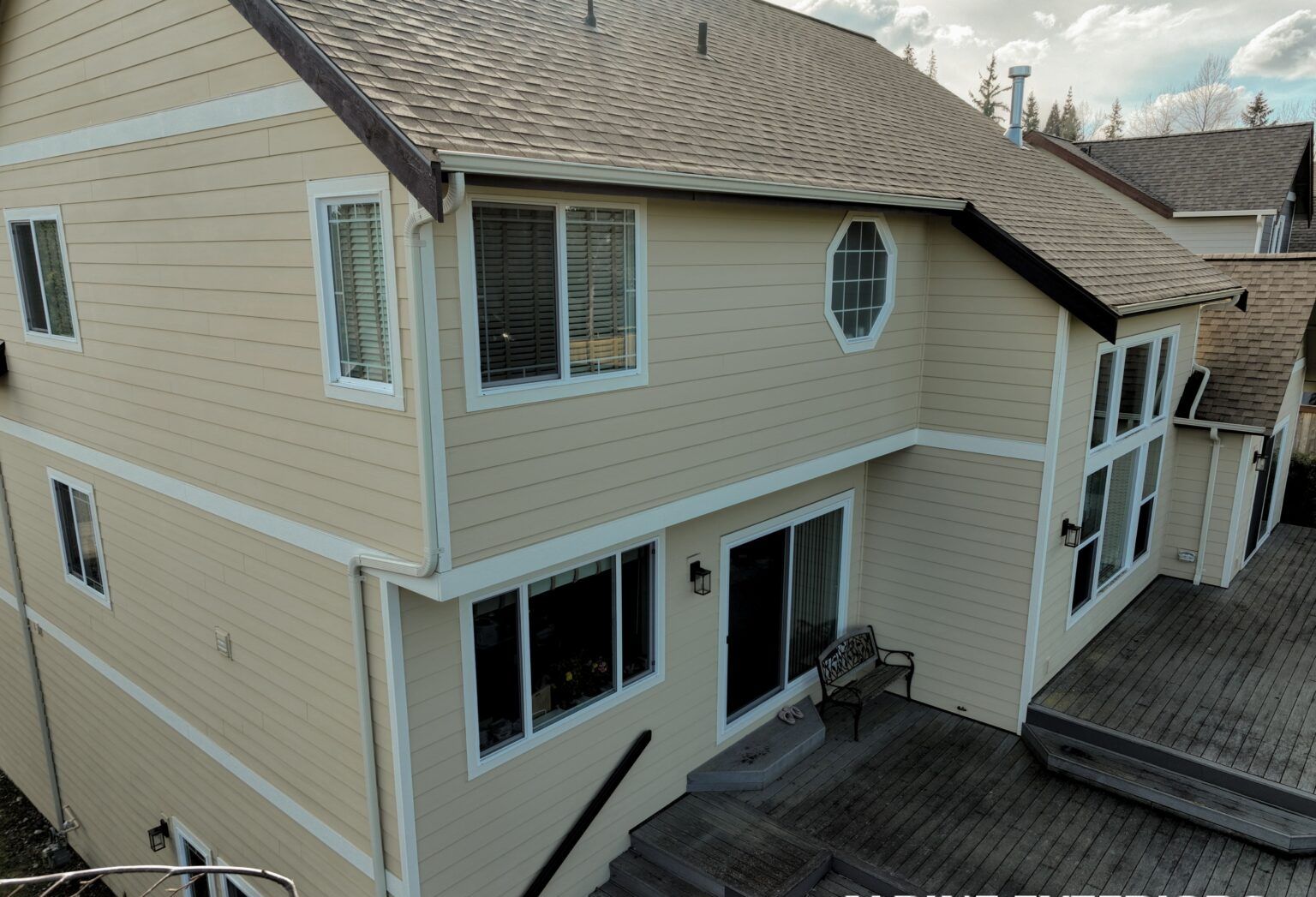
Dark streaks running down from a window head, a soffit, or a roofline are usually just water carrying dirt and organic growth down the face of the siding — common on any home here, and not automatically a sign of failure. What is a sign of trouble is green-black growth that comes back within a few weeks of being cleaned, especially on north-facing walls or under trees that keep a wall shaded most of the day. Moss and algae need sustained moisture to thrive, and siding that's staying damp long enough to grow moss is siding that isn't drying out properly between rains — which is exactly the condition that leads to rot underneath.
Shaded lots along wooded lots in Lynden and Sudden Valley see this more than open lots closer to the water, simply because tree cover slows evaporation. It's not a reason to remove trees, but it is a reason to keep gutters clear and check those walls a little more often.
This is the sign that should get your attention fastest. Press a thumb or a flathead screwdriver gently against the siding near the bottom of a wall, around a window sill, or near a hose bib. If it gives, feels spongy, or the tool sinks in slightly, that's active wood rot, not a surface issue. Rot spreads outward and downward from the entry point, and by the time it's visible on the surface, it's often already reached the sheathing behind the siding.
Wood rot in this region is almost always a water intrusion problem, not a materials-quality problem — cedar and fiber cement siding can both rot given years of trapped moisture. The usual entry points are failed caulk joints around windows, missing or improperly lapped flashing above trim, and horizontal surfaces like window sills and deck ledgers that catch and hold water instead of shedding it. Wind-driven rain off the bay makes this worse on west- and southwest-facing walls, where storms push water sideways into joints that were only ever designed to handle water running straight down.
Cracking and warping have a few different causes depending on the material. Vinyl siding can crack from age and UV exposure, or buckle if it was nailed too tightly and had no room to expand and contract with temperature swings — freeze-thaw cycles in the colder months make this worse, since the panel is repeatedly contracting hard in a cold snap and then expanding again. Fiber cement can crack at butt joints if they weren't caulked and painted correctly, letting water in behind the seam where it freezes and expands. Wood siding warps when it absorbs moisture unevenly, often because the back side of the board — the side facing the wall — isn't primed or ventilated the way the front is.
A few cracked panels aren't an emergency, but they are an open door for water, and each one left alone tends to create a second and third problem nearby.
Caulk and sealant have a service life, typically well under the lifespan of the siding itself, and in a climate with as much rain and temperature swing as Whatcom County's, that life gets shortened further. When you see a visible gap where siding meets a window frame, corner board, or the foundation line, that's a maintenance item that turns into a moisture problem the next time it rains sideways. It's one of the easiest things to catch early and one of the most expensive to ignore, because water entering at a gap doesn't stay at the gap — it travels behind the siding along the sheathing.
Siding failure isn't only cosmetic. If the water-resistive barrier or insulation behind the siding has been compromised, a wall can lose its ability to hold heat, and you'll notice it as a draft near an exterior wall or a heating bill that's crept up without an obvious reason. Homes built or renovated to meet the Washington State Energy Code are supposed to have a continuous air and water barrier behind the cladding; once siding starts failing and water gets behind that barrier, insulation can get wet and lose much of its effectiveness. This is a slower, quieter sign than a soft spot you can feel with your hand, but it's worth paying attention to, especially in an older Lynden farmhouse or a home that's had partial updates over the years rather than a full envelope replacement.
A musty or earthy smell in a room along an exterior wall, particularly after a stretch of wet weather, often means moisture has worked its way past the siding and sheathing and is sitting against the interior wall cavity. This is usually the last sign to show up, after the siding has already been compromised for a while, and it's worth taking seriously — trapped moisture in a wall cavity can lead to mold growth that's a health concern as well as a structural one.
Not every sign on this list needs a contractor out this week. Here's a rough way to sort them:
Address soon, ideally before the next heavy rain: soft or spongy spots anywhere on the wall, visible gaps at windows or corners, cracked panels near ground level or near downspouts, and any musty smell indoors. These involve active water intrusion, and every additional storm makes the eventual repair larger.
Can reasonably wait for a dry stretch or your next scheduled maintenance: surface staining that comes off with a wash, minor UV fading, small hairline cracks in a single panel with no softness around them, and cosmetic peeling paint on trim that isn't accompanied by soft wood underneath. It's still worth putting these on a list — they tend to become urgent over a year or two if ignored entirely.
When in doubt, the thumb-press test is a reasonable first check: firm and solid is a good sign; give, sponginess, or crumbling means it's time to get someone out to look at it rather than waiting.
If you're seeing one or two of the milder signs, start with the basics: clean gutters and downspouts so water isn't overflowing onto the wall below, trim back vegetation that's keeping a wall shaded and damp, and re-caulk any obviously open joints around trim and windows before the wet season sets in. These are reasonable weekend projects for a homeowner comfortable on a ladder.
If you're seeing soft spots, active leaks, or staining and softness clustered together, it's worth having someone experienced take a closer look rather than guessing. A surface repair over active rot doesn't solve anything — it just hides the problem for another season. Alpine Exteriors inspects the areas where water is actually getting in, not just the spot where damage happens to show, since those two locations aren't always the same on a home that's had siding for a couple of decades. Depending on what's found, the fix might be a localized repair — replacing a section of siding and correcting the flashing detail that let water in — or, if the damage is widespread, a broader residing project that also gives you a chance to add a proper rain screen gap and bring the wall assembly closer to current Washington State Energy Code expectations for the water-resistive barrier and insulation continuity.
Cost for a localized repair on a Lynden home is typically a modest few hundred to a couple thousand dollars depending on how much sheathing needs replacing behind the siding; a fuller residing project runs considerably more and depends heavily on square footage, material choice, and how much trim and flashing work is involved. Getting a firm number requires an actual look at the specific damage — anyone quoting a whole-house price over the phone without seeing the walls is guessing.
It varies a lot by material and installation quality more than by age alone. Vinyl siding installed correctly with proper expansion gaps can go several decades with only cosmetic wear, while wood siding with a missed flashing detail can develop rot within a handful of years. In general, homes here that see steady wind-driven rain off the bay or sit in a shaded, damp spot tend to show trouble sooner than homes on open, sunnier lots, regardless of the siding's official lifespan rating.
For minor cosmetic staining or a small open caulk joint, yes — that's reasonable maintenance and worth doing. But painting or caulking over a soft, rotted spot doesn't fix anything; it traps the moisture that's already there and hides the problem from view until it's worse and more expensive to repair. If a press test shows softness, that area needs the damaged material opened up and addressed, not sealed over.
Both are common on Whatcom County homes and both indicate a wall that's staying damp longer than it should. Algae is mostly cosmetic on its own, but moss holds moisture directly against the siding surface and can work its way into seams and under lapped edges, which does contribute to rot over time, especially on wood siding or wood trim. Cleaning it off periodically and improving drainage or sun exposure where possible helps more than any one-time treatment.
It depends on how contained the damage is. A leak around one window that's caused localized rot can often be repaired as a single-wall or single-section job without touching the rest of the house. If soft spots and staining are showing up in multiple unrelated areas, that's usually a sign the whole installation has aged out or was never detailed correctly, and patching one spot at a time ends up costing more over several years than addressing the whole exterior at once. An in-person inspection is really the only reliable way to tell which situation you're in.
If your Lynden home is showing any combination of the signs above, it's worth getting an honest, in-person opinion rather than guessing from the ground. Alpine Exteriors, WA contractor license ALPINI751OW, works with homeowners throughout Whatcom County — Bellingham, Ferndale, Lynden, Blaine, Birch Bay, Sudden Valley, and the islands — to inspect siding, identify where water is actually getting in, and lay out repair or residing options with real cost ranges, not guesswork. Reach out for an inspection before the next round of fall rain moves in off the Strait.