
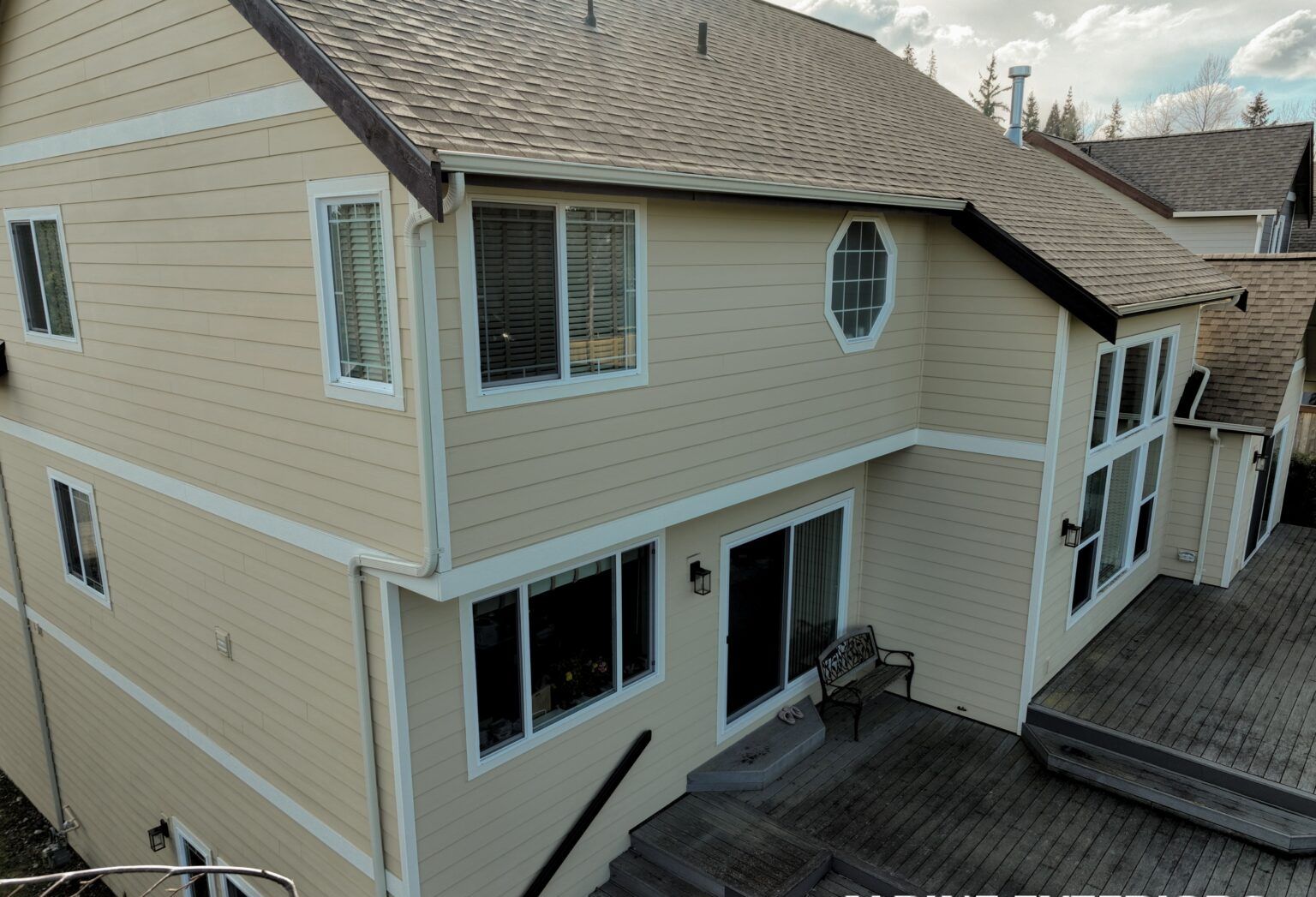
Whatcom County siding deals with a specific kind of pressure: months of steady drizzle, wind-driven rain that comes sideways off Bellingham Bay and the Strait of Georgia, moss and algae that thrive in the shade along the foothills, and enough freeze-thaw cycles each winter to work at any small gap. A siding leak almost never starts as a dramatic flood. It starts as a stain, a soft spot, or a smell, and by the time it is obvious, water has usually been getting behind the siding for a season or more.
Press on the siding near the bottom of a wall, around a hose bib, or under a window. If it flexes, feels spongy, or gives more than the panel next to it, water has likely reached the sheathing or framing underneath. In this climate the culprit is usually failed caulking at a penetration or a seam that has been sitting wet through repeated rain events rather than drying out between them, since Whatcom County rarely gets the long dry stretches that let a wall fully recover.
Paint failure on exterior walls is often read as a cosmetic problem, but paint bubbles and peels from the inside out when moisture pushes through the substrate and breaks the paint's bond. On older lap siding and on fiber cement that has lost its factory coating, this is frequently the first visible sign that water is moving through the wall assembly rather than running off it.
Brownish or dark streaking that runs down from a horizontal seam, a window head, or a butt joint usually means water is getting past that joint and running down the back side of the siding, staining the face as it weeps out lower down. On homes exposed to wind-driven rain off the Bay or the Strait, this shows up most on west- and southwest-facing walls, where wind pushes rain sideways into laps and seams that were only designed to shed water falling straight down.
A musty smell along an exterior wall, closet, or crawlspace, or windows that fog more than they used to, can mean moisture is trapped inside the wall cavity rather than draining and drying as designed. This is worth taking seriously here specifically because the Washington State Energy Code's insulation and air-sealing requirements make homes tighter than they were a generation ago; a tighter envelope holds humidity that used to escape, so a leak that once dried out quietly now has a harder time doing so.
Vinyl and wood siding that has visibly bowed outward, cupped, or pulled away from the wall at a seam is telling you moisture and, in colder pockets like Sudden Valley and the foothills near Lynden, repeated freeze-thaw cycles have already done mechanical damage. Water that gets behind a panel and freezes expands, which widens gaps and accelerates the next leak. Once a panel is visibly warped, the underlying water-resistive barrier has often been compromised too.
Some moss and algae growth on north-facing siding is normal in this climate and is not, by itself, a leak indicator. What matters is the pattern: moss or dark algae that grows heavier right along a seam, around a nail head, or below a specific joint, rather than evenly across the wall, suggests that spot stays wetter longer than the surrounding siding, which usually means water is being held there instead of shedding off.
Wood trim is usually the first material to show wood rot because it sits at the vulnerable transitions, corners, window and door casings, and the bottom edges of siding boards, where caulking joints are most numerous and most likely to fail first. A screwdriver pressed gently into suspect trim that sinks in easily, rather than meeting solid resistance, is a reliable sign that rot has already set in.
Not every sign on this list needs a same-week response, but some do. This is a general guide, not a substitute for someone looking at the actual wall in person.
| Treat as urgent | Can typically wait for scheduling |
|---|---|
| Interior drywall staining, bubbling paint, or soft drywall on an exterior wall | Isolated moss growth with no staining or softness nearby |
| Soft or spongy siding paired with a musty smell | Faded or chalky paint with no bubbling or peeling |
| Visibly warped or separated panels after a windstorm | Minor hairline caulk cracking at a single joint |
| Rot found in structural trim, window casings, or near the roofline | Cosmetic staining that has not changed in appearance over a season |
If you are seeing one or more of the urgent signs above, the priority is figuring out how far the water has traveled before deciding on a repair, because a patch over a small hole does nothing if the sheathing underneath is already saturated. A few practical steps:
Alpine Exteriors inspects siding on homes throughout Bellingham, Ferndale, Lynden, Blaine, Birch Bay, Sudden Valley, and the islands, and opens up suspect areas rather than guessing from the outside. Costs vary widely depending on how far the damage extends; a single resealed seam might run a few hundred dollars, while sheathing replacement behind a wider area of rot can run into the thousands, so an honest inspection before committing to a repair plan is worth the time.
Repainting without addressing the moisture source usually fails again within a season or two, because the paint is peeling as a symptom of trapped water, not because the paint itself failed on its own. It can buy a small amount of time on a low-priority spot, but it is not a fix, and it can mask a leak that is still getting worse underneath.
No. Given the amount of persistent rain and shade in this region, some moss and algae growth on north- and west-facing siding is common and does not by itself mean there is a leak. It becomes a more meaningful sign when it is concentrated at a specific seam or joint rather than spread evenly, or when it appears alongside staining or softness at that same spot.
It depends heavily on the cause and the specific policy; sudden storm damage is treated differently than gradual water intrusion from a failed seam or worn caulking, and most policies exclude damage that resulted from long-term lack of maintenance. Check with your insurer before assuming coverage, and keep the photos and dated notes from your own inspection to support a claim either way.
A siding repair or re-side that involves opening up the wall can trigger current Washington State Energy Code requirements for the insulation and weather-resistive barrier that go back into that section of wall, even if the rest of the house was built to an older code. It is worth asking your contractor upfront how the repair scope accounts for this, so the fix does not just address the leak while leaving the wall out of compliance.
If your home is showing one or more of these signs, it is worth having someone look before the next stretch of rain adds to the damage. Alpine Exteriors, WA contractor license ALPINI751OW, inspects and repairs siding across Whatcom County, from Bellingham and Ferndale to Lynden, Blaine, Birch Bay, Sudden Valley, and the surrounding islands. Reach out for an inspection and a straightforward assessment of what you are actually dealing with.