
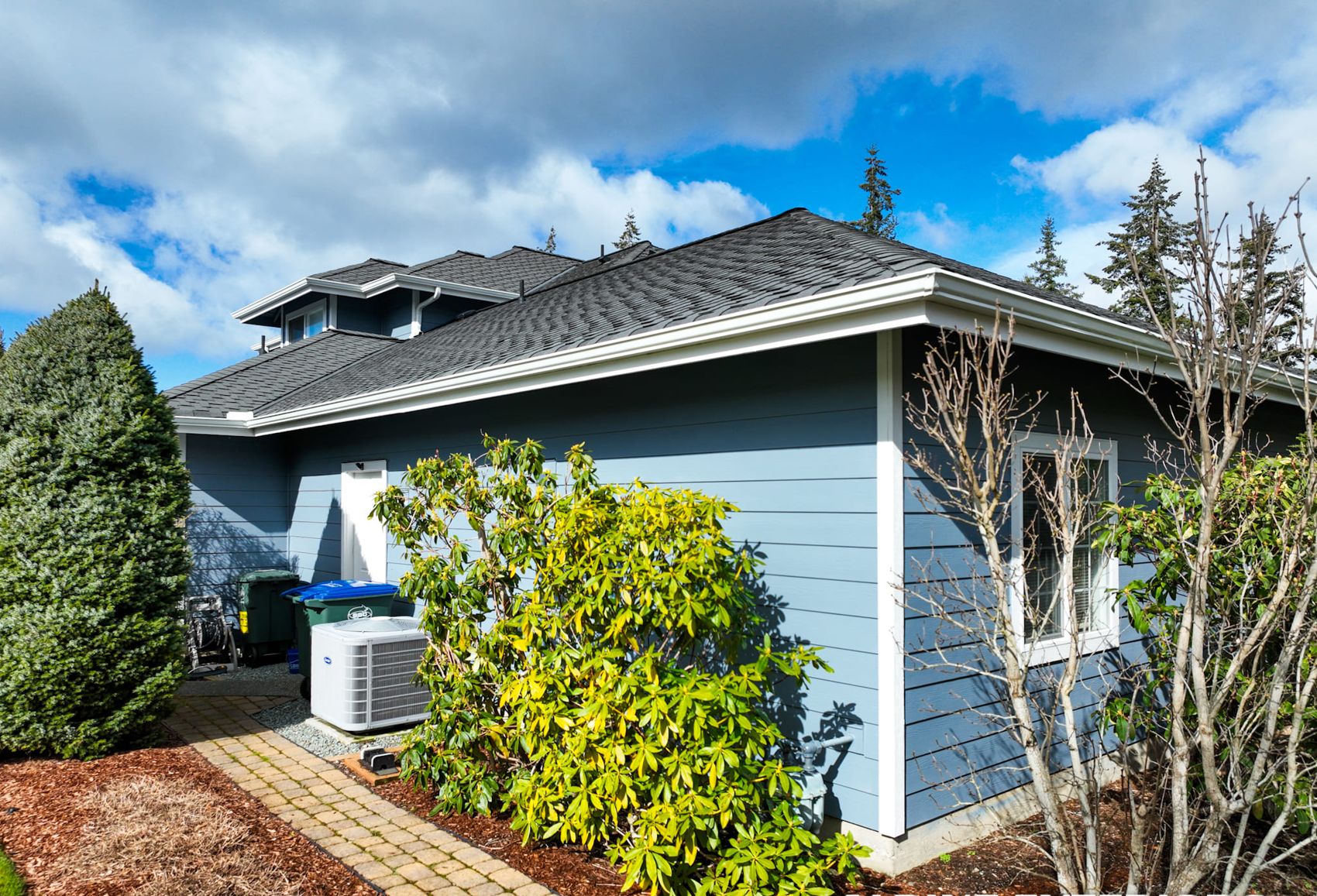
In Sudden Valley and the rest of unincorporated Whatcom County, new or replacement siding has to be installed under the Washington State Building Code — which adopts the International Residential Code (IRC) with Washington amendments — plus the Washington State Energy Code where the work touches the wall assembly. In practice that means the siding product needs a valid code-recognition report for wind and water exposure, and it has to go on with the fastening pattern, corrosion-resistant hardware, and drainage details that report and the manufacturer's instructions call for, not whatever a crew finds fastest.
Wind design for siding in Washington isn't handled by a single "wind rating" sticker the way people sometimes expect. The IRC, adopted statewide with local amendments layered on by Whatcom County, sets a design wind speed and exposure category for the area, and manufacturers test their products against that framework using recognized standards — ASTM D3679 for vinyl siding, ASTM C1186-based testing for fiber cement, and comparable standards for engineered wood and metal panel products. The results show up as an ICC Evaluation Service (ICC-ES) report or a manufacturer's code-compliance report, which a Whatcom County plans examiner or inspector can reference directly instead of re-deriving the math from scratch. If a product doesn't have that documentation, or if the installer swaps to a different exposure category or panel size than what was actually tested, the wind rating printed on the box doesn't mean anything on that specific wall.
Fastening is where most real-world failures start, and it's also the easiest thing for an inspector to check. The code and the manufacturer's instructions both specify nail or screw type, minimum penetration into structural sheathing or framing, spacing along the panel, and clearance from panel edges. Whatcom County's damp climate raises the stakes on fastener material specifically: standard electro-galvanized nails corrode faster in a coastal, high-moisture environment than hot-dip galvanized or stainless steel fasteners, and a corroded fastener loses holding power years before the siding itself shows any wear. Underneath the fastening, the code also requires a water-resistive barrier installed shingle-fashion so water sheds outward, with flashing integrated at every window, door, and roof-to-wall intersection. None of this is exotic — it's standard IRC wall-covering material requirements — but skipping or rushing it is the single most common reason siding fails early in wet Pacific Northwest conditions.
Whatcom County isn't a hurricane zone, and nobody here needs to worry about the wind-speed maps that drive siding decisions on the Gulf Coast or in Florida. The wind design values that apply locally are modest by national standards. But treating that as "wind doesn't matter here" misses the actual local problem: wind-driven rain. Storms coming off Bellingham Bay and the Strait of Georgia routinely push rain sideways into wall assemblies for hours or days at a stretch, rather than delivering a short, intense downpour. Siding that's rated fine for static wind load can still fail at the seams, laps, and flashing details if it wasn't installed with that sustained, horizontal-rain pattern in mind. That's a water-management problem more than a structural one, and it's the reason lap orientation, flashing sequencing, and drainage gaps matter more here than raw wind rating.
Sudden Valley adds its own wrinkles on top of the general Whatcom County picture. The community sits on forested slopes above Lake Whatcom, and that tree cover is a mixed blessing: it blocks a lot of direct wind exposure on wooded lots, but it also creates the shaded, slow-to-dry microclimates where moss and algae take hold fastest, especially on north- and east-facing elevations and anywhere gutters or trees keep a wall perpetually damp. Cleared lots and driveway cuts through the trees can also funnel wind unevenly across a single home, so one elevation ends up taking far more wind-driven rain than its neighbors. The elevation gain around Lake Whatcom compared to sea-level Bellingham also means Sudden Valley sees more freeze-thaw cycling in the shoulder seasons — repeated overnight freezes followed by daytime thaw stress caulk joints, trim fastener holes, and any siding that's already absorbed moisture, since water expands as it freezes and works small gaps into bigger ones over a few winters. And because Sudden Valley is a private, covenant-governed community, homeowners there often have a Sudden Valley Community Association architectural review layered on top of the county's permit and inspection process — a code-compliant installation can still get flagged if it wasn't cleared with the association first.
Wood rot is the cumulative result of all of the above: trapped moisture behind non-vented siding, moss holding water against a wall longer than it would otherwise sit, and freeze-thaw opening up small cracks for water to get in. None of this is unique to Sudden Valley, but the combination of tree-shaded moisture retention and elevation-driven freeze-thaw is more pronounced there than on an open, low-elevation Bellingham lot.
A lot of this comes down to asking the right questions before work starts, not after a problem shows up. In practice:
Be realistic about the cost and time trade-offs here too. Installing with the correct fasteners, a drainage gap, and properly sequenced flashing takes longer and costs more up front than a bare-minimum installation — often a difference of a few thousand dollars on a typical single-family home, depending on siding material and how much flashing and trim work the elevations require. That's a real drawback, and it's fair to weigh it. But the alternative is siding that can start showing moisture damage well before its expected service life, which costs far more to fix once it's behind the wall rather than on top of it. Alpine Exteriors installs siding across Whatcom County under WA contractor license ALPINI751OW and treats the flashing and fastening details above as non-negotiable on every job, specifically because of how often shortcuts on those details are what fail first in this climate.
No — the wind design values that apply under the Washington State Building Code don't change block by block within the county, and Sudden Valley isn't classified any differently than Bellingham or Ferndale for that purpose. What does change locally is exposure: tree cover, cleared lots, and driveway cuts through the woods can concentrate wind-driven rain on specific elevations of a specific home, which is a site condition an experienced installer should account for even though it isn't a separate code category.
In most cases, yes — a full siding replacement in unincorporated Whatcom County, including Sudden Valley, typically requires a building permit through Whatcom County Planning & Development Services, and Sudden Valley homeowners generally also need separate sign-off from the Sudden Valley Community Association's architectural review process. Confirm both before work starts, since they're independent approvals and one doesn't substitute for the other.
The core items are the water-resistive barrier and how it's lapped, flashing at every window, door, and roof-to-wall intersection, fastener type and spacing against the manufacturer's schedule, and minimum clearance from grade and roof surfaces. Inspectors are checking whether the installed assembly matches what the product's code-compliance documentation and the manufacturer's instructions actually require — not just whether the siding looks finished from the street.
It depends on the scope. A straightforward re-side that reuses the existing sheathing and doesn't add insulation usually doesn't trigger Washington State Energy Code upgrade requirements. But if the project opens up the wall assembly, adds continuous exterior insulation, or otherwise changes the wall's insulation and air-sealing details, energy code provisions for insulation values and vapor permeability can come into play — worth confirming with your contractor and the county before scope is finalized.
If you're planning a re-side in Sudden Valley or anywhere else in Whatcom County — Bellingham, Ferndale, Lynden, Blaine, Birch Bay, or the islands — Alpine Exteriors can walk your specific elevations, flag the flashing and drainage details that matter for your site, and handle the permit and inspection process alongside the installation. Reach out for a walk-through and a straightforward look at what your home actually needs before any work starts.