
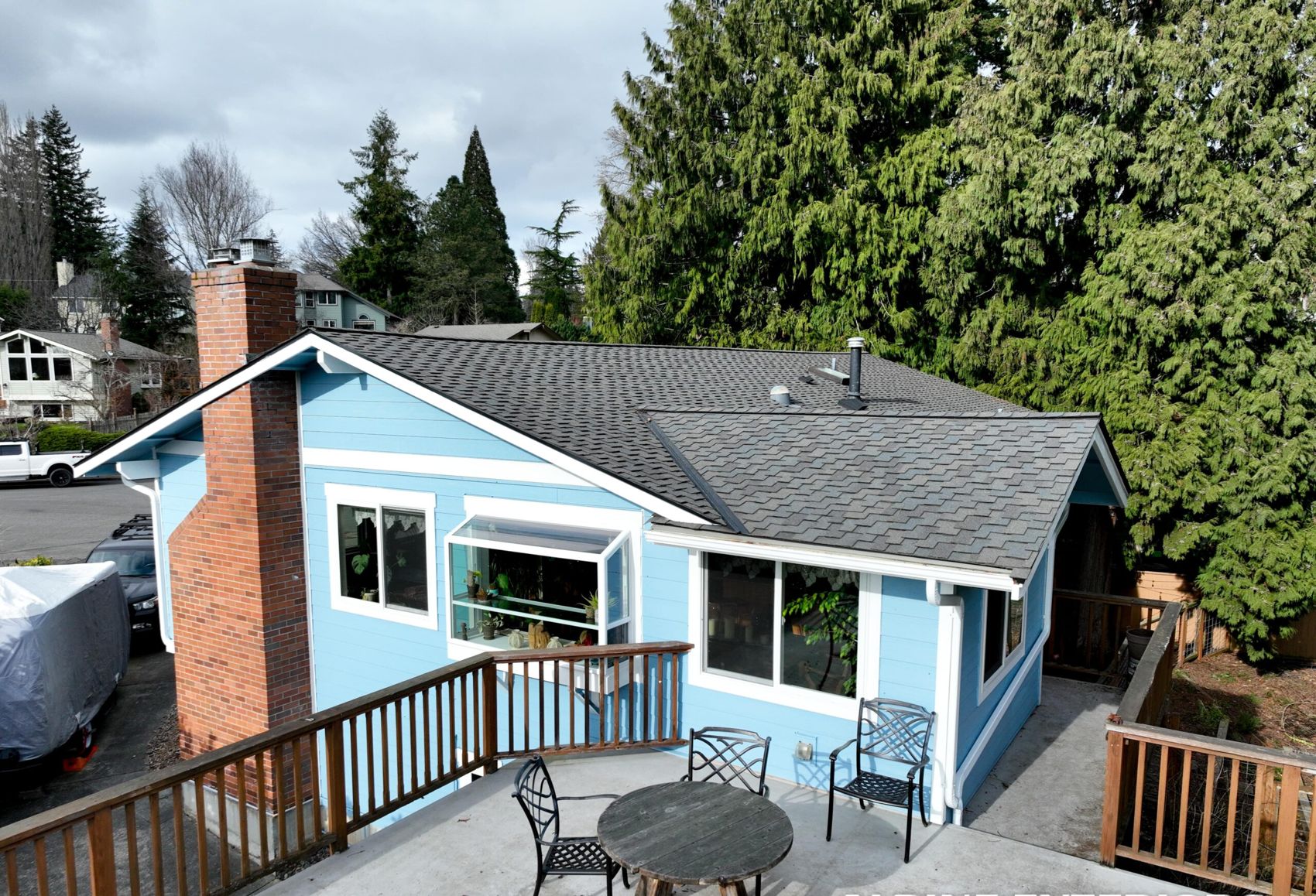
If you're re-siding a home in Bellingham, Ferndale, Lynden, Blaine, Birch Bay, Sudden Valley, or out on the islands, you've probably narrowed your options down to two: fiber cement and engineered wood. Both are marketed as low-maintenance upgrades from old cedar lap siding, and both can look great on a Whatcom County home. But they behave differently once they've spent a few winters soaking up rain off Bellingham Bay and the Strait of Georgia, and that difference matters more here than it does in drier parts of the state.
If your home sits in a spot that catches wind-driven rain — waterfront or near-waterfront property, an exposed hillside lot, or anywhere the siding takes rain sideways rather than straight down — fiber cement is the more forgiving material. It doesn't have wood fiber at its core, so it isn't vulnerable to the moisture intrusion that causes rot at butt joints and panel edges. If your home is in a more sheltered location with good roof overhangs and you want a warmer wood-grain look with a somewhat lower up-front cost, engineered wood is a reasonable choice, provided you're committed to keeping paint and caulking maintained on schedule. Neither material is wrong for this region; the right pick depends on exposure, budget, and how much ongoing maintenance you're realistically going to do.
Fiber cement is a blend of cement, sand, and cellulose fiber pressed into planks or panels, then factory-primed or pre-finished. Because the core material contains no wood, it doesn't absorb water the way a wood-based product does, and it resists the moss and algae growth that's a constant issue on north-facing walls and shaded siding throughout Whatcom County. It also holds paint far longer than wood siding, since the substrate doesn't expand and contract with moisture the same way.
The drawbacks are real, though. Fiber cement is heavy, which means installation takes longer and requires more labor, and it has to be installed with specific fastening patterns and clearances — sloppy installation is one of the more common causes of the failures we see when we're called in to inspect someone else's work. It also needs to be field-cut with dust control, since the silica content in the material is a respiratory hazard if it's cut dry without the right equipment. And while the material itself resists rot, the caulking and flashing details around windows, trim, and butt joints still have to be done correctly, or you'll get water intrusion behind the siding regardless of what the siding itself is made of.
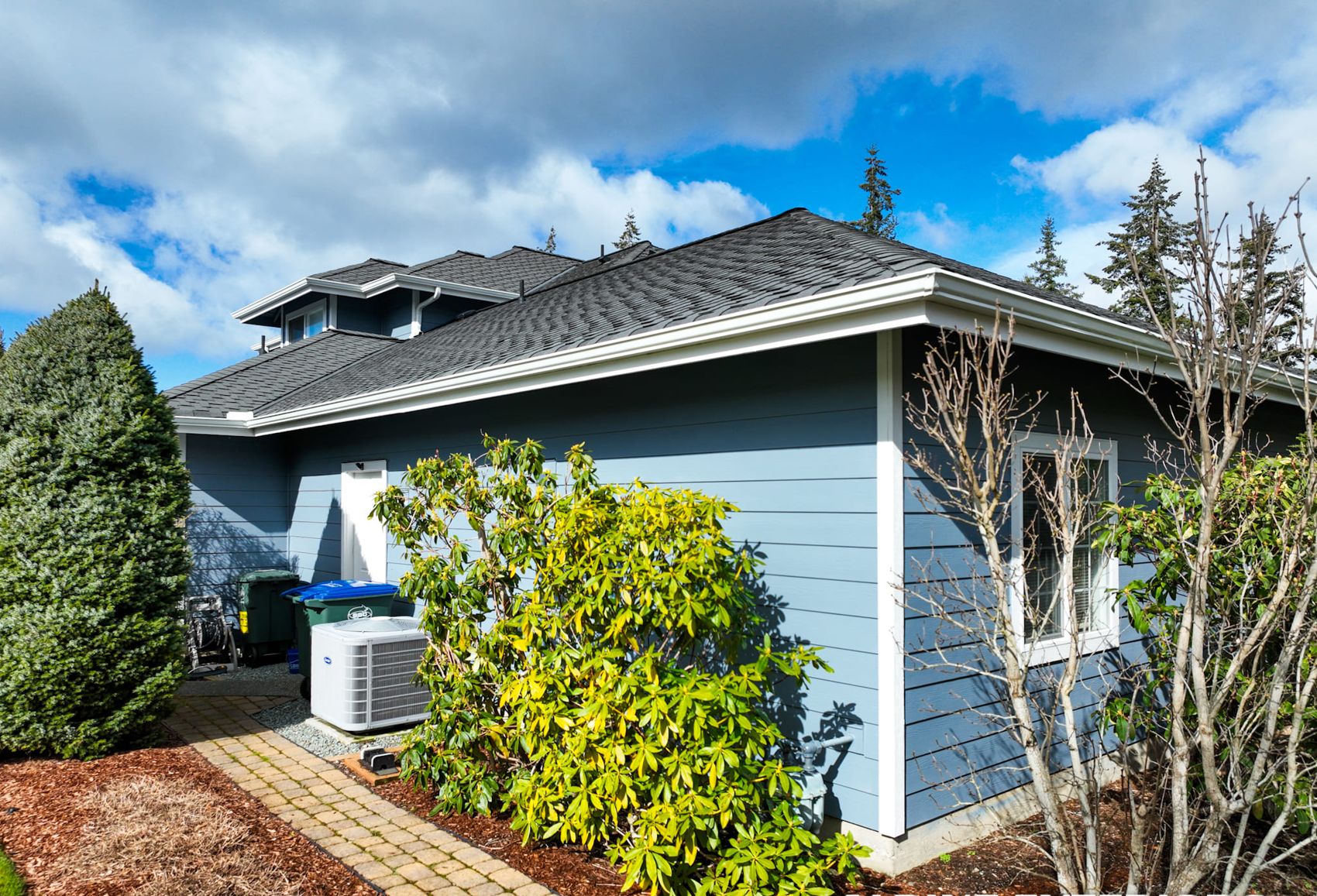
Engineered wood siding — often sold under names like strand-based composite panels — is made from wood strands or fibers bonded with resins under heat and pressure, then coated with a factory finish. It's lighter than fiber cement, which speeds up installation and reduces labor cost, and it has a warmer, more traditional wood-grain texture that some homeowners prefer over the more uniform look of fiber cement.
Because it still has wood at its core, though, engineered wood is more sensitive to sustained moisture exposure than fiber cement. Manufacturers have improved resin technology substantially over the last couple of decades, and today's engineered wood products perform much better in wet climates than older OSB-based siding did. But the material still depends on an intact factory finish and properly sealed cut edges to keep water out. In a climate where it can rain for weeks at a stretch and where wind off the water drives moisture into unsealed edges and joints, any gap in the finish — a scratch, an uncaulked seam, a cut end left exposed at installation — gives water a path into the panel, and once moisture gets into the wood fiber core, it doesn't dry out quickly given how little sun and wind we get here in winter. Freeze-thaw cycles in the foothills and inland valleys around Lynden and Sudden Valley can then widen any damage that's already started.
| Fiber Cement | Engineered Wood | |
|---|---|---|
| Installed cost | Generally higher, roughly $9–$16 per square foot installed depending on profile and finish | Generally lower, roughly $6–$11 per square foot installed |
| Typical lifespan in this climate | Often 40+ years with proper installation and maintained caulking/flashing | Commonly in the 20–30 year range, shorter if finish or seals are neglected |
| Maintenance | Repaint every 10–15 years; occasional caulk touch-up; resists moss but shaded walls still need periodic washing | Repaint or refinish on a similar or shorter cycle; cut edges and seams need vigilant caulk maintenance to prevent moisture entry |
| Appearance | Clean, uniform lines; accepts a wide range of paint colors well; can read as slightly more institutional in some profiles | Warmer, more natural wood-grain texture; wider range of factory finishes and textures out of the box |
For most of the homes we work on in Whatcom County, fiber cement ends up being the more durable long-term choice, and that's especially true for anything exposed to direct weather — waterfront lots near Birch Bay or Blaine, hillside homes catching wind off the Strait, or any wall that doesn't get much roof overhang protection. The higher up-front cost is offset by a material that isn't fighting a losing battle against constant moisture at its core, and that matters in a place where it's genuinely wet more months of the year than it's dry.
That said, engineered wood isn't a bad choice everywhere in this county. A well-protected home in Bellingham with generous eaves, good gutters, and a homeowner who's diligent about inspecting and re-caulking every couple of years can get solid performance and real cost savings out of it. The islands are a slightly different case — salt-laden air and near-constant exposure on many lots tend to push us toward recommending fiber cement there more often than not.
Either product also needs to meet the thermal performance requirements in the Washington State Energy Code when it's part of a full wall assembly replacement, which is one more reason the installation details — proper water-resistive barrier, correct flashing at penetrations, and rainscreen furring where it's called for — matter as much as which siding material you pick. Alpine Exteriors builds every siding installation around those details first, because the siding material only performs as well as the assembly behind it. As a WA-licensed contractor (ALPINI751OW), we walk homeowners through both options against their specific lot's exposure before recommending one over the other, rather than defaulting to whichever is easier for us to install.
In terms of resistance to moisture-driven rot, yes — fiber cement's cement-based core doesn't absorb and hold water the way wood fiber does, so it's less vulnerable to the slow rot that shows up at butt joints and cut edges on wood-based products after years of sustained rain. That said, both materials depend heavily on correct installation, flashing, and caulking; a poorly installed fiber cement job can still fail, and a well-installed engineered wood job can last for decades.
Both can develop surface growth on shaded, north-facing walls or under tree cover, which is common throughout Whatcom County. Fiber cement's non-porous surface generally sheds it more easily with a periodic gentle wash, while engineered wood's textured wood-grain finish can hold moisture and organic growth a bit longer in deeply shaded spots. Neither is immune, and neither issue is usually a sign of a failing product — it's mostly cosmetic and manageable with occasional cleaning.
Fiber cement is considerably heavier and requires specific cutting, fastening, and dust-control practices, which generally means more labor hours and a higher installed cost per square foot. Engineered wood panels are lighter and faster to install, which is part of why its installed cost tends to run lower even before material cost differences are factored in.
Yes, and it's a reasonable approach in some cases — for example, using fiber cement on the most exposed elevation facing prevailing wind and rain while using engineered wood or another accent material on a sheltered, well-protected wall for cost or aesthetic reasons. It does mean coordinating two different maintenance schedules and finish types, so it's worth discussing with your contractor up front rather than deciding wall-by-wall during the project.
Every lot in Whatcom County catches weather a little differently, and the right siding choice depends on your home's exposure, roofline, and budget more than it depends on which material sounds better on paper. Alpine Exteriors can walk your property, point out where wind-driven rain and moisture actually hit hardest, and give you a straightforward comparison of fiber cement and engineered wood for your specific situation — no pressure toward whichever material happens to be easiest for us to install. Reach out to schedule a walk-through and get real numbers for your home.