
For most homes in Bellingham, Ferndale, and Lynden with typical wall exposure, a mechanically fastened housewrap installed with a drainage gap and carefully taped seams is the right call — it does the job a water-resistive barrier (WRB) needs to do here for a reasonable cost, and it's what most siding crews on this side of the state already know how to detail correctly. Liquid-applied WRB earns its higher price on harder cases: waterfront or bluff-top homes catching wind-driven rain off Bellingham Bay or the Strait of Georgia, complex rooflines with lots of dormers and valleys, and re-sides that are adding continuous rigid foam insulation to meet the Washington State Energy Code's continuous insulation targets. Neither product is wrong — the question is how exposed your walls actually are and what else is happening in the wall assembly.
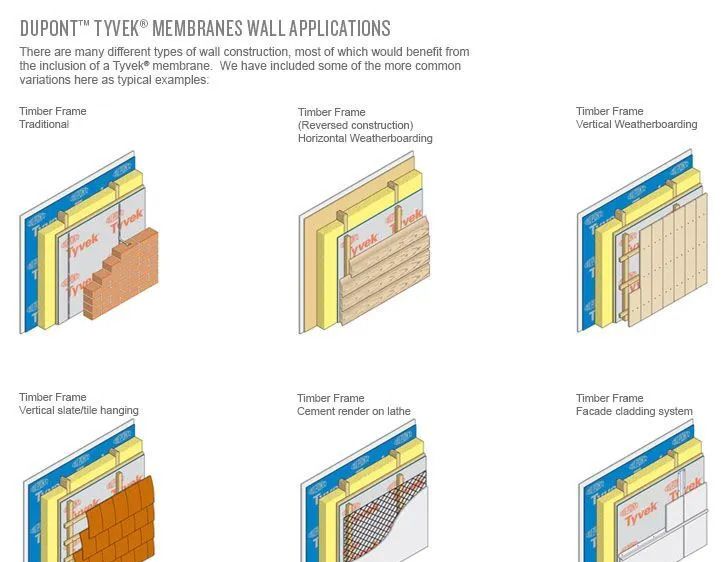
Housewrap — the rolled synthetic sheeting most people picture when they think of a WRB — gets fastened directly to the sheathing in horizontal courses, lapped shingle-style so water sheds downward, then taped at the seams and around every window and door flange. It's the product installed behind the vast majority of fiber cement, vinyl, and wood lap siding going up in Whatcom County right now, and for good reason: it's inexpensive relative to liquid systems, crews here already know its quirks, and a competent install goes up fast even between rain windows.
The catch is that housewrap's performance lives and dies by the details. Every fastener puncture, every seam, every rough opening is a place water can find its way in if the tape fails or the laps run the wrong direction. In a climate where the sheathing behind the siding stays damp for months at a stretch, a sloppy housewrap job doesn't announce itself right away — it shows up two or three years later as soft trim boards or a musty smell in an exterior wall. Left exposed to sun and weather too long before siding goes on (which happens more than it should during a wet Whatcom County build schedule), some housewraps also start to degrade at the seams before they're ever covered. None of that is a reason to avoid housewrap — it's a reason to insist on a rainscreen gap behind the siding and taped, shingled laps rather than a "fold it around the corner and staple it" approach.
A liquid-applied WRB is a fluid membrane — rolled, brushed, or sprayed directly onto the sheathing — that cures into a single continuous barrier with no seams and no tape joints to fail. Because it's monolithic, it handles the odd geometry of a home with multiple roof pitches, dormers, and tie-ins far better than sheet goods, which is a real consideration on the custom homes going up around Sudden Valley and in the newer Lynden and Ferndale developments. It also self-seals reasonably well around fasteners driven through it later for furring strips or siding attachment, which reduces one of housewrap's weak points.
Where it earns its keep in this county is on elevations that take a direct hit from wind-driven rain — waterfront and near-waterfront lots in Blaine, Birch Bay, and Semiahmoo, or exposed upper-story walls anywhere the wind comes straight off Bellingham Bay. It also simplifies sequencing on projects adding continuous exterior rigid foam to hit Washington State Energy Code requirements, since the membrane can go on before or integrate with the foam layer without the extra step of taping housewrap seams underneath it.
The tradeoffs are real. Material and labor cost more, application needs a dry substrate and a workable temperature window, which is not a given during Whatcom County's long wet stretches from October through April, and it requires an applicator who's actually trained on that specific product — this isn't a system where a crew that's never used it should be learning on your house. Once it's covered by siding, spot-checking it later is harder than lifting a corner of housewrap, so getting the sheathing prep and application right the first time matters more.
| Mechanically Fastened Housewrap | Liquid-Applied WRB | |
|---|---|---|
| Cost | Lower material cost; widely stocked and installed by most local siding crews, which keeps labor rates competitive | Higher material and labor cost, driven partly by the need for a trained applicator and slower per-square-foot application |
| Lifespan | Typically matches the siding's service life when detailed and taped correctly, but seam and fastener integrity depends entirely on install quality | Generally holds up as long as or longer than housewrap once cured, since there are no seams to fail over time |
| Maintenance | None once covered by siding, but any tear or puncture discovered during a later re-side needs to be patched or re-taped | Essentially none once covered; small punctures can usually be patched with a compatible sealant, though this isn't a common DIY repair |
| Appearance | Not visible once siding is installed; has no effect on the finished look of the home | Not visible once siding is installed; has no effect on the finished look of the home |
For a straightforward re-side or new build in Bellingham, Ferndale, or Lynden with normal wall exposure — meaning no direct waterfront wind exposure and a fairly simple roofline — housewrap with a proper rainscreen gap and shingle-lapped, taped seams is a sound, cost-effective choice. It's a well-understood system, it drains correctly when installed to spec, and it doesn't need a specialty applicator to get right. The persistent rain here doesn't require a fluid membrane on every house; it requires a housewrap job that's actually detailed the way the manufacturer specifies, which is where most of the corner-cutting happens on lower-bid jobs.
Liquid-applied WRB makes more sense once the site or the project adds complexity. A home on the water in Blaine or Birch Bay, or an exposed lot catching wind-driven rain off the Strait, is asking more of the drainage plane than a typical inland Lynden home. So is a house with a complicated roof-to-wall intersection, or a project that's adding continuous rigid foam to meet the prescriptive continuous insulation path in the Washington State Energy Code. In those cases the seamless membrane and better geometry handling are worth the added cost. Freeze-thaw cycling in the foothills toward Mt. Baker doesn't change which WRB holds up better on its own — either product handles freeze-thaw fine once properly installed — but it does raise the stakes on rot if water gets behind the siding at all, since a wall assembly that stays cold and damp longer gives fungus more time to work. That's an argument for getting the installation right, whichever system you pick, more than it's an argument for one product over the other.
Alpine Exteriors walks each home's actual exposure before recommending a system rather than defaulting to one product across the board. On a re-side, that includes pulling back existing siding to check the sheathing for rot before deciding what goes over it — no WRB, however good, fixes framing that's already wet.
It doesn't strictly require one to meet code, but a rainscreen gap — furring strips that hold the siding off the housewrap and let any water that gets past the siding drain and dry out — makes a real difference in a place where walls can stay damp for days after a storm. Most re-sides in Whatcom County benefit from the gap, especially on fiber cement and wood siding.
No. Moss and algae growth on siding is a surface phenomenon driven by shade, moisture, and the siding material itself — the WRB is behind the siding and has no effect on what grows on the outside of it. Reducing moss and algae comes down to siding choice, gutter and roof overhang design, and periodic cleaning, not the water-resistive barrier underneath.
The energy code doesn't mandate housewrap or liquid-applied membrane by name — it governs things like continuous insulation values and air-sealing performance. Where it matters for this decision is that projects adding continuous exterior rigid foam to hit code often find a liquid-applied membrane simpler to sequence with the foam layer than taping housewrap seams underneath it.
It's technically possible with the right transition detailing where the two systems meet, and some builders do exactly this on a wall that takes unusually direct wind-driven rain while the rest of the home is more sheltered. It adds a detailing step at the transition that has to be done correctly, so it's worth discussing with whoever is installing it rather than assuming any two products will tie in cleanly.
The right WRB for a sheltered street in Lynden isn't automatically the right one for a waterfront lot in Blaine, and the only way to know which fits your house is to look at the actual exposure, the roofline, and the condition of what's already behind your siding. Alpine Exteriors, WA contractor license ALPINI751OW, serves Bellingham, Ferndale, Lynden, Blaine, Birch Bay, Sudden Valley, and the islands, and can walk your home's specific conditions with you before recommending housewrap or a liquid-applied system. Reach out to Alpine Exteriors to schedule a look at your siding and get a recommendation based on your actual wall exposure, not a one-size-fits-all answer.