
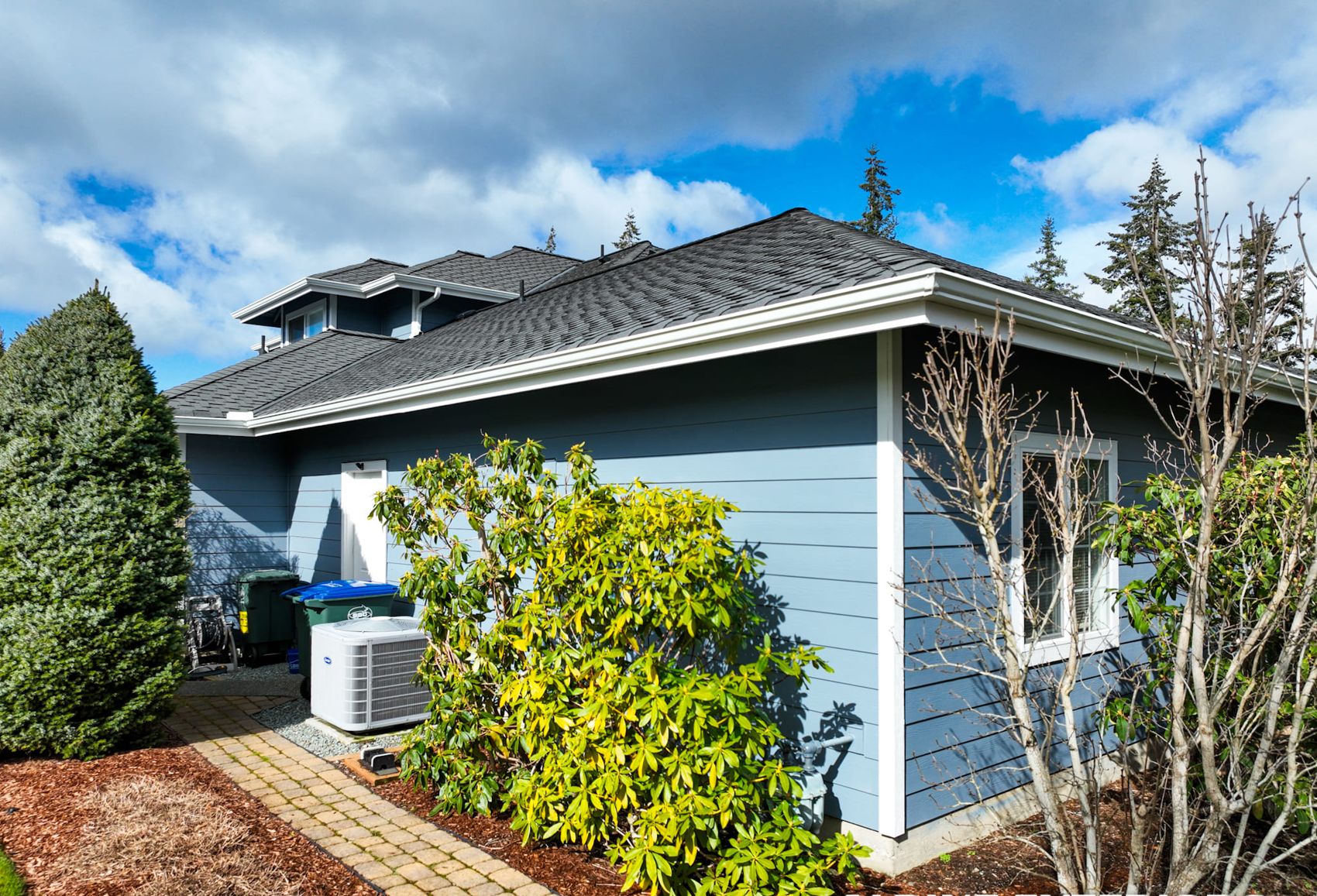
Semiahmoo sits on a narrow spit between Drayton Harbor and Semiahmoo Bay, a few minutes from Blaine and the Canadian border. It is one of the more exposed pockets of Whatcom County — wind off the Strait of Georgia and Boundary Bay pushes rain sideways into siding for a good part of the year, and homes here tend to show moss, algae streaking, and soft trim sooner than homes further inland. If you're pricing James Hardie fiber cement siding for a home in Semiahmoo, or anywhere else in Whatcom County from Bellingham and Ferndale out to Lynden, Birch Bay, or Sudden Valley, the honest answer is that there is no single number that applies to every house. What follows is a realistic range, an explanation of what pushes a project toward the low or high end, and what a trustworthy quote should actually contain. Alpine Exteriors puts these ranges together from the kinds of siding jobs we see across the county, not from a generic national price list.
For a full re-side of an average single-family home in the Semiahmoo area with James Hardie lap or shingle siding, most projects land somewhere in the neighborhood of the mid-teens to the mid-$40,000s, with larger homes, extensive trim work, or significant rot repair pushing higher. That is a wide range on purpose — a single-story rambler with simple lines and sound sheathing is a very different job than a two-story waterfront home with cedar shake accents, deep eaves, and forty-plus years of Whatcom County rain behind the old siding. On a per-square-foot basis, installed James Hardie siding in this region generally runs somewhere in the $9 to $16 per square foot range for straightforward lap siding, with shingle-profile Hardie panels, extensive trim, or ColorPlus prefinishing pushing toward the upper end or beyond. Treat these as planning figures, not a quote — the only way to get a real number is a site visit and a written estimate.
| Cost Factor | Typical Low Impact | Typical High Impact |
|---|---|---|
| Tear-off and disposal of existing siding | Minor add if old siding comes off clean | Significant add if layered over old wood or aluminum siding |
| Sheathing and framing repair from rot | Little to none on well-maintained homes | Can be one of the largest line items on homes with long-neglected wall rot |
| James Hardie panel style | Standard lap siding (HardiePlank) | Shingle profile, board-and-batten, or mixed panel types cost more per square foot |
| Finish: field-painted vs ColorPlus prefinished | Field-painted panels cost less upfront | Factory ColorPlus finish costs more but lasts longer without repainting |
| Trim, corner boards, and fascia detail | Simple ranch-style trim | Craftsman or farmhouse detailing common in Whatcom County adds labor |
| House height and access | Single story, flat or easy-access lot | Two-plus stories, steep Sudden Valley hillside lots, or tight waterfront access |
| Weather-resistive barrier and flashing upgrades | Existing barrier in good condition | Full WRB replacement plus enhanced flashing for wind-driven rain exposure |
The single biggest swing factor we see in Whatcom County isn't the siding material itself — it's what's underneath the old siding once it comes off. Homes in Semiahmoo, Birch Bay, and other wind-exposed shoreline areas take a steady beating from moisture that finds its way behind aging siding, especially around window flashing, butt joints, and anywhere caulking has failed. When our crews pull old siding and find soft or delaminated sheathing, that repair becomes part of the job, and it's not something a fair contractor can quote sight unseen. This is different from, say, coastal Florida pricing where wind rating and impact panels dominate the estimate; here it's rot, moisture intrusion, and years of moss holding water against the wall that drive up the number.
Elevation and terrain matter too. Homes up in Sudden Valley or on sloped lots near Lake Whatcom often deal with freeze-thaw cycling in the winter months that Semiahmoo's milder, wind-driven-rain climate doesn't see as much, and steep-lot access can add scaffolding or staging costs regardless of siding brand. On the water side, in Semiahmoo, Blaine, and Birch Bay, wind-driven rain off the Strait and the bay means we often recommend a heavier-duty weather-resistive barrier and more careful flashing detail at every penetration — vents, hose bibs, light fixtures — which adds labor but meaningfully reduces the odds of another moisture problem in ten years.
The Washington State Energy Code is another factor that's easy to overlook when comparing bids. Depending on your home's existing wall assembly and the compliance path a project uses, re-siding can trigger requirements for continuous insulation or an upgraded water-resistive barrier to meet current code minimums. That's not a cost every homeowner will hit, but on older homes with minimal existing wall insulation, it can add a real line item — and a bid that ignores it isn't necessarily cheaper, it's just incomplete.
A written estimate that's actually usable for comparison should spell out, at minimum: full tear-off and haul-away of existing siding, an allowance or per-sheet price for sheathing repair if rot is found, the specific James Hardie product line and profile (not just "Hardie siding"), whether the finish is factory ColorPlus or field-applied paint, the weather-resistive barrier being installed, flashing details at windows, doors, and penetrations, trim and corner board scope, fastener schedule matching Hardie's published installation requirements for this climate zone, permit handling, and warranty terms covering both the manufacturer's product warranty and Alpine Exteriors' own labor warranty. If a quote is a single lump-sum number with none of that detail, it's hard to know what you're actually buying, and harder still to compare against a competing bid.
The fastest way to get burned on a siding project is to compare two bids that aren't actually pricing the same job. Before putting numbers side by side, check that both contractors are quoting the same Hardie product line and profile, the same finish (ColorPlus versus field paint changes both cost and long-term maintenance), and the same scope around trim, flashing, and any known rot repair. A bid that comes in noticeably lower than the others is worth a second look — it may be skipping sheathing repair, using a lighter fastening pattern than the manufacturer recommends for wind-exposed sites, or leaving out disposal costs that show up later as a change order. It's also worth verifying that any contractor you're considering is properly licensed and insured in Washington; Alpine Exteriors carries WA contractor license ALPINI751OW, and any reputable siding company should be able to provide their license number without hesitation. Ask each contractor to walk you through their line items in person rather than just emailing a total — it's the quickest way to catch scope gaps before they become surprises mid-project.
Most siding contractors, Alpine Exteriors included, can point homeowners toward financing options for larger re-siding projects, whether that's a home equity line, a contractor financing partner, or a promotional plan tied to the material manufacturer. Terms and qualification vary by lender, so it's worth comparing more than one option rather than accepting the first offer presented. On the insurance side, it's important to be realistic: siding replacement driven by ordinary wear — moss buildup, gradual wood rot, sun-faded paint — is maintenance, and homeowner's policies generally don't cover it. Sudden, documented storm or wind damage is a different story and may be partially covered; if you suspect wind damage from a specific storm event, photograph it promptly and loop in your insurance adjuster before work begins so the claim and the repair scope line up.
Most full re-side projects in the Semiahmoo area fall somewhere between the mid-teens and mid-$40,000s depending on home size, trim complexity, and how much sheathing repair is needed once the old siding comes off. Homes with straightforward layouts and sound framing land toward the lower end; larger homes, extensive trim detail, or significant rot repair push the number higher.
For a wind-exposed, high-rainfall area like Semiahmoo and the rest of Whatcom County's coastline, many homeowners find the added upfront cost worthwhile because fiber cement resists moisture-driven warping and holds paint or ColorPlus finish longer than vinyl typically does in this climate. That said, vinyl remains a legitimate lower-cost option for budget-conscious projects, and the right choice depends on your home's exposure, your maintenance preferences, and your budget — it isn't a universal answer either way.
It can. Depending on your home's existing wall assembly, a re-side project may need to meet current Washington State Energy Code requirements for continuous insulation or an upgraded weather-resistive barrier, particularly on older homes that were built to older, less stringent standards. This isn't a cost that applies to every home, but it's worth asking any contractor directly whether their bid already accounts for it.
Timelines vary with home size, weather windows, and how much repair work turns up once tear-off begins, but most single-family re-side projects in this area take roughly a few weeks from start to finish under normal conditions. Persistent rain during the wetter months can extend that timeline, since fiber cement installation and painting both need reasonably dry conditions to go in correctly.
Ranges are useful for planning, but the only way to know what your specific Semiahmoo home will actually cost is a site visit that accounts for your home's current siding condition, trim detail, and exposure to wind-driven rain off the bay. Alpine Exteriors, WA contractor license ALPINI751OW, serves Semiahmoo along with Blaine, Birch Bay, Bellingham, Ferndale, Lynden, Sudden Valley, and the surrounding islands, and can walk your property and put together a written, itemized estimate so you know exactly what you're comparing before you commit.