
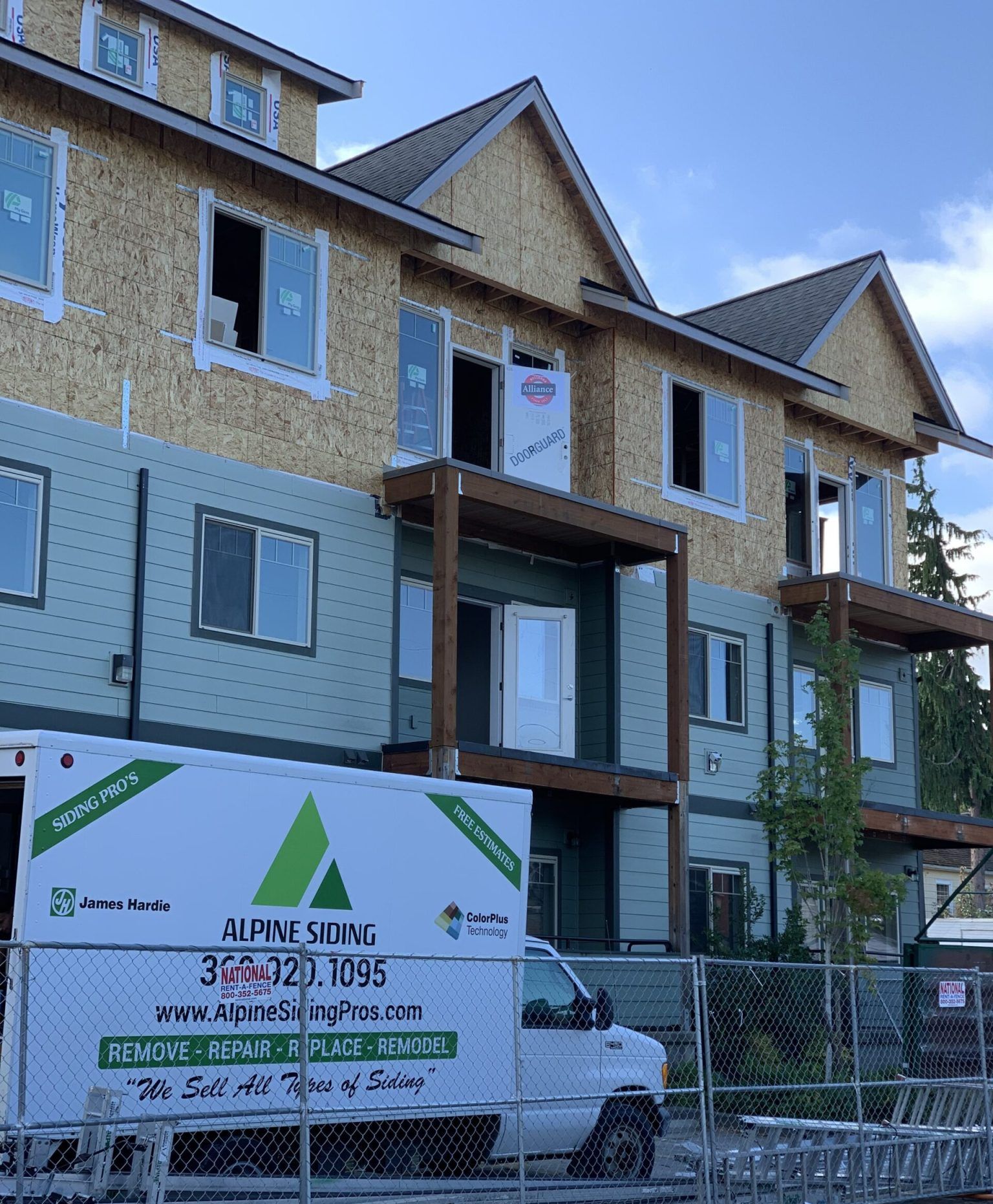
Homeowners in Geneva, the small lakeside community tucked along the north shore of Lake Whatcom between Bellingham and Sudden Valley, ask us some version of the same question almost every week: what does it actually cost to re-side a house here with James Hardie fiber cement siding? The honest answer is that it depends, but not in a way meant to dodge the question. It depends on things that are genuinely different in this part of Washington than they are inland or in a milder climate zone: standing timber and shade that keep walls damp longer, wind-driven rain that comes off Bellingham Bay and the Strait of Georgia at an angle instead of straight down, and freeze-thaw cycles in the foothills around Lake Whatcom that stress siding joints differently than a flat valley floor does. Below are the realistic cost ranges we see across Whatcom County — Geneva, Bellingham, Ferndale, Lynden, Blaine, Birch Bay, Sudden Valley, and the islands — along with the specific things that push a project toward the low end or the high end.
Fiber cement siding installed by a licensed contractor typically runs well above vinyl and below full masonry or high-end natural wood siding once you account for material, tear-off, moisture detailing, and labor. In Whatcom County, most full-house James Hardie projects land somewhere in a broad middle range per square foot of wall area, with the final number shaped far more by what's underneath the old siding than by the Hardie product line itself. A straightforward single-story rambler in Ferndale with sound sheathing and simple wall lines will price out very differently than a two-story Geneva home on a lake-view lot with dormers, extensive trim, and rot hiding behind decades-old cedar. Because every house carries a different mix of these variables, treat any number you see online — including the ranges below — as a starting point for a conversation with a contractor who has actually looked at your walls, not a quote.
| Cost Factor | Lower End Driver | Higher End Driver |
|---|---|---|
| Siding product & profile | Standard lap siding, field-painted | ColorPlus prefinished panels, shakes, or board-and-batten in mixed profiles |
| Tear-off & disposal | Single layer of existing siding, easy access | Multiple layers, older painted materials, or difficult disposal access on tight lots |
| Sheathing & rot repair | Dry walls, sheathing intact | Water-damaged sheathing or framing found at windows, decks, and roof-wall intersections |
| Weather barrier & rainscreen | Standard housewrap installation | Full rainscreen furring system for west- and south-facing exposures |
| Trim & architectural detail | Simple rectangular footprint, minimal trim | Dormers, bay windows, multiple gables, extensive corner and frieze trim |
| Home size & stories | Single story, smaller footprint | Two-plus stories, steep roof pitches requiring extra staging |
| Site access | Level driveway access, mainland delivery | Waterfront or steep-slope lots, island properties requiring ferry-scheduled deliveries |
| Permits & jurisdiction | Unincorporated Whatcom County standard permit | City of Bellingham or shoreline-adjacent permitting with added review |
| Season & scheduling | Booked during the drier summer/early fall window | Rush jobs or work squeezed into the wet season requiring extra weather protection |
The single biggest swing factor we see on Whatcom County homes isn't the siding itself — it's what the crew finds once the old siding comes off. This is a wet climate with a lot of tree cover, and houses that have gone two or three decades without a full siding replacement very often have some degree of hidden moisture damage at window sills, deck ledger connections, chimney chases, and anywhere trim meets a roofline. Sudden Valley and the lakefront stretches around Geneva see this especially often because of the shade and humidity off the lake keeping wall assemblies damp for longer stretches of the year. When a crew opens up a wall and finds soft sheathing or rotted framing, that's additional carpentry work that a clean-walled house simply doesn't need, and it's the main reason two houses of similar size can land at very different final invoices.
Wind-driven rain off Bellingham Bay and the Strait is the second major factor, and it mostly shows up in how much rainscreen and flashing detail a wall needs rather than in the siding material itself. West- and southwest-facing walls in Blaine, Birch Bay, and the more exposed parts of Ferndale take rain at an angle during winter storms, which means proper kick-out flashing at roof-wall intersections, correctly lapped weather-resistive barrier, and in many cases a furred-out rainscreen gap behind the Hardie panels to let any incidental moisture drain and dry. Skipping this detailing to save money up front is exactly how homes end up with premature rot behind brand-new siding, so it's worth paying for even though it doesn't show up as a line item most homeowners think to ask about.
Moss and algae growth is a lower-cost but still real consideration. Constant moisture and shaded north- and east-facing walls around the lake and in wooded lots let algae take hold on siding faster than it would on a sunny, open lot. James Hardie's factory-applied ColorPlus finish is formulated to resist this better than field-applied paint, and while it costs more up front than standard paint-grade siding, it also tends to hold its look longer in our climate, which is worth factoring into the total cost of ownership rather than just the install-day price.
Foothill freeze-thaw cycling, more common on the higher lots around Lake Whatcom and toward the Cascade foothills than down at sea level in Blaine or on the islands, adds stress to caulked joints and fastener lines over time. It doesn't change the up-front installation cost much, but it's a reason correct fastening per the manufacturer's requirements for the exposure category matters more here than it might in a milder inland climate — cutting corners on fastener spacing or type is a false savings that shows up as callbacks a few winters later.
Finally, straightforward logistics affect price. Island properties and some of the more remote parts of the county add cost simply because materials have to be scheduled around ferry service and crews spend more time in transit than they do on a mainland Bellingham or Lynden job. Permit requirements also vary by jurisdiction — unincorporated Whatcom County, the City of Bellingham, and smaller incorporated towns each have their own permitting process and fee schedule, and shoreline-adjacent parcels near Lake Whatcom or the bay can trigger additional review.
A complete, comparable James Hardie quote should spell out more than just "siding installation." At minimum, look for these line items or clearly stated inclusions:
If a bid is missing several of these, it's not necessarily a bad contractor, but it is a bid you can't fairly compare to one that spells everything out — you're not comparing the same scope of work.
The lowest number on paper is not automatically the best value, especially in a climate where hidden moisture problems are common. When you're lining up bids, check that each contractor is quoting the same Hardie product line and finish, not a mix of ColorPlus on one bid and field-paint on another. Ask each contractor directly how they handle sheathing repair if it's discovered mid-project — a fixed allowance, a time-and-materials add, or a full stop for a change order — because this is where budgets most often go sideways after the walls are opened. Ask specifically how they'll detail west- and south-facing walls for wind-driven rain, since a bid that's silent on rainscreen or flashing detail may be pricing a bare-minimum installation that looks the same on day one but performs very differently five winters from now.
Confirm licensing, bonding, and insurance for any contractor you're considering, and don't be shy about asking to see the license number. Alpine Exteriors is licensed in Washington under contractor license ALPINI751OW, and any legitimate siding contractor working in Whatcom County should be able to produce their own license number just as readily. Get at least two or three bids in writing, ask each contractor to walk the exterior with you and point out anything they're concerned about before demolition starts, and be wary of any quote that seems dramatically lower than the others without a clear explanation of what's being left out.
Most homeowners pay for a full siding replacement through some combination of savings, a home equity line of credit, or a financing plan offered through the contractor or a third-party lender — ask any contractor you're vetting what financing partners they work with and what the actual terms are before signing anything. Homeowners insurance in Washington generally does not cover siding replacement driven by gradual wear, moisture intrusion, or rot that develops over years, since those are treated as maintenance issues rather than sudden covered losses; coverage is more likely to apply if damage results from a specific, sudden event like a wind storm or falling tree. If you suspect storm damage contributed to what a contractor finds during tear-off, document it with photos before work begins and check with your insurer separately.
On the code and efficiency side, any full siding replacement in Whatcom County is a good opportunity to review your wall assembly's compliance with the Washington State Energy Code, particularly around continuous insulation and air-sealing requirements that may apply depending on your project's scope. It's also worth checking with your electric utility for any current rebate programs tied to building envelope improvements completed alongside a siding project — availability and terms change, so treat this as a "worth asking" item rather than a guaranteed discount.
Fiber cement is a heavier, denser material that requires more labor to cut, fasten, and finish than vinyl, and it typically involves more careful flashing and moisture-barrier detailing to perform well in a wet climate. That added labor and detailing, not just the material cost itself, is what accounts for most of the price difference. In exchange, fiber cement generally holds paint and resists moss, algae, and moisture damage better over time than vinyl does in our climate, which is a factor worth weighing against the higher upfront cost.
Fiber cement doesn't rot the way solid wood siding can, and it handles constant damp shade — common around Lake Whatcom and Geneva specifically — without the ongoing repainting and rot-repair cycle that older wood siding often requires here. That said, it isn't maintenance-free: caulked joints, trim connections, and the finish itself still need periodic inspection, and poor installation detailing can undermine those advantages regardless of how good the siding material is.
It depends entirely on the condition of your existing walls, which usually can't be fully assessed until the old siding comes off. Homes with a history of moisture intrusion at windows, decks, or roof-wall intersections are more likely to need some framing or sheathing repair, and this is genuinely one of the largest variables in final project cost. Ask your contractor for a clear process — ideally a stated allowance or unit pricing — for handling repairs discovered mid-project so you're not negotiating pricing after demolition has already started.
Timelines vary with home size and how much repair work is needed, but weather is a real scheduling factor here — persistent rain during the wetter months can slow or pause exterior work, and reputable contractors will protect open wall sections rather than push through active rain. Many homeowners and contractors prefer to schedule larger siding projects during the drier summer and early fall stretch for this reason, though work can and does happen outside that window with proper weather protection in place.
Every one of the ranges above is a starting point, not a quote — the only way to know what your specific project will cost is to have someone look at your walls, your trim, and your access. Alpine Exteriors serves Geneva, Bellingham, Ferndale, Lynden, Blaine, Birch Bay, Sudden Valley, and the surrounding islands, and we're glad to walk your exterior, point out what we see, and put together a detailed, itemized James Hardie siding estimate so you know exactly what you're paying for before any work begins. Reach out to schedule an on-site assessment.