
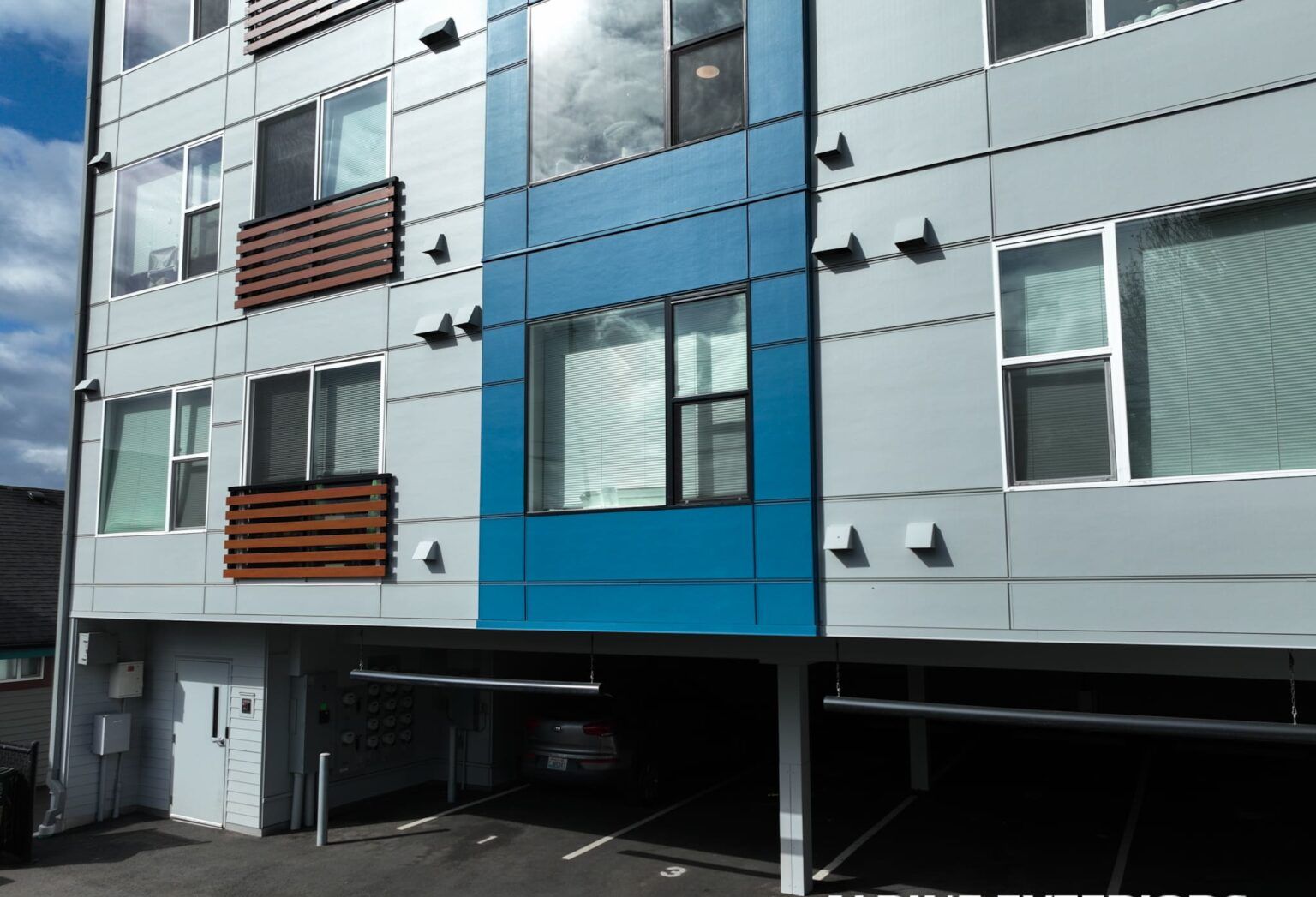
York is one of Bellingham's older in-town neighborhoods — a mix of craftsman bungalows, mid-century remodels, and newer infill sitting close enough to Bellingham Bay that wind-driven rain off the water is a real design factor, not a hypothetical one. If you're pricing James Hardie fiber cement siding for a York home, the honest answer is that there isn't a single number that applies to every house. There's a realistic range, a set of factors that push a project toward the low or high end of it, and a handful of things worth understanding before you sign anything. This page walks through all of it in plain terms, without pretending to know your exact price before anyone has measured your walls.
For a typical single-family home in the York area — roughly 1,800 to 2,600 square feet of exterior wall — a full James Hardie siding replacement generally lands somewhere in the broad range of $9 to $18 per square foot of siding installed, once you count material, tear-off, house wrap, trim, and labor together. On a home that size, that usually works out to a total project in the low-to-mid five figures on the inexpensive end, and well into the $30,000–$45,000+ range on a home with steep gables, multiple stories, or extensive trim and dormer work. Those numbers are planning ranges, not a quote — the only way to get an actual figure is an in-person inspection, because so much of the cost is hidden until a crew is already tearing into the wall.
What narrows that range for your specific house comes down to a short list of variables: how much of the existing wall assembly is sound versus rotted, how complicated the roofline and trim detailing are, which James Hardie product line you choose, whether you want the factory ColorPlus finish or field-applied paint, and how accessible the lots are around your home. A York lot backed up against a neighbor's fence or a mature tree line can genuinely add labor time versus a house with open access on all four sides — staging materials on tight lots takes longer and sometimes requires smaller loads carried by hand instead of by cart.
| Cost Factor | Typical Low End | Typical High End |
|---|---|---|
| Tear-off and disposal of old siding | Minor factor on sound walls | Significant if multiple layers or hidden damage |
| House wrap / water-resistive barrier | Standard single-layer wrap | Full rainscreen furring per energy code detailing |
| James Hardie product line | HardiePlank lap siding, standard profile | HardieShingle or HardiePanel with vertical/board-and-batten detailing |
| Finish | Field-painted after install | Factory ColorPlus finish, wider color selection |
| Trim and fascia | Reuse of sound existing trim | Full trim, corner board, and fascia replacement |
| Roofline complexity | Simple gable, one or two stories | Multiple gables, dormers, cut-up rooflines |
| Wall repair scope found during tear-off | None — sheathing sound | Rotted sheathing, framing repair, moisture-damaged studs |
| Site access | Open lot, easy staging | Tight lots, limited equipment access, hand-carry required |
| Permits and code compliance | Standard Whatcom County permit | Additional review for complex or historic-adjacent assemblies |
A siding decision made in the Nooksack valley or up toward Sumas doesn't carry the same stakes as one made a few blocks from Bellingham Bay. York sits close enough to open water that homes take direct exposure to salt-laden air and storms that come in off the Strait of Georgia with real force behind them. Inland Whatcom County homes deal with plenty of rain too, but they aren't taking the same sustained wind-driven rain loading on their west- and south-facing walls, and they don't sit in quite the same salt air envelope. That combination is exactly the scenario fiber cement was engineered to outperform wood and vinyl in, which is part of why it shows up so often in siding estimates for this part of the county.
Understanding cost means understanding what the Pacific Northwest actually does to an exterior wall assembly over time. Whatcom County doesn't get hurricanes or hard freezes at sea level, but it gets something arguably harder on siding over the long run: months of low-intensity, near-constant moisture. Wood siding and trim that isn't perfectly maintained starts to hold moisture against the wall, and once that happens, rot follows — often quietly, behind the siding, where you don't see it until a contractor pulls the old boards off. That's the scenario behind almost every "we found more than expected" conversation on a tear-off, and it's the single biggest wildcard in any siding estimate.
Homes closer to the water take driving rain at an angle during winter storms, which pushes moisture into laps, corners, and butt joints that a garden-variety product might not be detailed to handle. Salt air also accelerates corrosion on fasteners and metal flashing that isn't rated for it. None of this makes a York home impossible to side well — it just means the assembly has to be built correctly the first time, because this climate doesn't forgive shortcuts the way a drier region might.
Whatcom County's moss and algae season is basically most of the year. Shaded, north-facing walls under mature trees — common throughout York's older lots — stay damp longer after every rain, and that's exactly where moss and algae take hold on wood and some composite products. It's cosmetic at first, but sustained moss growth holds moisture against a wall surface long after the rain has stopped, which is one more reason product choice matters more here than it would in a drier inland town.
James Hardie fiber cement siding holds up to this climate for a straightforward reason: it's a cement-based product, not an organic one, so it doesn't feed rot fungi or absorb water the way solid wood siding does. It resists moss and algae better than most wood products, holds paint or factory finish for years longer than wood typically does between repaints, and doesn't warp or check the way wood can after repeated wet-dry cycles. It isn't magic — it still has to be installed with the correct clearances, flashing, and fastening to actually deliver on that durability — but as a product line, it's a good match for what a York wall has to survive every winter.
It's also worth being honest about the trade-offs. Fiber cement is heavier than vinyl, costs more upfront in most cases, and requires specialized blades and dust control to cut, which is part of why installer experience matters. It's not a product that forgives an inexperienced crew the way vinyl sometimes does — done wrong, you can trap moisture behind it just as easily as behind any other siding.
A siding job is a water-management system before it's a color choice. What separates a quote that protects your home for decades from one that looks fine for a year or two comes down to details most homeowners never see once the job is finished.
Manufacturer spec calls for specific clearances between the bottom edge of the siding and the ground, roofline, decks, and any hardscaping — gaps that exist so water has somewhere to go instead of wicking up into the board. It also calls for correct flashing at every window, door, and roof-to-wall intersection, and a continuous water-resistive barrier behind the siding itself. Skipping or shortcutting these details is one of the most common ways a siding job fails early, and it's invisible from the street until a problem shows up on the inside of a wall.
James Hardie siding has to be fastened at specific spacing and depth to perform as designed — over-driven or under-driven fasteners are a known cause of premature failure. Butt joints and corners need to be detailed to shed water rather than collect it, and any siding installed in this climate benefits from joint treatment that accounts for the amount of driving rain a wall will see over its lifetime. This is the kind of thing that separates a correctly installed wall from one that merely looks correct at final walkthrough.
Beyond the baseline factors in the table above, a handful of things tend to swing an estimate the most in practice:
A complete siding proposal for a project that involves fiber cement replacement should spell out, at minimum: full tear-off and disposal of the existing siding, the specific James Hardie product line and profile, house wrap or water-resistive barrier replacement, flashing details at penetrations, trim and fascia scope, fastening specification, finish (factory ColorPlus or field paint, with color), permit responsibility, an allowance or process for repair scope discovered during tear-off, cleanup, and warranty terms in writing. If a bid is missing several of these, it's worth asking why before comparing it on price alone — a lower number that leaves out flashing detail or a wall-repair allowance isn't actually a lower price, it's an incomplete one.
The most useful thing you can do with two or three bids is line them up item by item rather than total to total. Confirm each bid names the same product line and profile — a quote for standard lap siding isn't comparable to one that includes shingle accents or a rainscreen assembly. Check whether each contractor is quoting factory finish or field paint, since that alone can shift a number meaningfully. Ask each bidder directly how they handle repair scope found during tear-off: some build in an allowance, others simply stop and requote, and it matters which one you're dealing with before the job starts. Finally, verify licensing and insurance independently rather than taking a business card's word for it — Washington's Department of Labor & Industries maintains a public contractor lookup, and it takes a few minutes to confirm a license is active and bonded.
Most established siding contractors either offer financing directly through a third-party lender or can point you toward options, and it's reasonable to ask about terms, interest structure, and any early-payoff penalties before committing. On the insurance side, a few things are worth knowing going in: homeowner's insurance in Whatcom County generally covers sudden, accidental damage (a storm-blown branch through a wall, for instance) but does not typically cover gradual deterioration from long-term moisture exposure or maintenance neglect — which is exactly the kind of damage this climate tends to produce over years of driving rain and moss growth. That's a strong argument for addressing failing siding proactively rather than waiting for a covered event. Separately, confirm that any contractor you're considering carries active general liability insurance and is registered with L&I — a legitimate, insured contractor will produce proof of both without hesitation. New siding installed to current Washington State Energy Code detailing, with continuous insulation and a properly furred rainscreen where called for, also tends to perform better in this climate than an older wall assembly built to a prior code cycle.
In most cases, yes. James Hardie offers several profiles — traditional lap, shingle-style, vertical panel, and board-and-batten — plus a range of factory ColorPlus finishes and trim options, which gives enough flexibility to match or reasonably approximate the character of most York homes, from older craftsman bungalows to newer builds. On a home with unusual existing detailing, we'll walk through profile and trim options during the inspection so you can see how close a match is realistic before committing to a direction.
Yes — James Hardie backs its siding products with a manufacturer's product warranty, and factory ColorPlus finishes carry a separate finish warranty that's typically longer than what field-applied paint can offer. On top of the manufacturer coverage, Alpine Exteriors stands behind our own installation workmanship, since a warranty on the material doesn't mean much if the installation itself is the point of failure. We'll go over exactly what's covered, by whom, and for how long, in writing, before work starts.
Yes. Alpine Exteriors holds Washington state contractor license ALPINI751OW and carries general liability insurance. We'd encourage you to verify this independently through the Washington L&I contractor lookup rather than taking our word for it — it's a quick check and it's exactly what we'd recommend before hiring anyone for exterior work.
Scheduling depends on the season — spring and summer tend to book out further in advance across Whatcom County — but we can usually get an inspection on the calendar within a reasonable window and will give you a straight answer on timing when you reach out. An in-person look at your walls, trim, and roofline is the only way to move from a general cost range to numbers specific to your house.
Cost ranges are a useful starting point, but they can't account for what's actually happening behind your siding or how your roofline is put together. Alpine Exteriors serves York, Bellingham, and the rest of Whatcom County — Ferndale, Lynden, Blaine, Birch Bay, Sudden Valley, and the islands — and we're happy to walk your property, point out anything we see (good or bad), and put together a written estimate that reflects your actual house rather than a generic average. If you're weighing James Hardie siding for a York home, reach out and we'll get an inspection scheduled.