
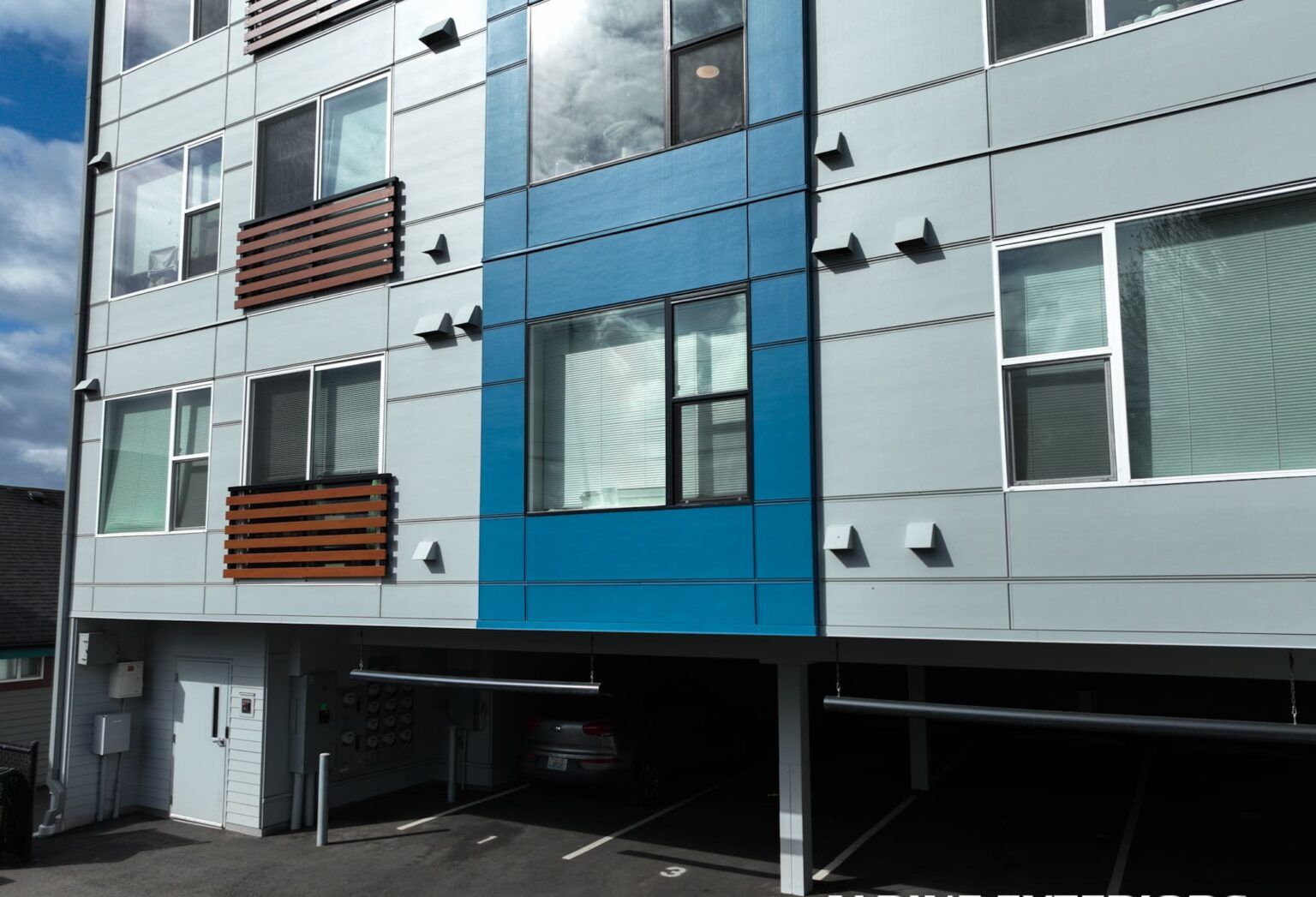
If a storm just came through Alabama Hill and your siding looks worse for it — streaking, a panel that's come loose, a soft spot near the bottom of a wall — the damage is almost always wind-driven rain finding a gap that was already there, not the wind itself tearing the wall apart. What the storm usually does is push water sideways into a seam, a nail hole, or a piece of failed caulking that had been letting moisture in slowly for a while, and then a few days later you notice the result.
That distinction is worth understanding before you call anyone, because it changes both the repair and, if you're filing a claim, what your insurer is going to ask you. A single wind event that cracks or blows off a panel is a different animal than years of moisture sitting behind siding that finally shows up as rot. Both happen in this part of Whatcom County. Knowing which one you're looking at is the first real step.
Whatcom County doesn't get the kind of storms that flatten a roof in one afternoon. What it gets instead is a long wet season — roughly October through April — made up of frontal systems that roll in off the Pacific and dump rain over Bellingham for days at a stretch, sometimes with sustained wind and gusts attached, sometimes just steady drizzle that never really stops. That pattern is harder on siding than a single violent storm, because it's not about impact, it's about exposure time. Water gets more chances to find its way past a lap joint, a corner trim piece, or a window flashing that's slightly out of alignment.
On a house with sound siding and intact caulking, that's not a problem — the assembly is built to shed water, and a few wet months a year is exactly what it's designed for. The trouble shows up on homes where something was already compromised: a caulk joint that dried out and cracked, a nail that backed out and left a gap, a spot where the paint film failed and the substrate underneath started absorbing water directly. Once water gets behind the siding, it doesn't dry out quickly in a climate this damp, and that's when you get rot, especially in older cedar and hardboard siding, which make up a lot of the housing stock on Alabama Hill and in the surrounding Bellingham neighborhoods.
Wind adds a second layer to this. Alabama Hill sits up on a ridge in central Bellingham with a lot of homes oriented to take advantage of views out toward Bellingham Bay and the Strait of Georgia, which is nice for the view and less nice for the siding, because that same open exposure means storms coming off the water hit those walls with more force than they'd hit a house tucked into a valley or shielded by trees. During a strong frontal passage, rain doesn't just fall — it's driven horizontally into gable ends, corners, and any wall facing west or southwest. That's the setup that turns a small existing gap into an active leak, and it's why two houses a few blocks apart, one exposed to the bay and one sheltered by a hill or a stand of trees, can have very different siding conditions after the same storm.
A few things about Whatcom County's climate and Alabama Hill's specific setting change how siding fails here compared to drier or more sheltered parts of the state.
Persistent rain over intensity. This isn't a region where you design for a single extreme event. The stress comes from months of sustained moisture exposure, which is why maintenance items that seem minor elsewhere — a cracked bead of caulk, a slightly separated trim joint — become real entry points here. A gap that might dry out fine in a drier climate just stays wet in Whatcom County until something rots.
Moss and algae. Bellingham's tree cover, marine humidity, and shaded lots mean north- and east-facing walls, and anything near overhanging branches, tend to grow moss and algae over time. This is mostly cosmetic on vinyl, but on cedar and fiber cement it's more than cosmetic — moss holds moisture against the surface longer than bare siding would, and if it gets into a seam or a butt joint, it can act almost like a wedge, gradually working the joint open. A storm can knock loose a section of siding that moss had already been undermining for a year or two.
Wood rot in older siding. A lot of the homes around Alabama Hill were built with cedar lap siding or the hardboard composite siding that was common in the 1980s and 90s, both of which are vulnerable to rot once water gets behind or into them repeatedly. Rot doesn't announce itself right away — by the time you can see soft, dark, or crumbling wood, or paint that's bubbling and flaking in a localized spot, moisture has usually been working on that area for a while. Storms tend to be the thing that finally pushes a marginal spot into visible failure.
Wind-driven rain off the bay. As covered above, Alabama Hill's elevation and orientation toward Bellingham Bay and the Strait mean wind-driven rain is a real factor here in a way it isn't for more sheltered inland lots. This isn't hurricane-force wind — it's the kind of sustained 30-50 mph gusts that come with a strong Pacific frontal system — but combined with heavy rain, it's enough to work water into vertical seams and around window and door trim that would stay dry in a calmer wind pattern.
Freeze-thaw, more at elevation than right on the hill. Alabama Hill itself doesn't see the hard freeze-thaw cycling that higher, colder pockets of the county do — areas like Sudden Valley and the foothills toward the North Cascades get more of that. But Bellingham does get occasional cold snaps and freezing rain, and when temperatures swing through freezing on siding that already has a crack or a gap holding water, that water can expand and widen the crack. It's a smaller factor here than it is further up the valley, but it's part of why a minor crack left alone over a winter tends to be a bigger crack by spring.
The Washington State Energy Code. This one isn't a weather factor, but it matters anytime storm damage is bad enough to require replacing a section of siding rather than just patching it. Under the Washington State Energy Code, work that opens up a wall assembly is an opportunity — and in some cases a requirement — to bring the assembly closer to current standards for the weather-resistive barrier and insulation continuity. A lot of older Alabama Hill homes were built before these requirements existed, so a storm repair can end up being the practical moment to add a proper house wrap or address a insulation gap that's been there since construction, rather than just putting new siding back over the same conditions that let the water in the first time.
After a storm, don't wait for a problem to get obviously bad before you look. A walk around the exterior the next dry day you get is worth it. Specifically:
Photograph everything you find, with a date, before any repair work starts. This matters more than people expect if you end up filing an insurance claim. Homeowner's policies in Washington generally do cover sudden, accidental damage from wind — a panel torn off in a specific storm, for example — but they typically exclude damage from gradual deterioration, which includes long-term rot, moss damage, or a leak that's clearly been going on for a long time before the storm. Adjusters are looking for that distinction, and the more documentation you have showing the damage appeared or worsened at a specific point in time, the stronger your position. If the damage is really a years-old moisture problem that a storm just exposed, it's worth knowing that going in rather than being surprised when a claim gets denied.
Either way, get a written estimate from a licensed contractor before you sign anything with an insurer. A good estimate should separate what's storm-related from what's pre-existing wear, since that's exactly the line an adjuster is going to draw. Alpine Exteriors does these inspections regularly for homes around Alabama Hill and the rest of Whatcom County and can put together documentation that holds up whether you're filing a claim or just deciding whether to repair a section now or wait.
It depends on the cause. Most standard homeowner's policies cover sudden, accidental wind damage — a section of siding physically torn loose or cracked during a specific storm — but they exclude damage attributed to gradual deterioration, deferred maintenance, or long-term rot and moisture intrusion. Because Whatcom County's climate produces a lot of the second kind of damage, it's common for an adjuster to determine that what looks like storm damage is actually a pre-existing moisture problem the storm just made visible, which would not be covered. Reading your specific policy's wind and water damage language, and documenting the timeline with photos, matters a lot here.
Fresh storm damage tends to look mechanical — a panel physically cracked, bent, or pulled away from its fasteners, often with clean breaks. Long-term rot looks different: soft or crumbling wood, dark staining that's clearly been building for a while, paint that's been peeling in the same spot for more than one season, or moss that's established enough to have a real root structure. If you're not sure which you're looking at, a contractor who does this kind of inspection regularly can usually tell fairly quickly by probing the affected area, and that assessment is useful whether or not you end up filing a claim.
Straightforward like-for-like siding repair or replacement generally does not require a permit, but the answer changes if the repair involves structural work, a significant portion of the exterior wall, or triggers Washington State Energy Code requirements for the weather-resistive barrier and insulation when a wall assembly is opened up. The City of Bellingham and Whatcom County have their own permitting jurisdictions depending on where the property sits, so it's worth confirming with the relevant building department, or having your contractor confirm it, before larger repair work starts.
There isn't one material that's immune to this climate — moisture management in the installation matters as much as the product itself. That said, fiber cement and properly maintained vinyl generally hold up better against sustained wet exposure than untreated wood or older hardboard composite siding, which are more prone to rot once water gets in. Whatever material you choose, the details that actually determine how it performs on an exposed lot like Alabama Hill are the flashing, the weather-resistive barrier behind it, and how well seams and joints are sealed — a premium material installed with weak flashing will still fail, and a modest material installed correctly will often outlast it.
If you're looking at siding damage on Alabama Hill after a storm and aren't sure whether it's a quick repair, a bigger moisture problem, or something worth filing a claim over, get an inspection before you make that call either way. Alpine Exteriors is licensed in Washington (contractor license ALPINI751OW) and works throughout Whatcom County, including Bellingham, Ferndale, Lynden, Blaine, Birch Bay, Sudden Valley, and the islands, and can walk your property, document what's actually going on, and give you a straight answer about what's storm-related, what isn't, and what it will take to fix it properly for this climate.