
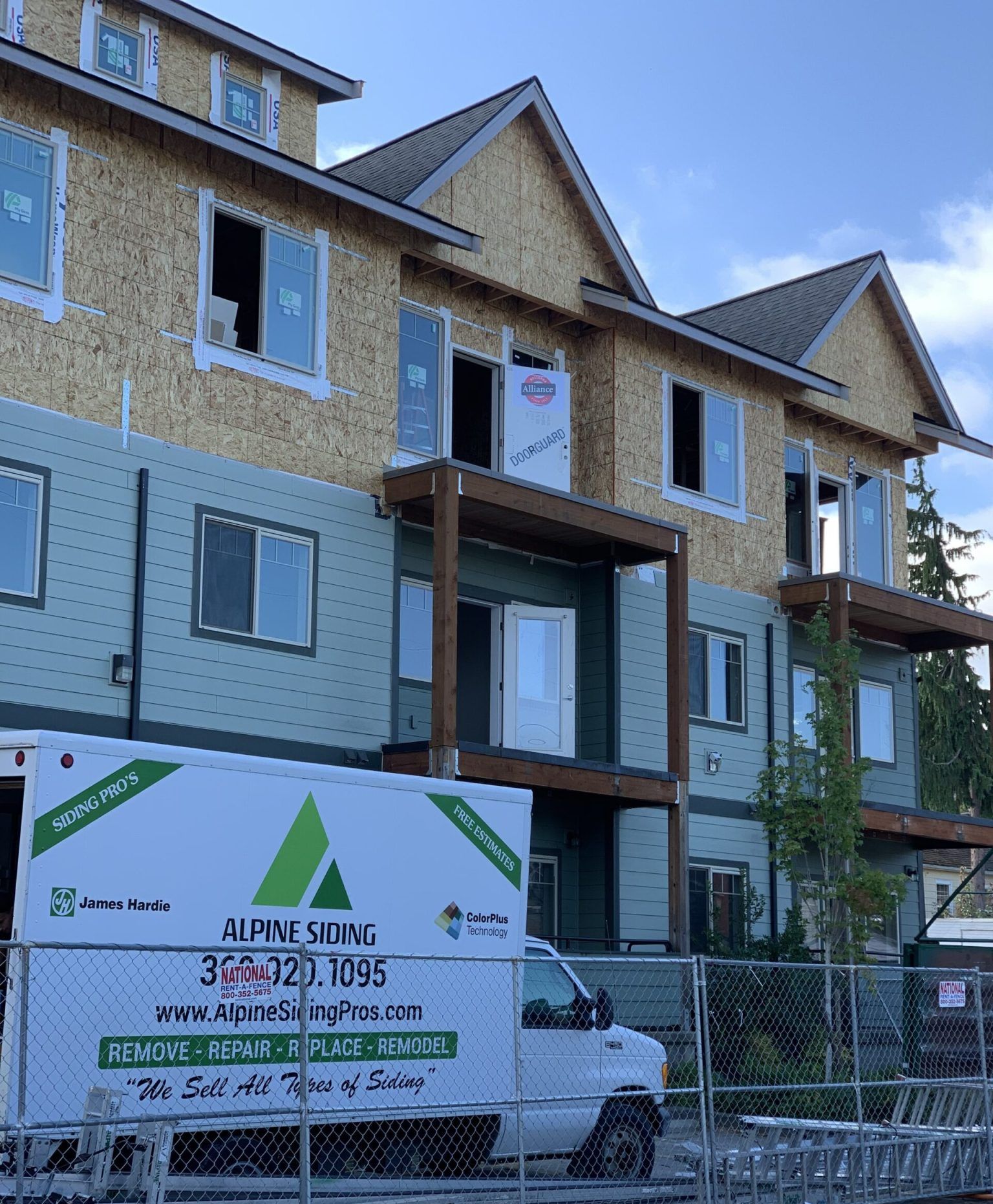
After a windstorm rolls through Fairhaven off Bellingham Bay, walk the full perimeter of your home and look closely at whichever wall faces southwest, since that's almost always where wind-driven rain and flying debris do the most work. If you spot cracked, lifted, or missing siding, photograph it right away, tarp any exposed sheathing before the next rain arrives, and get a licensed local contractor's assessment before you file a claim, not after.
Fairhaven sits right on the water, which means storms don't just bring rain the way they might a few miles inland in, say, Lynden or Everson. They bring rain that's being pushed sideways by wind funneling up the Strait of Georgia and across Bellingham Bay. Lap siding, board-and-batten, and fiber cement panels are engineered to shed water moving downward, not water being forced upward and sideways under the laps by sustained gusts. Over one storm that's rarely a problem. Over a winter of repeated southwesterlies, though, water starts finding its way behind panels, around trim, and into fastener holes that have worked slightly loose.
The damage often isn't dramatic at first. A single course of siding pulls away from the wall by an eighth of an inch. A nail backs out under repeated wind-loading and rocking. A seam that used to be tight now has a hairline gap. None of that looks urgent from the ground, but it's exactly the kind of opening that lets bulk water and wind-driven moisture get behind the water-resistive barrier, where it can sit against the sheathing for days in our climate before anything dries out. That's the real mechanism behind most "storm damage" claims here — it's less about a single violent event snapping boards, and more about wind exploiting small existing weaknesses until water gets somewhere it shouldn't be.
Add in the moss and algae that grow on almost every north- and west-facing wall in this part of Whatcom County, and you've got a second problem layered on top of the first. Moss holds moisture against the siding surface long after a storm passes, which slows drying and, on wood or engineered wood products, accelerates rot at butt joints and anywhere caulking has failed. A contractor inspecting storm damage in Fairhaven is usually looking for two things at once: what the wind and rain did in the last 48 hours, and what months or years of damp, shaded, mossy conditions had already softened up before that storm ever arrived.

A few things separate storm-related siding failure in Fairhaven and the rest of Whatcom County from what you'd see elsewhere, and they're worth understanding before you decide what's actually wrong with your house.
First, this is not hurricane country, and it's worth saying plainly: nobody in Fairhaven needs to worry about the kind of sustained tropical wind loads that drive building codes in the Gulf or Atlantic coast states. What we deal with instead is frequent, moderate wind combined with near-constant moisture. Whatcom County can go weeks in the fall and winter without a real dry stretch, and that persistent dampness is a bigger long-term threat to siding here than any single storm event.
Second, elevation and exposure vary more than people expect across a fairly small area. A home right along the Fairhaven waterfront or on the bluff above it takes direct wind-driven rain off the Bay. A few miles inland or up toward Sudden Valley, homes are more sheltered from wind but sit at elevations where freeze-thaw cycling becomes a real factor in a way it simply isn't down at sea level. Water that gets behind siding in the foothills and then freezes can expand joints and fastener holes in a way that accelerates cracking, especially in older fiber cement and engineered wood products that have already absorbed some moisture. If you own a place near Lynden, Deming, or the Sudden Valley area, that freeze-thaw stress is worth asking your contractor about specifically — it behaves differently than the wind-driven rain damage typical of Fairhaven and Blaine's waterfront.
Third, a lot of Fairhaven's housing stock is genuinely old — this is a historic neighborhood with homes dating back over a century, alongside newer infill construction. Older homes were often built and re-sided under very different assumptions about drainage planes, house wrap, and rain screens than current practice calls for. When we're assessing storm damage on an older Fairhaven home, we're frequently finding that the storm exposed a gap in the original water management, not that the storm itself was unusually severe.
Once you've done the initial walk-around and taken photos, the sequence matters. Insurance companies, contractors, and your own long-term maintenance budget all respond differently depending on how you handle the first week after a storm.
It's also fair to say plainly: not every case needs a full re-side. Sometimes storm damage is genuinely limited to a handful of panels and some flashing, and a competent repair is the honest recommendation. Other times what looks like storm damage on the surface turns out to be years of moisture and rot that the storm simply made visible, and in those cases a partial repair is a short-term fix that will need to be revisited. A contractor who tells you everything needs replacing without explaining why isn't doing you any favors, and neither is one who patches over rot to save you money today.
Storm damage tends to be localized and directional — you'll see it concentrated on the wall that faced the wind, often as cracked panels, popped fasteners, or sections pulled away from the wall in a line. Ordinary wear, by contrast, shows up as gradual discoloration, moss and algae buildup, or caulk that's shrunk and cracked evenly across a surface over years. In practice the two often overlap, since a storm frequently finishes off siding that was already weakened by long-term moisture exposure, which is part of why a professional inspection is worth getting rather than guessing from the ground.
Often, yes, if the damage is tied to a specific covered wind event and you can document it, but coverage usually excludes damage attributed to gradual deterioration, lack of maintenance, or pre-existing rot. This is why documentation and a contractor's written assessment matter so much here — an adjuster deciding whether your damage was "sudden" or "gradual" is making a judgment call, and clear evidence from the day of the storm strengthens your position considerably.
It's more than cosmetic in our climate. Moss holds moisture against the siding surface, which slows drying after every rain and, over time, can contribute to rot at seams, butt joints, and anywhere caulking has already started to fail. On its own, moss rarely causes structural problems quickly, but it's one of the conditions that turns a moderate storm into a bigger repair than it would otherwise be, because the siding underneath was already staying damp longer than it should.
Fairhaven sits close to sea level right on Bellingham Bay, so freeze-thaw cycling is a smaller factor there than it is for homes at higher elevation, such as up toward Sudden Valley or out toward the foothills near Lynden and Deming. Wind-driven rain off the Bay is the bigger concern for Fairhaven homes. If your property is at a higher elevation or further from the water, it's worth asking your contractor to look specifically at how freeze-thaw cycling may be affecting fastener holes and seams, since that damage mechanism behaves differently than storm-driven water intrusion.
If a recent storm left you unsure whether what you're looking at is a quick repair or something more involved, that's a reasonable thing to want a second opinion on before you spend money either way. Alpine Exteriors is a licensed Washington contractor (license ALPINI751OW) serving Fairhaven, Bellingham, and the rest of Whatcom County, including Ferndale, Lynden, Blaine, Birch Bay, Sudden Valley, and the islands, and we can walk your property, document what the storm actually did, and give you a straightforward assessment of what needs attention now versus what can wait. Reach out to schedule a look at your siding before the next system rolls in off the Strait.