
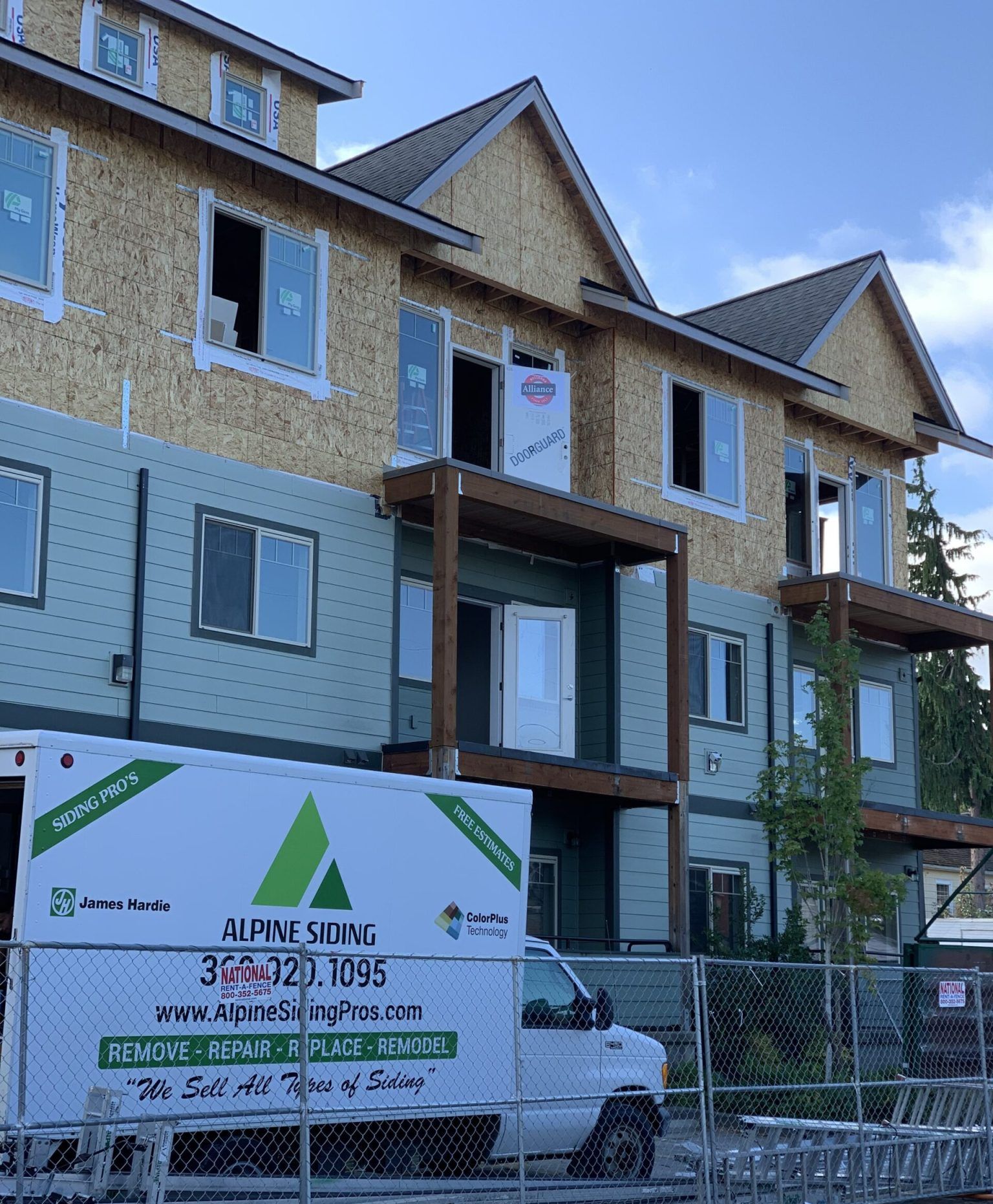
Flashing belongs at every horizontal joint, window and door head, deck ledger, and roof-to-wall transition — anywhere water can collect or run behind the siding. Caulk belongs at vertical trim joints, butt seams between boards, and small gaps where two rigid materials meet and need a flexible, paintable seal. The two aren't competitors; they're teammates, and the mistake we see most often on older Bellingham and Ferndale homes is caulk asked to do a flashing's job — sealing a horizontal seam it was never built to hold against months of driving rain.
In a marine climate like ours, where rain falls sideways off Bellingham Bay and the Strait for days at a stretch, that distinction matters more than it does in drier parts of the state. Get it backwards and you're not looking at a cosmetic problem — you're looking at sheathing rot behind the siding, discovered only when a contractor pulls a board and finds soft, dark wood.
Caulk is a flexible sealant — typically a high-quality exterior-grade polyurethane, silicone, or hybrid sealant — applied in a bead to close a gap and keep it closed as the building moves with temperature and moisture. It's inexpensive, fast to apply, comes in colors to match trim, and it's the right call for the joints it's designed for: where trim boards meet at a corner, where a window casing meets siding on the sides (never the bottom), and where two pieces of fiber cement or wood siding butt together vertically.
Its limits show up fast on a horizontal run. Caulk has no depth — it's a surface seal, not a drainage path. If water gets behind it, and in Whatcom County's wet season it eventually will, there's nowhere for that water to go but into the wall assembly. Caulk also has a service life; even good sealants shrink, crack, and pull away from the substrate within roughly 5 to 10 years, faster on south- and west-facing walls that see the most UV and the most wind-driven rain off the water. Once it's cracked, it's not just ineffective — it can trap moisture behind it, which is worse than having no seal at all. We also see homeowners in Sudden Valley and the foothills lose caulk joints early to freeze-thaw cycling, where repeated winter freezing pulls a bead away from the substrate faster than it would in a milder microclimate.

Flashing is a physical barrier — sheet metal, self-adhered membrane, or rigid vinyl/composite trim — installed to shed water downward and outward, always overlapping the layer below it like shingles on a roof. Done correctly, flashing doesn't rely on an unbroken seal; it relies on gravity and lapped geometry, so a pinhole or minor gap doesn't automatically mean a leak. That's the fundamental advantage over caulk: flashing manages water that gets past the siding face, rather than betting everything on the siding face staying perfectly sealed for years in a climate that gets well over 100 days of measurable rain a year.
Flashing is more labor-intensive to install correctly — it has to be sequenced with the water-resistive barrier and the siding itself, lapped in the right order, and tied into window and door flanges properly. Get the sequence wrong (flashing installed on top of the housewrap instead of under it, for instance) and it can direct water into the wall instead of away from it. That's a workmanship issue, not a materials issue, but it's exactly why flashing details are worth paying attention to on a bid rather than assuming "flashing was installed" means it was installed correctly.
| Factor | Caulk / Sealant | Flashing |
|---|---|---|
| Upfront cost | Low — often a few dollars per linear foot in materials, plus labor for a small crew | Higher — metal or membrane materials plus more installation time and sequencing with the weather barrier |
| Typical lifespan | Roughly 5–10 years before it needs inspection or replacement, shorter on sun- and rain-exposed elevations | 20+ years for properly installed metal flashing; membrane products vary but generally outlast sealants |
| Maintenance | Needs periodic inspection and re-caulking as beads shrink or crack | Largely maintenance-free once installed correctly; occasional check for debris or moss buildup at laps |
| Appearance | Nearly invisible when fresh and color-matched; visibly cracked or yellowed when failing | Visible as a discrete trim line (drip cap, kickout, etc.) unless designed to sit behind the siding face |
For most homes across Bellingham, Ferndale, Lynden, Blaine, Birch Bay, Sudden Valley, and the islands, the honest answer is both, applied to the right joints. Any horizontal transition — above windows and doors, at deck ledgers, at roof-to-wall intersections, above bump-outs and bay windows — needs flashing, full stop. These are the spots where wind-driven rain off the Bay and the Strait gets pushed against the wall, and where a caulk-only seal is asking for trouble. Vertical trim joints and small gaps between rigid pieces are legitimate caulk territory, and a good sealant there is fast, affordable, and appropriate.
The Washington State Energy Code also puts weight on this decision indirectly: it requires a continuous water-resistive barrier and proper flashing details as part of the building envelope, which means flashing isn't an upgrade here so much as the baseline a code-compliant wall assembly is built around. Caulk supplements that assembly at the surface; it doesn't substitute for it.
We also weigh in moss and algae growth, which is a fact of life on north-facing walls and shaded lots throughout the county — it holds moisture against the siding longer than a sunnier wall would, which shortens the practical life of exposed caulk joints and makes correctly lapped flashing even more valuable underneath. On older homes we open up in Lynden and the Sudden Valley foothills, we routinely find wood rot behind window and door trim where caulk was used as the only line of defense on a horizontal seam for a decade or more. Alpine Exteriors flags those details during any siding inspection or replacement bid, because retrofitting flashing after rot has set in costs far more than getting the detail right the first time.
No. Above a window is a horizontal joint exposed to wind-driven rain, and caulk alone has no drainage path if water gets behind it. A drip cap or head flashing, lapped under the housewrap above and over the window flange below, is the correct detail; caulk can seal the side trim but shouldn't be the only barrier at the top.
Plan on inspecting exterior caulk joints every couple of years and expect full replacement somewhere in the 5-to-10-year range, sooner on walls that face the prevailing wind and rain off Bellingham Bay or the Strait. Cracked, chalky, or peeling caulk should be cut out and replaced rather than caulked over, since caulking over a failed bead just traps moisture underneath it.
Yes — flashing fails when it's installed out of sequence (over the housewrap instead of under it), when laps are reversed so water runs behind the piece below instead of over it, or when it's punctured or crushed during other work. Signs include staining or bubbling paint below a window or roofline, or soft sheathing found during a siding tear-off. This is why installation sequence matters as much as the material itself.
Flashing costs more upfront but needs replacement far less often, so over a 20-plus-year siding lifespan it's typically the better value at every horizontal transition. Caulk is the cheaper, faster option for vertical trim joints where it's actually suited to the job, so a mixed approach — flashing where water collects, caulk where it doesn't — tends to be both the safest and most cost-effective path for local homes.
If you're not sure whether the joints on your siding are relying on caulk that should have been flashing — or if you're planning a re-side and want the details done right the first time — Alpine Exteriors can walk your home's exterior with you and point out exactly where each material belongs. Alpine Exteriors is licensed in Washington as ALPINI751OW and works throughout Whatcom County, from Bellingham and Ferndale out to Blaine, Birch Bay, Lynden, Sudden Valley, and the islands. Reach out for an on-site look before small gaps become expensive repairs.