
If you're standing in a paint aisle or scrolling swatches trying to picture how a siding color will actually look on a home tucked into the fir and cedar canopy around Lake Whatcom, here's the short version: mid-tone, muted colors tend to perform best in Sudden Valley. Weathered grays, deep sage and forest greens, and warm cedar-brown tones read as natural against the evergreen backdrop, hide the inevitable streaking from wind-driven rain and moss spores better than very light or very dark colors, and are the least likely to draw a second look from the architectural review process. Pure white and true black each have a place, but both come with tradeoffs specific to this area's tree cover, humidity, and lake-effect glare that are worth understanding before you commit.
We're not going to tell you there's one single "best" color, because the right choice depends on your lot's sun exposure, how close your roofline sits to overhanging conifers, which direction your longest wall faces, and what your neighbors and the Sudden Valley Community Association expect a home in this setting to look like. What we can do is walk through how those regional factors actually affect color performance, so you're choosing with your eyes open rather than going purely on a chip in good showroom lighting.
Every color recommendation below was weighed against conditions that are specific to Sudden Valley and the rest of Whatcom County, not generic "curb appeal" advice that could apply anywhere in the country. The criteria that actually matter here:
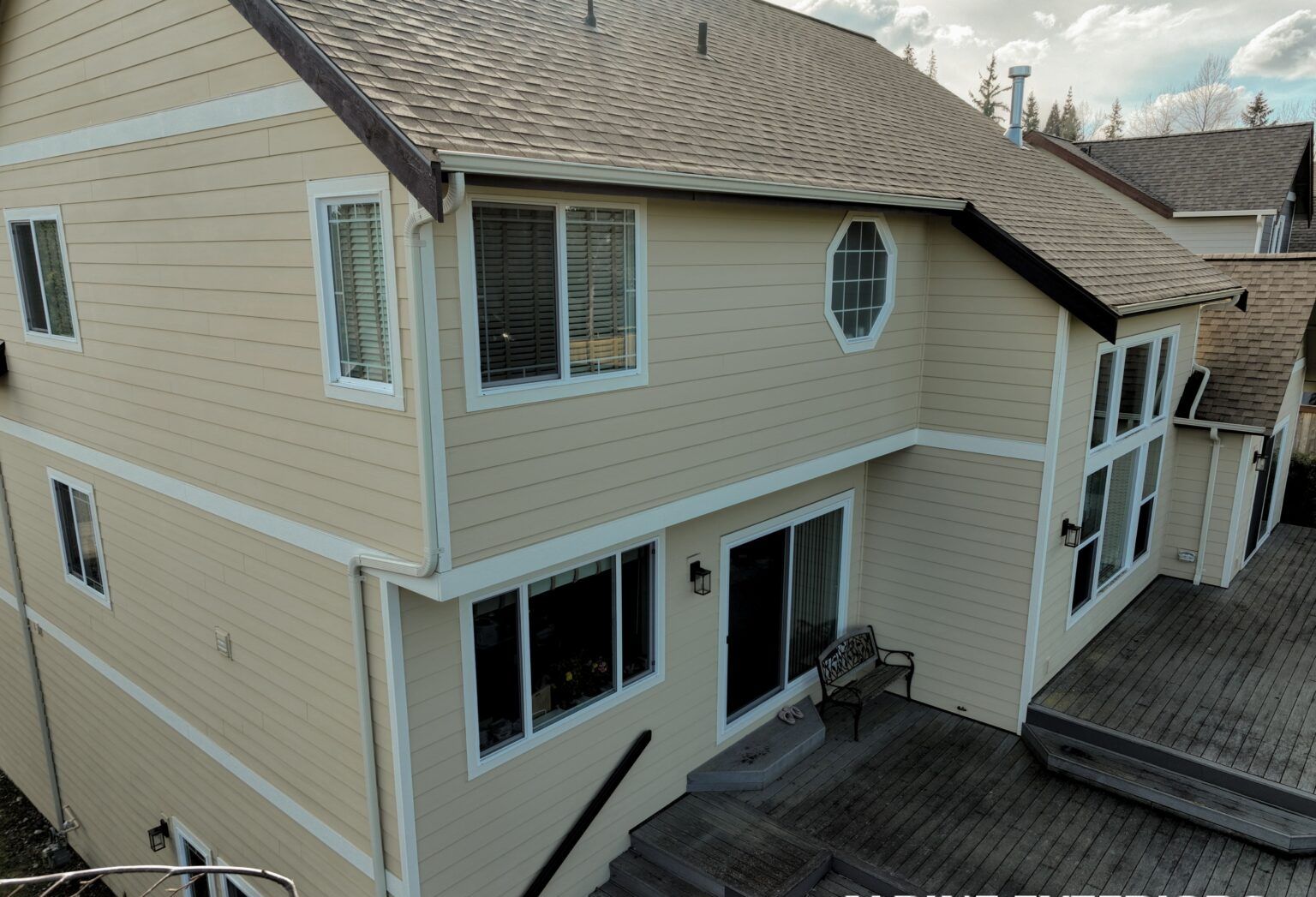
Gray has become the default "safe" choice across the Pacific Northwest for a reason, and in Sudden Valley specifically it earns that reputation. A mid-tone, slightly warm gray — avoid anything too blue or too stark — sits comfortably against gray skies, wet asphalt, stone accents, and the silvery bark of alder and big-leaf maple that mix into the conifer stands here.
Pros: Gray masks the fine gray-green film that forms from airborne moss spores better than white does, since the base color is already in a similar tonal family. It also hides water streaking from wind-driven rain reasonably well, and it's about as uncontroversial a choice as exists for an architectural review committee, since it reads as neutral and natural rather than a statement color.
Cons: Gray can look flat or cold on homes with little other visual interest — no stone, no wood accents, no varied rooflines — especially under the area's frequent overcast skies. A gray-on-gray-on-gray house under a gray sky can genuinely disappear. It's worth pairing gray siding with a warmer trim or door color, or a cedar accent, to keep the home from reading as monochrome for eight months of the year.
Green siding is a distinctive choice for a lake community surrounded by second-growth forest, and it's one of the few colors that actually gets more forgiving, not less, as it weathers.
Pros: A muted sage or deep forest green camouflages the home into its setting more than any other color family, which tends to be well received both by neighbors and by architectural review, since it reinforces rather than fights the wooded character of Sudden Valley. It also does an excellent job of hiding early-stage moss and algae growth, since the biological staining is often a similar hue to begin with.
Cons: Green is harder to resell to a future buyer with different taste than a neutral gray or cream — it's a more personal choice. Cheaper or older green pigments can also shift toward a slightly yellow or olive cast as they age and are exposed to years of damp conditions, which isn't always the direction homeowners expect. Choosing a well-reviewed, fade-tested pigment matters more with green than with most other colors.
Warm brown tones — whether on real cedar siding or a fiber-cement or engineered-wood product finished to resemble it — have obvious appeal in a region built around its timber heritage, and Sudden Valley's wooded lots make the connection even more direct.
Pros: Brown tones hide dirt, tannin streaking, and general weathering better than almost any other color, which matters given how much organic debris — fir needles, cedar duff, maple leaves — ends up against siding here. They also read as warm and inviting against the cooler gray-green backdrop of the forest, which some homeowners prefer to an all-gray palette.
Cons: If you're using actual wood siding rather than a wood-look composite, brown paint or stain doesn't solve the underlying vulnerability of wood to persistent moisture — rot risk in this climate comes from water intrusion and poor detailing, not paint color, and a brown stain job still needs the same flashing, drainage plane, and maintenance attention any wood exterior needs here. Lighter cedar-tone stains can also gray out or fade unevenly faster than a true paint film, since stains are more permeable by design.
White and near-white — cream, warm greige, soft linen — siding photographs beautifully and pairs well with black-framed windows, a look that's genuinely popular right now. It's worth going in with clear expectations about how it performs here specifically.
Pros: Done well, white and warm neutrals brighten a lot that otherwise sits in near-constant tree shade, and they reflect rather than absorb heat, which is a minor plus for wall temperature in the stretches of summer sun Whatcom County does get.
Cons: This is the color family most likely to disappoint a Sudden Valley homeowner who doesn't stay ahead of maintenance. White shows moss, algae, and mildew staining faster and more starkly than any other color — the contrast between the growth and the base color is exactly what makes white so visually stark to begin with. On heavily shaded, north-facing walls under mature conifers, streaking and green-black staining can become visible within a season or two without regular soft-washing. Bright white can also stand out against the wooded, muted-tone character of the community in a way that draws more architectural review scrutiny than a warmer neutral would.
Charcoal and black siding, often used as an accent on a garage face, a shed dormer, or a full modern-style elevation, has real visual punch and works well against green forest backdrops in renderings and photos.
Pros: Dark colors hide moss staining and water streaking almost entirely — the biological growth simply doesn't contrast against a near-black surface the way it does against white or pastel tones. It also creates a striking, modern look that can work well as an accent against a lighter or wood-toned main field.
Cons: Dark siding absorbs significantly more heat on any wall that does get direct sun, which increases surface temperature and, over years of freeze-thaw cycling common in Sudden Valley's higher-elevation setting, can accelerate expansion-and-contraction stress on certain siding materials and their fasteners. It's also the color most prone to visible fading over time, and because Sudden Valley homes so often have mixed sun and shade exposure across different walls, a full-black house can fade unevenly — one elevation staying rich and dark while another goes chalky — in a way that's more noticeable than uneven fading on a mid-tone color. Full-elevation black is also more likely to draw architectural review discussion in a community built around blending into forest surroundings, though a black accent on a smaller feature is usually a much easier approval.
Navy and slate blue sit in an interesting middle ground for a lake community — closer to gray in practical performance, but with more personality.
Pros: A muted slate or navy blue reads as sophisticated without being as attention-grabbing as black, hides water streaking about as well as gray, and can echo the lake itself for homes with water-facing elevations.
Cons: Like green, blue pigments can drift over years of damp exposure, sometimes taking on a slightly chalky or washed-out cast before other colors would. Brighter or more saturated blues can also feel out of place against the muted, natural palette that dominates Sudden Valley's wooded lots, so sticking to a deep, desaturated shade matters more with blue than with most other options.
A few choices consistently cause more problems than they solve for homes in this specific setting:
Most Sudden Valley properties are subject to review through the community's architectural control process, and exterior color changes typically fall within that review. Requirements and turnaround times can vary, so it's worth checking with the association directly and submitting your proposed color and material before ordering materials or scheduling work, rather than after.
In practice, yes, especially on north-facing walls or elevations shaded by mature fir and cedar trees. The contrast between light siding and green-black biological staining is simply more visible than it is on a mid-tone or darker color. Light siding isn't a bad choice, but it does mean planning for more regular gentle washing to keep it looking its best.
Dark colors generally show fade more visibly than light or mid-tone colors, because the color change from sun and weather exposure creates more contrast against the original deep shade. Sudden Valley's mixed sun-and-shade exposure across different walls can also make that fading uneven, with sun-exposed elevations lightening faster than shaded ones on the same house.
Factory-baked or factory-finished products, such as fiber-cement siding with a baked-on finish or quality prefinished engineered wood, generally hold color more consistently over time than field-applied paint or stain, particularly in a climate with this much sustained rain and freeze-thaw cycling in the higher-elevation parts of the community. Field-applied finishes can still perform well, but they typically need more frequent maintenance to hold their color and protect the substrate underneath.
Choosing a siding color in Sudden Valley isn't just about picking a swatch — it's about matching that color to your lot's specific sun and shade pattern, your wall's exposure to wind-driven rain, and what the architectural review process will realistically approve. Alpine Exteriors works with homeowners throughout Sudden Valley, Bellingham, Ferndale, Lynden, Blaine, and Birch Bay, bringing real material samples to your home so you can see how a color actually reads under your trees and against your roofline rather than guessing from a chip under fluorescent light. Alpine Exteriors is licensed in Washington, contractor license ALPINI751OW; reach out for an on-site consultation and an honest assessment of which colors and materials will hold up best on your specific home.