
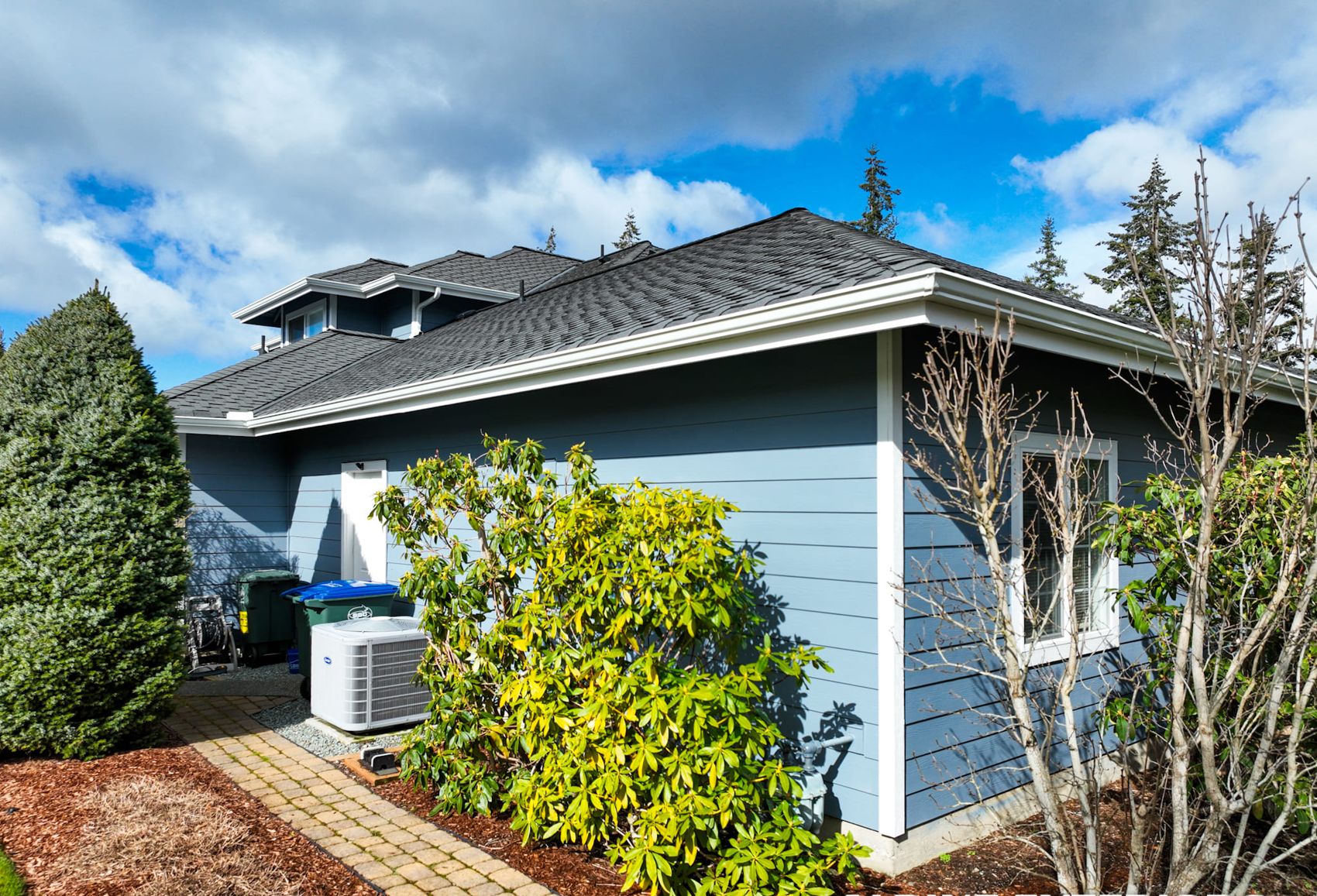
Sunnyland is one of Bellingham's older, tree-shaded neighborhoods, and that history shows up in its siding. Walk the blocks between James Street and the Guide Meridian and you'll see 1940s and 1950s bungalows in original cedar or hardboard, a scattering of 1970s-80s infill with aluminum or T1-11, and newer builds and remodels wrapped in fiber cement or engineered wood. Every one of those materials has to survive the same thing: a wet, temperate, moss-friendly climate that punishes anything without a clear path for water to get out. This guide walks through what actually holds up on a Sunnyland house, what doesn't, and why, based on the conditions specific to this part of Whatcom County rather than generic siding advice written for a different climate.
For most Sunnyland homes, fiber cement siding is the strongest all-around choice. It resists the rot that ends up being the real long-term cost driver in this climate, it holds paint well through repeated wet-dry cycles, and it's rated for the wind-driven rain that comes off Bellingham Bay during winter southerlies. Engineered wood siding is a close second and often the better fit for a budget-conscious remodel or an addition that needs to match an existing profile without the extra weight and install cost of fiber cement. Cedar remains the right call for homeowners who specifically want the traditional Pacific Northwest look and are willing to keep up with refinishing. Vinyl and steel each have a place, covered below, but neither is our default recommendation for this neighborhood's housing stock.
Whatcom County's siding decisions come down to water management more than anything else. Sunnyland sees a long, steady wet season rather than short violent storms, and that changes what "durable" means. A material can be perfectly strong and still fail here if it holds moisture against the wall assembly. We weighed each option against the conditions that actually show up on Sunnyland job sites:
Fiber cement is a cement, sand, and cellulose fiber board formed into lap, panel, or shingle profiles. It doesn't rot, doesn't feed moss and algae the way wood does, and it holds paint far longer than wood siding because it doesn't move much with moisture. In our experience it's the material that best matches Sunnyland's rain patterns: it can sit wet for days without swelling, cupping, or delaminating. It also carries a Class A fire rating, which some Whatcom County insurers now factor into premiums.
The drawbacks are real. Fiber cement is heavy and brittle compared to wood or vinyl, so it has to be cut, scored, and fastened correctly or it chips and cracks — this is not a confident DIY material. It has to be factory-primed or field-painted and caulked at joints, and if that paint film fails, the exposed board can absorb water at the cut edges. Installed cost runs meaningfully higher than vinyl and is generally on par with or slightly above engineered wood, largely because of the labor and blade wear involved.
Engineered wood siding — wood strands or fiber bonded with resins and treated with a zinc borate or similar preservative, then finished with a factory overlay — has become a common choice on Sunnyland remodels because it's lighter than fiber cement, easier to install, and less prone to cracking during handling. Properly detailed with flashing and back-primed cut ends, it performs well against the county's steady rain and holds up reasonably well to the moss and algae pressure under tree cover.
The honest downside is that its performance depends heavily on installation quality and on keeping every cut end, nail hole, and joint sealed. Older generations of engineered wood siding had a documented reputation for swelling and delaminating when water got behind the factory finish, and while today's borate-treated products are a different, better product, the material still isn't as forgiving of gaps in caulking maintenance as fiber cement or steel. It's a strong value pick, not a set-and-forget one.
A lot of Sunnyland's original 1940s and 1950s homes were built with cedar, and there's a reason people want to keep that look: it's genuinely the regional material, and a well-maintained cedar exterior still looks better than almost anything else on a craftsman bungalow. Cedar has natural extractives that resist decay better than most softwoods, and it takes stain and paint well.
But cedar asks for ongoing attention in this climate that many homeowners underestimate. Left unfinished or under-maintained, cedar under tree cover in Sunnyland will grow moss and algae within a few seasons and can start to soften at end grain and lower courses within a decade. Refinishing on a five-to-seven-year cycle, plus periodic gentle cleaning to keep moss from taking hold, is realistically part of owning cedar siding here. For homeowners restoring an original character home, we think it's worth it. For a rental property or a low-maintenance goal, it usually isn't the right call.
Vinyl remains the most budget-friendly option and it never needs painting, which appeals to a lot of Sunnyland homeowners weighing siding against other renovation priorities. Modern insulated vinyl also helps close some of the energy code gap by adding a layer of rigid foam behind the panel.
Its weaknesses show up specifically in this climate. Vinyl is a rain-screen material by nature — water is expected to get behind it — so it depends entirely on correct house wrap, flashing, and drainage detailing underneath; skip that and moisture sits against the sheathing far longer than it should in a place that's already wet most of the year. Vinyl also becomes brittle and can crack during Whatcom County's occasional hard freezes, and it fades and chalks with UV exposure over the years, especially in darker colors. It's a reasonable choice on a tight budget, but only when the installer treats what's behind the panel as seriously as the panel itself.
Steel siding is the most durable option against the specific stresses of this neighborhood: it doesn't rot, it sheds moss and algae far better than wood or engineered wood, and it stands up to wind-driven rain off the bay without absorbing water. For a home with heavy tree cover and a north-facing wall that never fully dries, it's arguably the lowest-maintenance material available.
The tradeoffs are cost and aesthetics. Steel siding costs more upfront than vinyl or engineered wood and, depending on the profile chosen, can read as more industrial or contemporary than what fits a traditional Sunnyland bungalow. It can dent from impact, and if it's installed without a rainscreen gap for drainage and ventilation, condensation can form on the back side of the panel in this humid climate. Done right, on the right style of home, it's an excellent long-term choice; it's just not the automatic answer for every house in the neighborhood.
| Material | Moisture/rot resistance | Moss/algae resistance | Maintenance level | Relative install cost |
|---|---|---|---|---|
| Fiber cement | Excellent | Good | Low-moderate (repaint over time) | Higher |
| Engineered wood | Good, install-dependent | Good | Moderate (caulk/seal upkeep) | Moderate-higher |
| Cedar | Fair without upkeep | Fair, needs cleaning | High | Moderate-higher |
| Vinyl | Good if detailed correctly | Fair | Low | Lower |
| Steel | Excellent | Excellent | Low | Higher |
A few choices that work fine in drier climates are consistently a problem here, and we'd rather flag them than let a homeowner find out the hard way. Traditional hard-coat stucco and EIFS (exterior insulation finish systems) are both poor fits for Sunnyland's rain pattern unless installed as a fully drained system with a rainscreen behind the finish coat. In a climate with this much sustained wet weather, any stucco or EIFS assembly that traps moisture against the sheathing rather than draining and drying it — a common shortcut on older installs — leads to hidden rot that isn't visible until the wall is opened up.
We'd also flag older hardboard (masonite-style) siding, common on some 1970s and 1980s Sunnyland homes, which was widely installed without adequate back-priming or flashing detail and has a well-documented history of swelling and rotting from the bottom edge up in wet Pacific Northwest climates. If your home still has its original hardboard siding from that era, it's worth an inspection even if it looks intact from the street, since the failure often starts at the bottom courses and butt joints where water collects.
Finally, avoid any siding installation — regardless of material — that skips a drainage gap or rainscreen behind the cladding. In a climate this wet, the single biggest predictor of a siding failure isn't the material at all; it's whether water that inevitably gets past the surface has anywhere to go.
Yes. Any siding replacement tied to a permitted project, or that opens up the wall assembly, typically has to meet the current Washington State Energy Code's wall insulation requirements, which in most cases call for continuous exterior insulation or an equivalent performance path. This affects details like furring strip thickness and whether rigid foam goes under the new siding, so it's worth confirming the approach with your contractor and the City of Bellingham permit desk before work starts.
Moss and algae need shade and sustained moisture to establish, and many Sunnyland lots have both from mature tree canopy, especially on north- and west-facing walls that don't get much direct sun. Cleaning removes the visible growth but doesn't change the conditions that let it grow, so it tends to return within a season or two unless the siding material itself resists moisture retention or the surrounding vegetation is trimmed back to let the wall dry faster.
It depends on what's underneath. If the original cedar or hardboard is largely sound and the issues are cosmetic or localized, targeted repair and refinishing can be the more cost-effective and character-preserving choice. If there's rot at multiple locations, especially near grade, window sills, or butt joints, or if the sheathing behind the siding shows signs of water damage, full replacement usually ends up cheaper than repeated repairs and gives you the chance to add a proper rainscreen and code-compliant insulation at the same time.
Costs vary widely based on square footage, siding material, how much of the existing wall assembly needs repair, and access on the specific house, so we'd rather give you an accurate number after a walk-through than a generic figure. As a general range, vinyl tends to sit at the lower end, engineered wood and fiber cement in the middle-to-upper range, and steel toward the top, with the final number shaped heavily by any hidden rot repair uncovered once the old siding comes off.
Every Sunnyland property is a little different — a shaded lot near Whatcom Creek behaves differently than an open one closer to the bay, and a 1948 bungalow has different needs than a 1990s remodel. Alpine Exteriors has spent years matching siding materials to specific Whatcom County conditions rather than defaulting to whatever's easiest to sell, and we're happy to walk your property, point out where moisture or rot has already started, and give you a straight recommendation with real pros and cons for your specific house. Alpine Exteriors is licensed in Washington under contractor license ALPINI751OW, serving Bellingham's Sunnyland neighborhood along with Ferndale, Lynden, Blaine, Birch Bay, Sudden Valley, and the islands. Reach out for a site visit and a written estimate before you decide on a material.