Best Siding for Sumas, WA Homes: A Whatcom County Guide
Updated August 2026 · Alpine Exteriors · WA contractor license ALPINI751OW
The Short Answer
For most homes in Sumas, fiber cement siding and engineered wood siding (like LP SmartSide) are the two options that hold up best year after year. Both resist the rot that comes from Whatcom County's long, wet winters, both take paint or factory finish well so moss and algae staining can be washed off without damaging the material underneath, and both are widely available through local suppliers, which keeps repair siding easy to match if a piece is ever damaged. Cedar remains a legitimate choice for homeowners who want a natural look and are willing to keep up with staining or sealing on a regular schedule, and vinyl still has a place on tighter budgets if it's installed correctly with a drainage gap behind it. There is no single "best" siding for every house here — a 1970s farmhouse near the Nooksack River bottomland has different needs than a newer build up toward the foothills — but the short list above is where nearly every Sumas project on our punch list starts.
How We Judged Siding for This Part of Whatcom County
Sumas sits at the far northeast edge of Whatcom County, closer to the foothills and the Nooksack River floodplain than to Bellingham Bay, so the conditions that matter here are a little different from the coastal towns. We weighed every product against the same list:
- Rain exposure over time. Sumas doesn't get the direct, wind-driven rain off the Strait of Georgia that Blaine or Birch Bay deal with, but it still sits under the same persistent Pacific Northwest drizzle pattern for months at a stretch. Siding here needs to shed water reliably during long, low-intensity rain events, not just survive an occasional storm.
- Moss and algae resistance. Shaded north walls, mature trees, and the humidity that settles into the river valley all favor moss and green algae growth on siding. We looked at how easily each material sheds that growth and how it holds up to the cleaning needed to remove it.
- Rot resistance. Wood rot is the single most common repair we see on older Sumas homes, usually starting at butt joints, window trim, and anywhere siding sits too close to grade or garden beds.
- Freeze-thaw behavior. Being closer to the Mt. Baker foothills than the water, Sumas sees more hard frosts and the occasional deep cold snap than Bellingham does. Siding and its fasteners need to tolerate repeated freeze-thaw cycling without cracking, warping, or popping nails.
- Washington State Energy Code compliance. The current WSEC prescriptive path pushes most new construction and major re-sides toward continuous exterior insulation and a well-detailed water-resistive barrier with a drainage gap behind the cladding. We favor products that pair easily with that assembly rather than fighting it.
- Fit with the local housing stock. Sumas has a mix of older farmhouses, ranch-style homes from the 1960s-80s, manufactured and modular homes on acreage, and a smaller number of newer builds. Maintenance realism matters — a rural homeowner on a few acres doesn't always want a siding that needs re-staining every few years.
Fiber Cement Siding
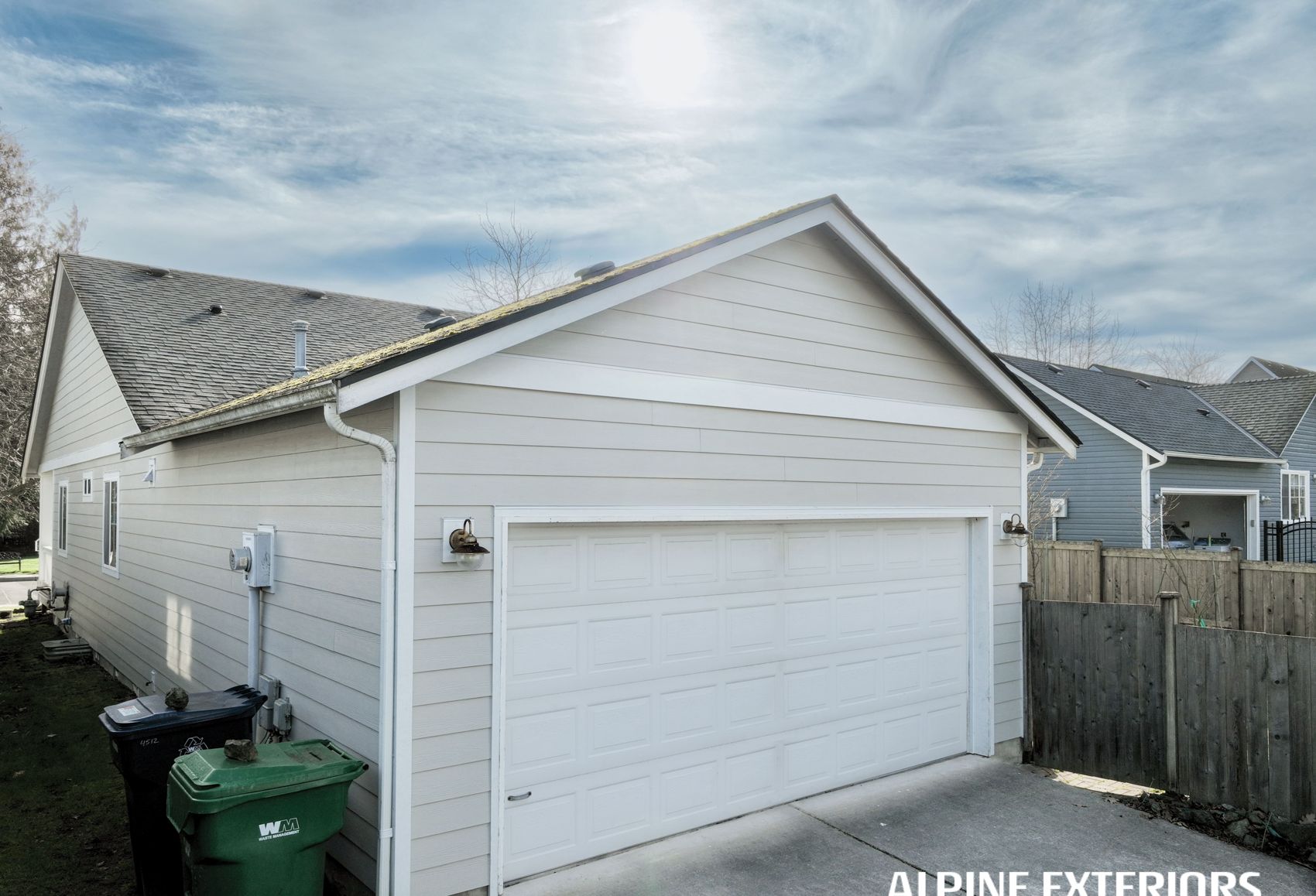
Fiber cement is a blend of cement, sand, and cellulose fiber pressed into planks or panels, then factory-primed or fully pre-finished. It's become the default recommendation for most re-sides we do in Whatcom County, Sumas included, because it splits the difference between durability and cost better than almost anything else on the market.
- Pros: Doesn't rot, isn't a food source for moss or mildew the way raw wood is, holds paint far longer than wood siding between repaints, stands up well to freeze-thaw cycling, and carries Class A fire ratings that some other siding types can't match.
- Cons: Heavy — installation is labor-intensive and not a realistic DIY project. It must be painted or ordered pre-finished, and cut edges need to be sealed at install or they can wick moisture. Material cost runs higher than vinyl or basic engineered wood, and it's less forgiving of a rushed installation; flashing and caulking details matter more with fiber cement than with some other products.
Engineered Wood Siding (LP SmartSide and Similar Products)
Engineered wood siding is made from wood strands bonded with resins and coated with a resin-saturated overlay, then factory-primed. It looks and installs much like traditional wood lap siding but is engineered specifically to resist the fungal decay that plain wood is prone to in wet climates.
- Pros: Lighter and easier to install than fiber cement, which can mean lower labor cost on a re-side. Takes paint well, comes pre-primed, and modern formulations include zinc borate treatment that resists rot and fungal decay far better than untreated wood. Handles the freeze-thaw swings in the foothills reasonably well.
- Cons: It is still a wood product at its core, so any breach in the factory coating — a deep scratch, an unsealed cut edge, a poorly flashed window — gives moisture a path in, and swelling or delamination can follow. It needs the paint film maintained; letting it go bare for a season or two in this rainfall is asking for trouble. Not quite as fire-resistant as fiber cement.
Vinyl Siding
Vinyl remains common on manufactured and modular homes around Sumas and on budget-driven re-sides. It has a real place here, but it rewards a careful installer and punishes a sloppy one more than most people expect.
- Pros: Lowest material cost of the mainstream options, never needs painting, doesn't rot, and is straightforward to install correctly over a proper water-resistive barrier and drainage gap. Low-maintenance for owners who don't want a repainting schedule.
- Cons: Thin, budget-grade vinyl can crack in a hard cold snap or oil-can (ripple visibly) in temperature swings if it wasn't installed with the correct nailing slop for expansion and contraction. It traps moisture behind it if the drainage plane isn't detailed properly, which on an older Sumas home can mask rot in the sheathing until it's advanced. It also doesn't achieve the continuous insulation values some Washington State Energy Code paths call for without added rigid foam underneath, and it can fade over a long enough span of UV exposure, even under our cloud cover.
Cedar and Other Wood Siding
Cedar has been used on Whatcom County homes for generations, and there's a real argument for it: it's a regionally appropriate, naturally rot-resistant softwood that looks the part on a farmhouse or a craftsman-style home. It's not the easiest choice, but it's not a bad one either, if the owner goes in with clear eyes.
- Pros: Natural, regionally authentic appearance that many other materials only imitate. Cedar's natural oils give it real rot resistance compared to other untreated woods, and it can be refinished repeatedly rather than replaced.
- Cons: Requires the most ongoing maintenance of anything on this list — staining or sealing on a recurring schedule, more often on south- and west-facing walls that see more sun and weather cycling. Left unmaintained in this climate, it will pick up moss and gray out within a couple of seasons, and eventually the boards themselves will start to rot at joints and lower courses. Material and labor cost run on the higher end, and it needs a rainscreen gap behind it, not a face-nailed direct-to-sheathing install, to perform well long-term.
Metal and Steel Siding
Steel and aluminum siding show up less often on standard residential re-sides here but are worth a mention, especially for shops, outbuildings, and some of the more modern-styled homes going up in the county.
- Pros: Doesn't rot, doesn't feed moss or algae the way organic materials can, handles freeze-thaw cycling without issue, and holds up well to decades of Pacific Northwest rain with minimal maintenance.
- Cons: Can dent from impact — falling branches are a real consideration on wooded Sumas lots. Cut edges and fasteners need to be properly coated or they can develop rust streaks over time. It reads as a more modern, sometimes industrial look that doesn't suit every older farmhouse in the area, and it tends to sit at a higher price point than vinyl or engineered wood.
What to Avoid in Sumas and Why
A few choices come up on older homes and budget re-sides in this area that we'd steer most homeowners away from, or at least caution heavily against.
- Old T1-11 plywood panel siding left unpainted or poorly flashed. It's still common on outbuildings and some older Sumas houses, and where it hasn't been maintained, it's usually the first thing failing — swollen edges, delaminating plies, and rot at the bottom courses where it sits close to grade.
- Stucco or EIFS on ground-level walls in flood-prone areas. Sumas has a documented history of flooding near the Nooksack River and Sumas Creek. Stucco and exterior insulation finish systems can trap moisture against sheathing if water gets behind them, and that's a bad combination on a wall that may see standing water during a major flood event. It's not a system we'd recommend for lower-level walls on properties in the floodplain.
- Any siding installed without a drainage gap (rainscreen) behind it. This applies across materials, not just one product. Face-nailing siding directly to the water-resistive barrier with no air gap is the single most common install mistake we see causing early failures in this climate — trapped moisture has nowhere to go, and it eventually shows up as rot, mold, or peeling paint from the inside out.
- Bargain-tier vinyl on south- or west-facing exposures. Thin, low-grade vinyl is more prone to warping in direct sun and cracking in a cold snap. If vinyl is the right budget fit, it's worth spending up to a mid-grade product rather than the thinnest option available.
Sumas Siding FAQ
Does siding choice really matter that much given how much it rains in Sumas?
Yes — the material matters less than the installation details in a lot of cases, but the two work together. A well-installed drainage gap and properly lapped water-resistive barrier can make even a modest siding perform well, while a premium material installed without those details will still fail early. We treat the assembly, not just the surface product, as the real answer to Sumas's rain.
Is fiber cement worth the extra cost over vinyl for a Sumas home?
For most owners planning to stay in the home for a decade or more, yes. Fiber cement's resistance to moss staining, rot, and repainting frequency tends to offset the higher upfront material and labor cost over the life of the siding. If the home is a short-term hold or the budget is firm, correctly installed mid-grade vinyl is still a reasonable choice.
Do I need to worry about wind-driven rain in Sumas the way homes near Blaine or Birch Bay do?
Less so. Sumas sits inland from the Strait of Georgia and doesn't take the same direct, wind-driven rain off the water that the immediate coastline does. The bigger factor here is the sheer duration of the region's wet season combined with foothill freeze-thaw cycling, so we weight rot resistance and cold tolerance more heavily than wind-loading for Sumas projects.
How does the Washington State Energy Code affect my siding options?
The WSEC's prescriptive insulation path generally pushes new construction and significant re-sides toward continuous exterior insulation and a detailed water-resistive barrier with a ventilated drainage gap behind the cladding. Fiber cement, engineered wood, and metal panels all pair easily with that assembly. Vinyl can work too, but it often needs added rigid foam underneath to help the wall assembly meet code, which is worth planning for early rather than discovering at inspection.
Ready to Talk Through Your Options?
Every property in Sumas is a little different — river-bottom lots, foothill acreage, and in-town homes all put slightly different demands on siding, and the right call depends on your home's age, exposure, and how much maintenance you want to take on. Alpine Exteriors has worked on siding projects throughout Whatcom County, from Bellingham and Ferndale out to Lynden, Blaine, and Sumas, and we're glad to walk your property, look at what's already on the walls, and lay out honest options with real pros and cons before you commit to a material. Alpine Exteriors holds Washington contractor license ALPINI751OW — reach out to schedule a walkthrough and get a straight answer on what will actually hold up on your home.
Want a straight answer for your home? Alpine Exteriors gives free on-site assessments across Bellingham, Ferndale, Lynden, Blaine, Birch Bay, Sudden Valley and the islands.
Call (360) 543-4799 or
request an estimate.