
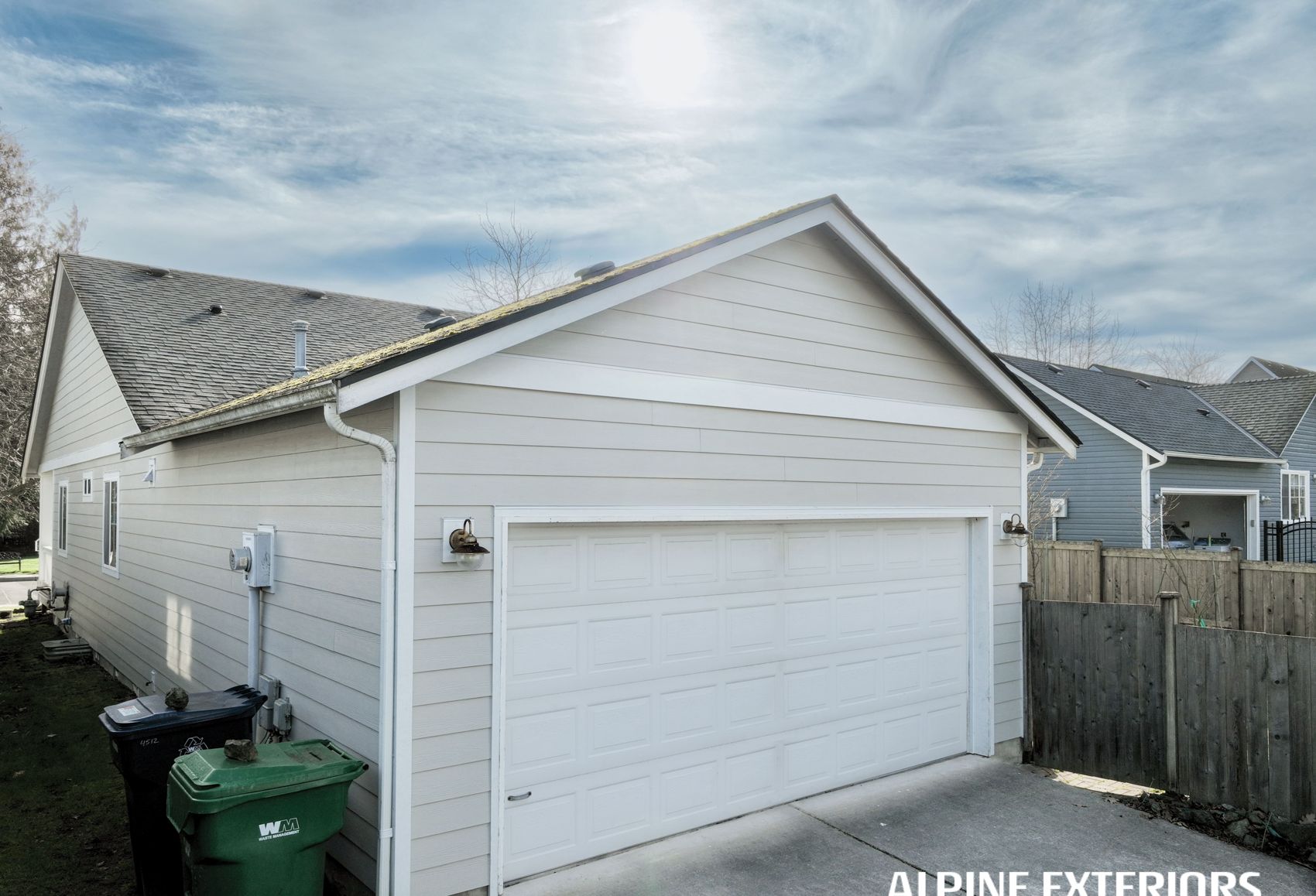
Siding on a Sumas home has to meet the same wind-load and attachment requirements as siding anywhere else in Washington, but Sumas is one of the few places in Whatcom County where those requirements get tested in real conditions rather than sitting on paper. Between the Nooksack River valley funneling cold outflow wind down from the Fraser Valley and the persistent wet-side rain that keeps siding damp for days at a stretch, a code-compliant install here has to actually hold and actually shed water, not just pass a folder review.
The building code that governs this is the International Residential Code as adopted and amended by Washington State, enforced locally through Whatcom County's building department (or the City of Sumas directly, for work inside city limits). It sets minimum fastener type, spacing, and penetration for exterior wall coverings, and it requires that the siding product itself be backed by the manufacturer's printed installation instructions or a current code-evaluation report before an inspector can sign off on it. Product approval, fastening schedule, and inspection are really three checkpoints on the same question: will this wall covering stay attached and stay dry.
Every siding product sold for exterior use in Washington is supposed to come with manufacturer installation instructions that specify nail or screw type, minimum shank length, spacing along studs, and clearance from butt joints and corners. Those instructions aren't marketing material — under the code adopted here, they're treated as part of the enforceable installation standard, alongside the general exterior wall covering provisions in the residential code. If a product doesn't have current instructions, or the crew installs it in a way that doesn't match those instructions (screws instead of nails, wider spacing to save time, face-nailing where the manufacturer calls for blind-nailing), the wall covering is technically out of compliance even if it looks fine the day it goes up.
Fastening is where most siding failures actually start in this county, and it is rarely dramatic. It's a handful of missed studs on a gable end, nails driven flush instead of the specified depth, or vinyl panels face-nailed too tight so they can't expand and contract with temperature swings. None of those show up as a problem in year one. They show up in year six, when a gust off the Strait catches a loose panel at a corner or a rake edge and starts working it back and forth until it separates. Corners, gable ends, and the field near roof-to-wall intersections take the highest wind pressure on a house, and that's exactly where inspectors — and any contractor worth hiring — look hardest at fastener count and placement.
Beyond the mechanical attachment, Washington's energy code layers in requirements that touch the same wall assembly: continuous insulation or an equivalent thermal path outside the sheathing, and a properly lapped water-resistive barrier underneath the siding. The energy code isn't primarily a wind document, but on a re-side or new build it dictates how thick the wall assembly gets and how the siding is furred out or fastened through rigid insulation, which changes the fastener length and pattern the manufacturer's instructions call for. Skipping that detail is one of the more common ways a technically approved product ends up installed incorrectly.
Sumas sits at the bottom of a natural gap where the Fraser Valley in British Columbia narrows down into the Nooksack lowlands. Cold, dense air draining out of that valley funnels through the gap and picks up speed as it goes, producing wind events that are noticeably more sustained and directional than what a house in, say, Bellingham's Fairhaven neighborhood typically sees. Locals and old-timers just call it the Sumas Gap effect. It's not a hurricane-scale event and it doesn't get named storms — it's a cold outflow wind, usually strongest in late fall and winter, and it hits from a fairly consistent direction, which means the same wall and roof edges take repeated loading year after year instead of getting hit from all sides equally.
Closer to the water — Blaine, Birch Bay, and the shoreline stretches around Bellingham Bay and the Strait of Georgia — the issue is wind-driven rain more than raw wind speed. Storms pushing in off the water drive rain sideways into south and west-facing walls, which is a water-management problem as much as a structural one. A wall assembly that's fastened correctly but has a poorly lapped weather-resistive barrier or under-flashed window and door openings will still take on water in that kind of weather, regardless of how well the siding itself is nailed.
Up toward Sudden Valley and the foothill terrain east of Lake Whatcom, the freeze-thaw cycle does its own damage over time. Moisture that gets behind siding or trapped in a poorly ventilated wall cavity freezes on cold nights and expands, working joints and fasteners loose gradually rather than all at once. And across the whole county, the baseline condition is just persistent rain — Whatcom County doesn't dry out fast between storms the way drier parts of the state do, so moss and algae growth on north-facing and shaded walls is a near-constant maintenance issue, and any wood trim, fascia, or fiber-cement product that isn't properly primed and sealed at cut ends starts showing rot faster here than it would somewhere with more sun exposure.
Put together, a Sumas or Whatcom County wall doesn't need siding rated for extreme wind events. It needs siding that's correctly fastened for repeated directional gusts, correctly flashed and lapped against sideways rain, and detailed to shed water fast enough that moss, algae, and rot don't get a foothold.
Start by asking whoever is bidding the job for the manufacturer's current installation instructions for the specific product they're proposing, and ask them to point out the fastening schedule in writing — nail or screw type, spacing, and minimum penetration into the stud. A contractor who can't produce this, or who shrugs it off as unnecessary, is telling you something about how carefully the rest of the job will be done. Alpine Exteriors keeps manufacturer specs on hand for every product it installs and will walk a homeowner through the fastening schedule before work starts, not after a complaint.
Second, pay attention to the water-resistive barrier and flashing details, not just the siding itself. Ask how window and door openings are flashed, how the barrier is lapped at seams, and how the bottom of the wall terminates above grade. These details matter more in Whatcom County's rain than almost anywhere else in the state, and they're also the details that are easiest for a rushed crew to shortcut because they're invisible once the siding goes on.
Third, get a real inspection, not just a permit sign-off from the driveway. Whatcom County and the City of Sumas will inspect sheathing, the water-resistive barrier, and in many cases the siding attachment itself before it's covered up — don't let a crew close in a wall before that inspection happens, even if it means a short delay.
| Common siding option | Wind/fastening consideration here | Moisture consideration here |
|---|---|---|
| Fiber cement lap siding | Needs corrosion-resistant fasteners driven to the manufacturer's specified depth; over-driven nails crack the board over time | Cut ends and field-cut edges must be primed or sealed or they'll wick water and swell |
| Vinyl siding | Must be face-nailed loose enough to expand/contract; over-tightened panels are the most common wind-pull-off failure locally | Doesn't rot, but traps moisture behind it if the WRB and drainage plane aren't done right |
| Engineered wood siding | Fastening schedule is usually tighter than vinyl; follow the manufacturer's nailing pattern at corners exactly | Most vulnerable to moss, algae, and edge rot in shaded, north-facing walls without regular maintenance |
| Cedar or wood siding | Traditional but requires careful nailing to avoid splitting near coastal wind zones | Highest maintenance burden in this climate; needs periodic refinishing to resist rot and moss |
No single product is mandated specifically for Sumas. The same Washington-adopted residential code and manufacturer installation instructions apply here as elsewhere in the state; what changes is that correct fastening and flashing actually matter in practice, because the Sumas Gap produces more frequent, more directional wind events than many other parts of the county.
Inspectors typically want to see the water-resistive barrier properly lapped and fastened before it's covered, correct flashing at window and door openings, and in many jurisdictions a check of the siding attachment itself — fastener type, spacing, and penetration — against the manufacturer's approved installation instructions for that product.
Sometimes, but it depends on the condition of what's underneath and the thickness the new product and any added insulation require for proper fastener penetration. If there's hidden rot, a failed water-resistive barrier, or the existing wall doesn't leave room for correct fastener length once new material and Washington State Energy Code insulation requirements are factored in, covering over it just hides a problem rather than fixing it. A proper inspection of the wall before bidding the job is the only way to know.
There's no fixed schedule that fits every property, since it depends on sun exposure, tree cover, and which sides of the house face the prevailing wet weather. North-facing and heavily shaded walls in Whatcom County generally need attention more often than south-facing ones; letting moss and algae sit for years lets moisture stay in contact with the siding surface longer, which accelerates rot on wood-based products in particular.
If you're planning a re-side or new siding installation anywhere from Sumas down through Lynden, Ferndale, Bellingham, Blaine, Birch Bay, Sudden Valley, or the islands, it's worth having a licensed local contractor walk the exterior before you settle on a product. Alpine Exteriors, WA contractor license ALPINI751OW, installs and inspects siding to the fastening schedules and flashing details this region actually requires, not a generic checklist written for a drier climate. Reach out for a walk-through and a written scope before work starts.