
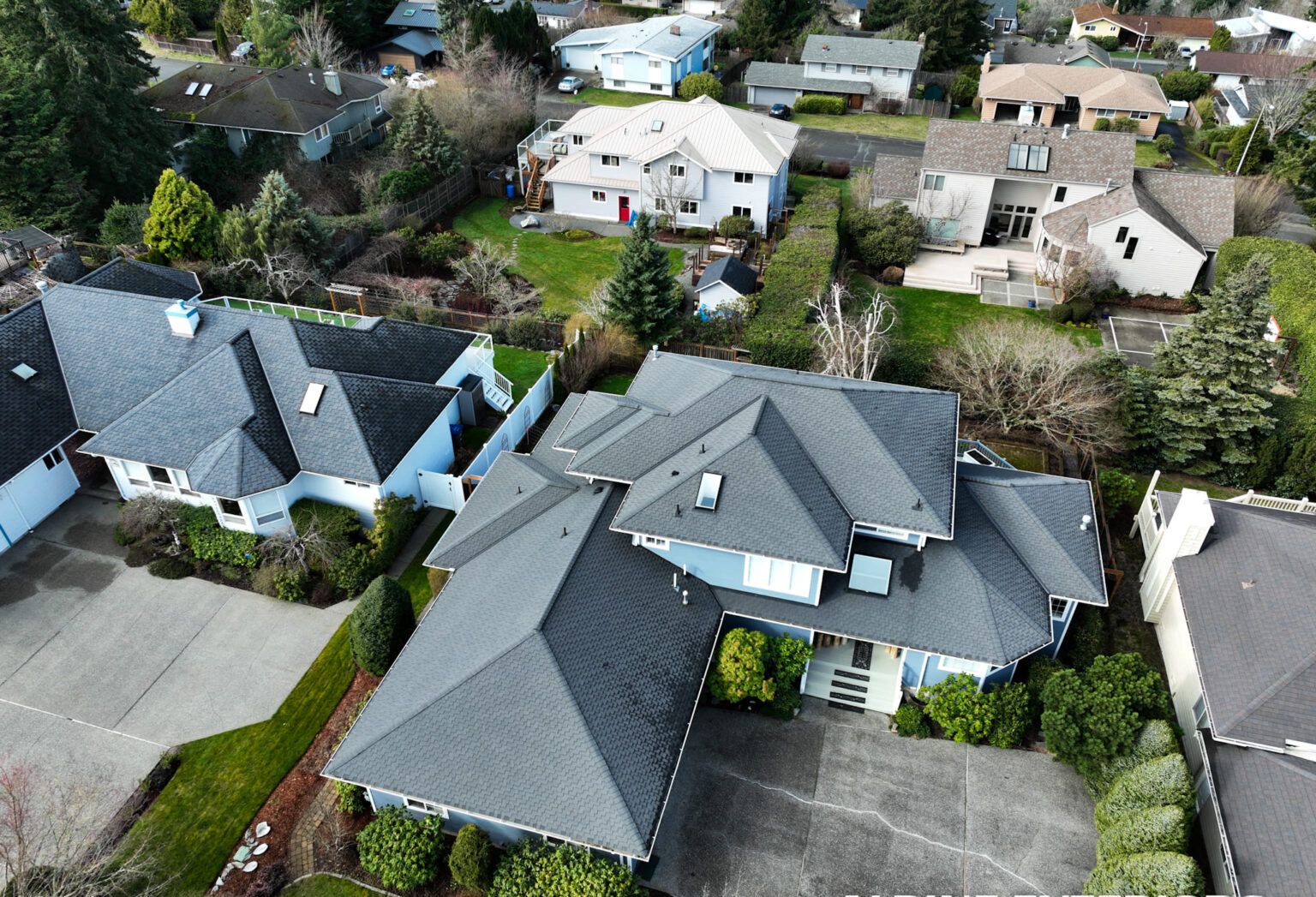
Chuckanut sits in a corner of Whatcom County that gets its own microclimate: steep, forested slopes along Chuckanut Drive, heavy tree cover that keeps siding shaded and damp for days after a storm, and a shoreline exposure to Bellingham Bay and the Strait of Georgia that drives rain sideways into walls most homes never have to deal with. A siding inspection here is not the same task as it would be on the drier east side of the county. This checklist is built around what actually fails on Chuckanut homes — not a generic national list.
Whatcom County gets a long, wet fall-through-spring season, and Chuckanut's tree canopy and hillside setting make it worse in specific ways. Shade slows drying time after every rain, which is exactly the condition moss and algae need to colonize a wall. Homes closer to the water take wind-driven rain directly off the bay and the Strait, which pushes moisture sideways through joints and laps that would stay dry in a calmer setting. Up in the foothills and shaded ravines, occasional freeze-thaw cycles work water in and out of small cracks in caulk and trim, widening them a little more each winter. None of this is hurricane-force weather — Whatcom County doesn't get that — but the combination of shade, moisture, and repeated freeze-thaw is its own slow, cumulative threat to siding, especially wood and wood-based trim. A once- or twice-a-year walk-around catches problems while they're still a caulking tube and an afternoon, not a wall replacement.
Work your way around the house in this order. Bring a ladder for anything above eye level, or skip the ladder and use binoculars — either works for a first pass.
Siding Field (the panels or boards themselves)
Trim, Fascia and Soffits
Caulking, Flashing and Water Management
Moss, Algae and Organic Growth
Foundation Line and Lower Wall
Windows, Doors and Penetrations
Ventilation and Energy Code Considerations
Not every failed item is an emergency. A patch of moss on a north wall or a chalky, faded panel is routine maintenance — a soft-bristle wash (never a high-pressure setting that can drive water behind the siding) and a note to check again next season is usually enough. Cracked caulk at a window or door is a same-week fix with an exterior-grade sealant rated for wet climates; leaving it through another rainy season is how a small gap becomes a rotted stud.
Soft or spongy siding, staining that keeps reappearing after cleaning, or a wall section that feels damp to the touch is a different category. These point to moisture already inside the wall assembly, and covering that up with paint or caulk without finding the source just traps the problem. The same goes for any siding that's visibly pulled away from the wall, or fascia and trim with active rot — these need to be opened up to see how far the damage has traveled before anyone can size a repair.
Call a licensed siding contractor if you find soft or spongy material anywhere on the wall, staining that returns after cleaning, panels that have visibly shifted or separated, or any sign of water reaching interior drywall or framing. Also call if you're not comfortable getting on a ladder to check the upper courses and fascia yourself — a lot of Chuckanut's rot damage starts high up under tree cover where it's easy to miss from the ground. A contractor can also tell you whether a repair is realistic or whether the underlying house wrap and flashing need to come out along with the siding, which isn't something you can determine from the outside alone. Alpine Exteriors, licensed in Washington under ALPINI751OW, does this kind of diagnostic walk-around for Whatcom County homeowners, including Chuckanut, Bellingham, Ferndale, Lynden, Blaine, Birch Bay, Sudden Valley, and the islands, and can tell you honestly whether you're looking at a caulk-and-clean job or something more involved.
Twice a year is a reasonable baseline for most homes — once in late fall before the wet season sets in, and again in spring to check how the siding held up. Homes in shaded, tree-covered spots like much of Chuckanut, or homes with direct exposure to wind off the bay, benefit from an additional check partway through the winter, since moss and moisture problems can develop faster in those conditions than on a more open, sunnier lot.
Light surface moss on its own is mostly cosmetic, but it's a signal worth taking seriously. Moss holds moisture against the siding far longer than bare material would, and over time that constant dampness can degrade caulk, promote wood rot underneath painted trim, and work its way into seams. Clean it off with a soft wash before it spreads, and pay attention to whether it keeps coming back in the same spot — that usually means the area isn't drying out between rains, which is worth investigating further.
Yes, in a specific way. Ordinary vertical rain mostly runs down the face of the siding and off. Wind-driven rain gets pushed sideways and can work its way up under laps, around trim edges, and through caulk joints that would otherwise shed water fine. Homes with more direct exposure to the water — along the shoreline or on higher, more open ground near the bay and the Strait — tend to see caulk and flashing wear out faster than homes tucked into more sheltered, tree-covered terrain further inland.
The energy code governs how walls are insulated and sealed, and modern wall assemblies rely on a combination of house wrap, proper flashing, and ventilation gaps to manage the moisture that inevitably gets past the outer siding layer. If siding is removed and reinstalled during a repair, re-siding project, or window upgrade, that underlying moisture-management layer needs to go back together correctly to keep meeting code and to keep the wall assembly performing the way it's designed to. It's less about the siding material itself and more about what's happening behind it.
A checklist can tell you where to look, but it can't tell you how deep a problem goes once you've found one. If your walk-around turned up soft spots, recurring staining, or siding that's pulled away from the wall, Alpine Exteriors serves homeowners throughout Whatcom County — including Chuckanut, Bellingham, Ferndale, Lynden, Blaine, Birch Bay, Sudden Valley, and the islands — and can walk the property with you, explain what's actually happening behind the siding, and lay out honest options, from a targeted repair to a full re-side, before anything gets worse.