
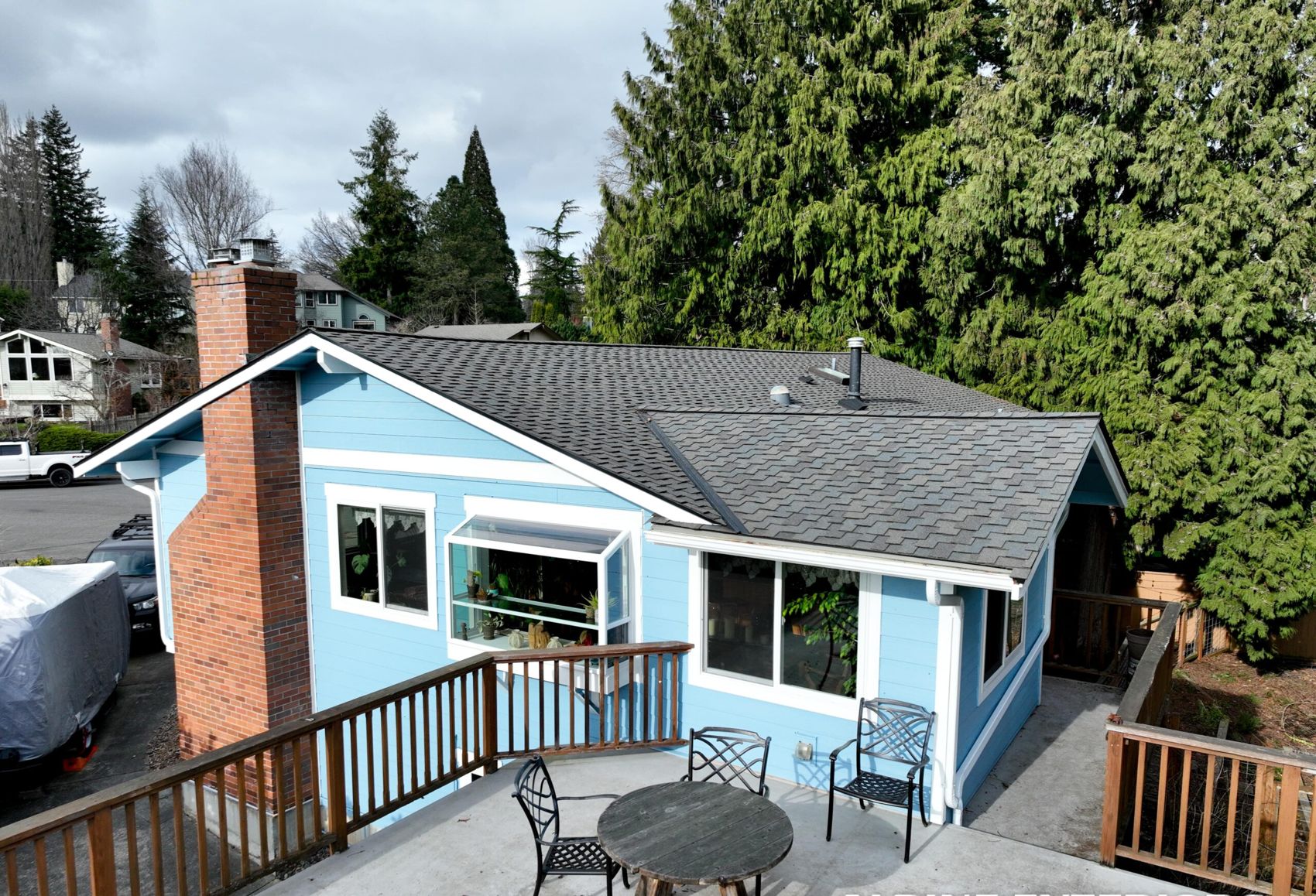
Hardie trim and corner boards last in Whatcom County when they're installed with a drainage gap behind them, sealed at the top and ends rather than face-caulked shut, and flashed so water is thrown clear of the substrate instead of pooling against it. Skip any one of those steps and the trim itself will usually be fine — it's the wall behind it that rots.
James Hardie trim boards are cement composite, so the boards themselves don't absorb and swell the way wood trim does. That's a real advantage here. But trim doesn't fail on its own — it fails at the seams, and every seam is a place water can get behind the material if it's not detailed correctly. The three joints that matter most on a corner or trim run are the top cut, the butt joints where two lengths meet, and the inside corner where trim meets siding.
At the top of a trim board — under a soffit return, at a window head, or where trim dies into a roofline — the cut factory edge is exposed and will wick water if it's left raw. Hardie's own installation instructions call for sealing that cut edge with a compatible caulk or the factory-primed surface, and for a Z-flashing or drip cap above any horizontal trim run that isn't already protected by an overhang. A lot of the rot we find in this county traces back to a trim board that was cut, nailed, and never sealed at the top — the crew assumed paint would handle it, and paint isn't a flashing detail.
Corner boards get built one of two ways: mitered corners, where the two boards meet at a 45-degree joint, or corner boards installed flat with a butt joint. Miters look clean but they open a hairline gap as the boards move seasonally, and that gap sits at the most rain-exposed edge of the house. Most siding crews working in this climate have moved toward a flashed inside corner with a rain screen gap behind it rather than a tight miter, because a miter with no drainage path behind it just becomes a funnel. Either approach can work — what can't work is a corner detail that relies entirely on caulk to keep water out for the life of the siding. Caulk is a maintenance item, not a waterproofing system.
Behind all of it, the drainage gap matters as much as the trim itself. Furring strips or a manufactured rain screen product create a small air space between the back of the siding and the weather-resistive barrier, so any water that does get past the face of the trim has somewhere to go besides sitting against sheathing. Face-nailing trim directly to the wall with no gap is faster and cheaper, and it's still common on production-built homes in this area — it also means the first sign of trouble is often rot you can't see until the trim is pulled off.

Whatcom County doesn't get the wind speeds that drive coastal building codes further south, but it gets something siding trim has to deal with just as often: sustained, low-intensity rain over many months a year, plus wind-driven rain off Bellingham Bay and the Strait of Georgia that pushes water sideways into walls rather than straight down. A trim detail that would be fine in a drier climate — one seasonal storm here and there — gets tested constantly here, because the wall assembly rarely gets a long stretch to fully dry out between rain events, especially October through April.
That persistent moisture is also what feeds the moss and algae growth you see on north-facing trim and corners in Bellingham, Ferndale, and up toward Lynden and Blaine — shaded elevations that don't get direct sun stay damp longer, and organic growth on trim isn't just cosmetic. It holds moisture against the surface and, over time, works into any seam that wasn't sealed properly. Homes near Birch Bay and out on the islands see an added layer of salt-laden air off the water, which doesn't rot Hardie trim the way it would wood, but it does accelerate wear on fasteners and metal flashing if those aren't corrosion-resistant.
Up toward the foothills and out around Sudden Valley, the concern shifts a bit — those areas get cold snaps and freeze-thaw cycles that coastal Bellingham rarely sees. Any water that's gotten behind trim and hasn't drained or dried before a freeze can expand and push a joint apart, which is one more reason the drainage gap and top-of-board sealing aren't optional details — they're the difference between trim that lasts decades and trim that needs rework in five years.
The Washington State Energy Code also plays into how trim and corners get built, because most homes here now use continuous exterior insulation or a thicker sheathing assembly to hit code-required R-values. That changes the depth trim has to bridge and the fastening pattern needed to keep boards secure through the assembly — a corner detail designed for a bare OSB wall doesn't automatically transfer to a wall with two inches of rigid foam behind the siding. Whoever's doing the install needs to be building trim details around the actual wall assembly on your house, not a generic spec sheet.
You don't need to know the difference between a miter and a butt joint to ask the right questions before trim goes on your house, or to know what to look for after. A few things are worth doing:
It's also fair to expect some trade-offs. A properly furred-out rain screen assembly with flashed corners costs more in labor than face-nailed trim with caulked joints, and it adds a small amount of visible depth at window and door returns. Homeowners on a tighter budget sometimes choose the simpler detail knowingly — that's a reasonable call as long as it's an informed one, with an understanding that maintenance and caulk inspection matter more on that assembly, not less.
No — Hardie trim is a fiber cement product and doesn't absorb water and swell or decay the way wood trim does. The rot risk in this climate is almost always at the wall assembly behind or beneath the trim, where water that got past an unsealed joint or a missing drainage gap has nowhere to go and sits against sheathing or framing.
There's no fixed schedule that fits every house, since exposure varies a lot by elevation and orientation, but a general check every year or two is reasonable, with closer attention to north- and west-facing corners that stay damp longest. Cracked, shrunk, or missing caulk at a trim seam is worth addressing before the next wet season rather than after.
Both can perform well if they're built correctly, but a flashed inside-corner detail with a drainage gap behind it tends to be more forgiving of the seasonal movement and near-constant rain exposure typical of Whatcom County. A tight miter with no drainage path relies more heavily on the caulk joint staying intact, which is a higher-maintenance approach over time.
Moss and algae themselves don't eat into fiber cement trim, but a persistent layer of growth holds moisture against the surface longer than bare trim would, and that extra dwell time is what eventually finds its way into an imperfect seam. Keeping shaded, north-facing trim reasonably clear of heavy moss buildup is a legitimate part of maintaining the trim, not just a cosmetic preference.
If you're planning new siding, a repair, or you're just not sure how the trim and corners on your current siding were detailed, Alpine Exteriors can walk the house with you and explain exactly what's going on behind the boards — drainage gap, flashing, fastening — not just what it looks like painted. Alpine Exteriors is a licensed Washington contractor (license ALPINI751OW) serving Bellingham, Ferndale, Lynden, Blaine, Birch Bay, Sudden Valley, and the surrounding islands, and we're happy to give you a clear, no-pressure look at what your home actually needs.