
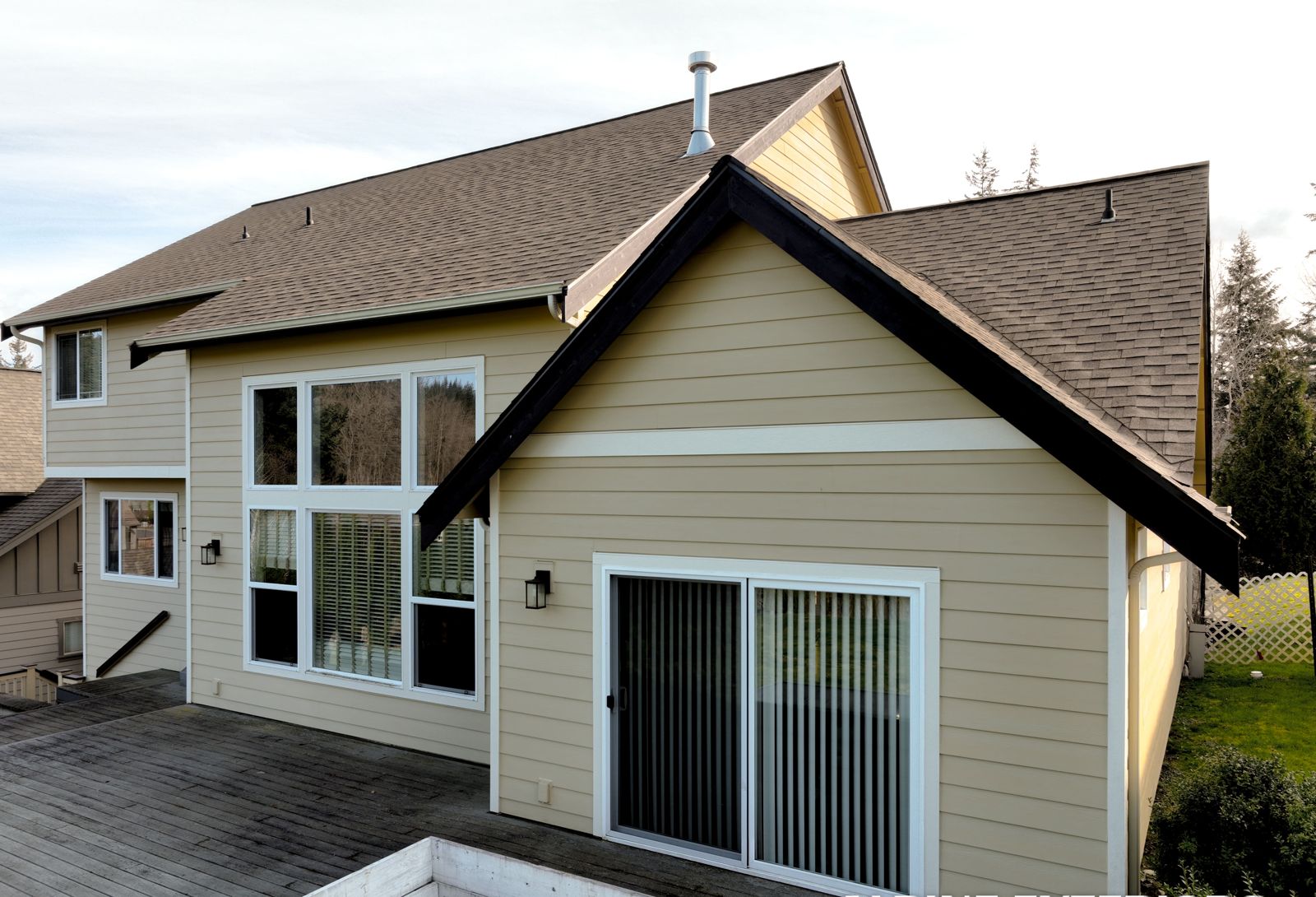
After a storm moves through the Kendall area, siding damage is usually quiet rather than dramatic — a lifted panel corner, a dark water stain creeping out from a seam, a soft spot near the bottom course where a downspout dumps runoff against the wall. Walk the exterior within a day or two while the damage is fresh, take photos of anything that looks new, and don't assume that because nothing blew off the house nothing happened.
Whatcom County doesn't get the kind of straight-line wind events that tear siding off in sheets, so most Kendall homeowners never see the obvious damage they'd expect from a "storm." What they see instead is water getting somewhere it shouldn't, a panel that's started to bow, or a patch of siding that's noticeably darker and softer than the rest of the wall. That's storm damage too, and it's the kind that costs more the longer it sits.
Kendall sits up in the North Fork Nooksack valley, closer to Mt. Baker than to the water, which changes what a "storm" actually does to a house here compared to, say, a place on Bellingham Bay. The dominant pattern isn't one big wind event — it's weeks of low-intensity rain punctuated by a handful of harder systems each fall and winter, on top of a tree canopy that keeps a lot of the property shaded and damp long after the rain stops. That combination is what actually degrades siding.
Persistent moisture works into the material in a few predictable ways. On fiber cement and engineered wood products, caulked joints and butt seams are the weak points — the caulk shrinks and cracks over a few seasons, water gets behind the panel, and by the time you see a stain on the face of the board the substrate behind it may already be swelling. On older wood or hardboard siding, especially anything installed before better flashing details were standard, water intrusion shows up as soft, spongy wood near window sills, at the bottom course close to grade, and anywhere a deck or porch roof ties into the wall. Vinyl siding handles moisture better on the panel itself, but storms still stress the fastening — panels can loosen at the nailing strip, or J-channel around windows can pull away enough to let wind-driven rain track behind the wall during a harder blow.
Then there's what grows on top of all that moisture. Kendall's tree cover and lower winter sun angle mean north- and west-facing walls, and anything under a tree line, stay damp for extended stretches. Moss and algae take hold on rougher-textured siding and in the grooves of lap siding, and once established they hold water against the surface even between storms, which accelerates rot underneath. A wall that looks cosmetically bad with green or black streaking is usually also a wall that's been staying wet longer than it should.
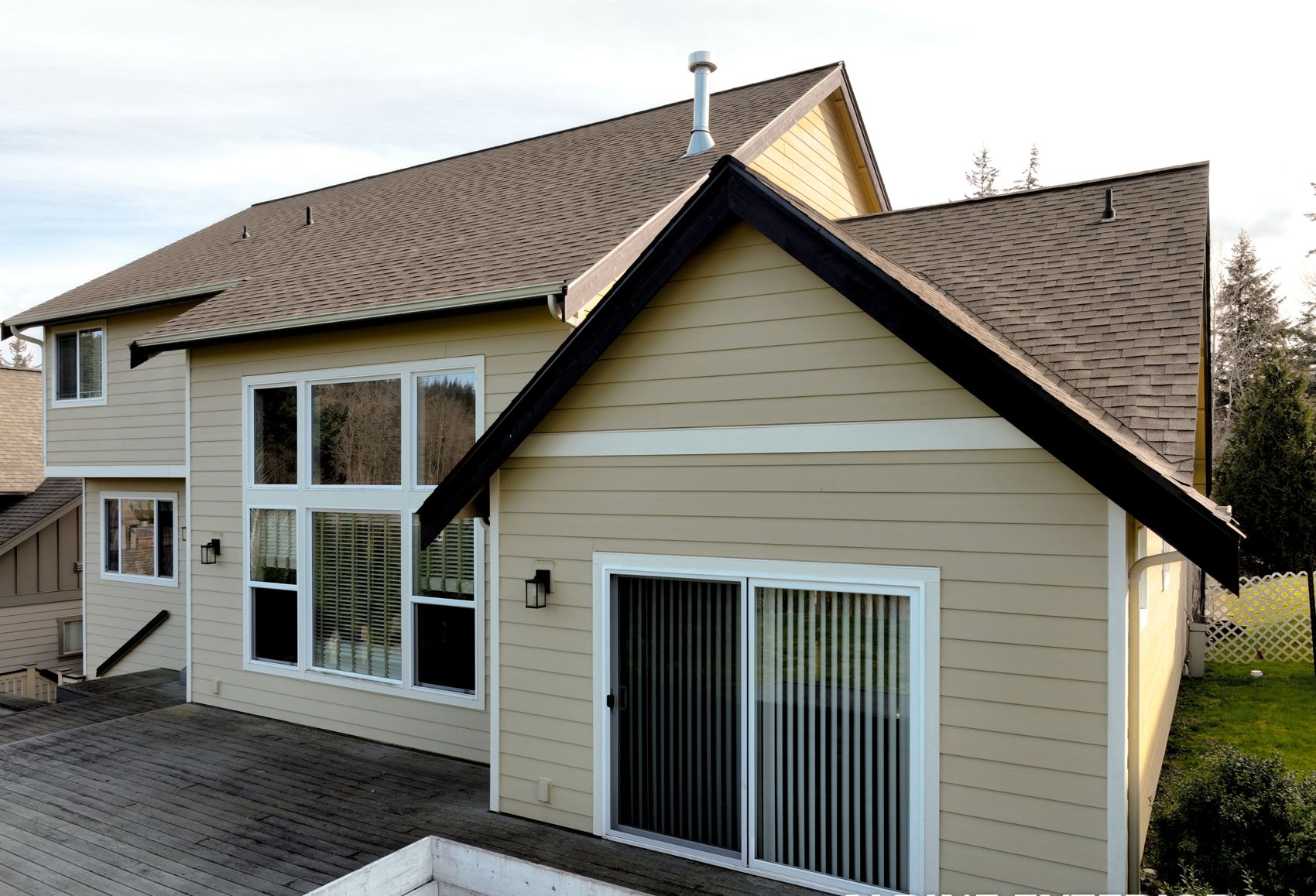
It's worth being specific about what actually applies in Kendall versus what applies elsewhere in Whatcom County, because the two aren't the same. Down toward Blaine, Birch Bay, and the Bellingham waterfront, wind-driven rain coming off Bellingham Bay and the Strait of Georgia is the bigger factor — storms push rain sideways into west- and southwest-facing walls, stressing seams and trim on exposed elevations. Kendall, being inland and up in elevation, doesn't take that same direct exposure. What it takes instead is more time spent wet, and more temperature swings.
Because Kendall sits higher and further from the marine influence that keeps Bellingham's temperatures more moderate, the foothills see more freeze-thaw cycling over a typical winter — nights that drop below freezing followed by daytime thaw, repeated over weeks. Any water that's already worked its way into a seam, a nail hole, or a crack in aging caulk expands when it freezes, widening the opening a little more each cycle. That's a slow, cumulative process rather than storm damage in the classic sense, but a hard autumn storm is often what gets water into the material in the first place, and the winter freeze-thaw cycle is what turns a small intrusion point into a real problem by spring.
The other regional factor is simply how much of Kendall is wooded and semi-rural. Properties with a lot of tree cover get more debris — needles, cones, small branches — building up in siding grooves, behind shutters, and where the wall meets the roofline, all of which traps moisture and gives moss somewhere to start. Homes on more open lots dry out faster between storms and generally hold up better over the same number of years, all else being equal.
Start with a walk-around, not a ladder. From the ground, look for these things after any storm and again at the start of each dry stretch:
If you find soft wood, active water staining, or panels that have separated, don't wait for it to get worse — get it looked at before the next storm, not after. Small repairs (recaulking a joint, replacing a section of rotted trim, reattaching a loose panel) are inexpensive relative to what happens if that same spot stays open through a winter of freeze-thaw cycles. Alpine Exteriors inspects siding across Whatcom County, including Kendall and the rest of the foothills, and can tell you honestly whether a spot is a caulk-and-monitor situation or something that needs a panel replaced now.
On the insurance side, most homeowner's policies in Washington cover siding damage that's clearly tied to a specific storm event — wind, falling debris, ice — but they generally exclude damage from gradual deterioration, and an adjuster who sees moss-covered, long-soaked wood is going to ask questions about maintenance history. That's exactly why the photo documentation matters: dated photos from before and after a storm, plus a written estimate that separates storm-caused damage from pre-existing wear, give you a much stronger claim. If a project does involve exterior work, anything affecting the building envelope on a Washington home also needs to meet the Washington State Energy Code's insulation and air-sealing requirements for the wall assembly, which is one more reason to have a licensed contractor involved rather than patching it yourself with whatever's on hand.
It's also fair to say what siding repair won't fix. If a house has years of accumulated moisture damage in the sheathing or framing behind the siding, replacing the visible panels without addressing what's underneath just hides the problem for a season or two. A proper inspection checks behind damaged sections, not just the surface, and an honest contractor will tell you when a repair needs to open up the wall rather than just swap a board.
| Siding Material | Main Vulnerability in Kendall's Climate | What to Watch For |
|---|---|---|
| Wood / hardboard | Moisture absorption, rot at grade and sills | Soft spots, swelling, paint failure |
| Fiber cement | Caulk failure at seams and trim | Cracked joints, staining below seams |
| Vinyl | Fastener and J-channel loosening in wind | Panels that rattle, gaps at corners/windows |
| Engineered wood | Edge swelling where moisture penetrates | Puffy or delaminating panel edges |
Compare the damaged area to the rest of the wall and check your own records — if a section changed noticeably right after a known storm (a new stain, a panel that's suddenly loose), that's storm-related and worth documenting with dated photos for a possible claim. Damage that's uniform, slow-developing, and tied to shaded or moss-covered areas is more likely gradual weathering, which most insurance policies don't cover.
Generally no. Moss and algae growth is treated as a maintenance issue rather than storm damage, since it develops over time rather than from a single event. If a storm caused separate, identifiable damage — like a lifted panel or a broken piece of trim — that portion may still be covered even on a wall that also has moss staining nearby.
A yearly ground-level check plus a look after any storm strong enough to bring down branches is a reasonable baseline for a wooded lot. Homes with heavy shade, close tree cover, or a history of moss growth benefit from checking twice a year, since those conditions keep walls wet longer than more open properties in the same neighborhood.
Yes. Freeze-thaw damage is cumulative — it happens over a series of ordinary cold nights and daytime thaws, not from one dramatic event, which is why it's easy to miss. Any existing crack or gap that holds water becomes a freeze-thaw entry point regardless of whether the water got there from a storm or just routine rain, so sealing small openings before winter matters more in Kendall's foothill climate than in milder parts of the county.
If your Kendall home took on rain damage this season, or you're just not sure whether that stained wall is a quick fix or something more, Alpine Exteriors can take a look and give you a clear, honest read on what's actually going on — no pressure to replace more than the house needs. Alpine Exteriors is a licensed Washington contractor (ALPINI751OW) serving Kendall and the rest of Whatcom County, from Bellingham and Ferndale out to Lynden, Blaine, Birch Bay, Sudden Valley, and the islands. Reach out for an inspection before the next round of fall storms works its way up the valley.