
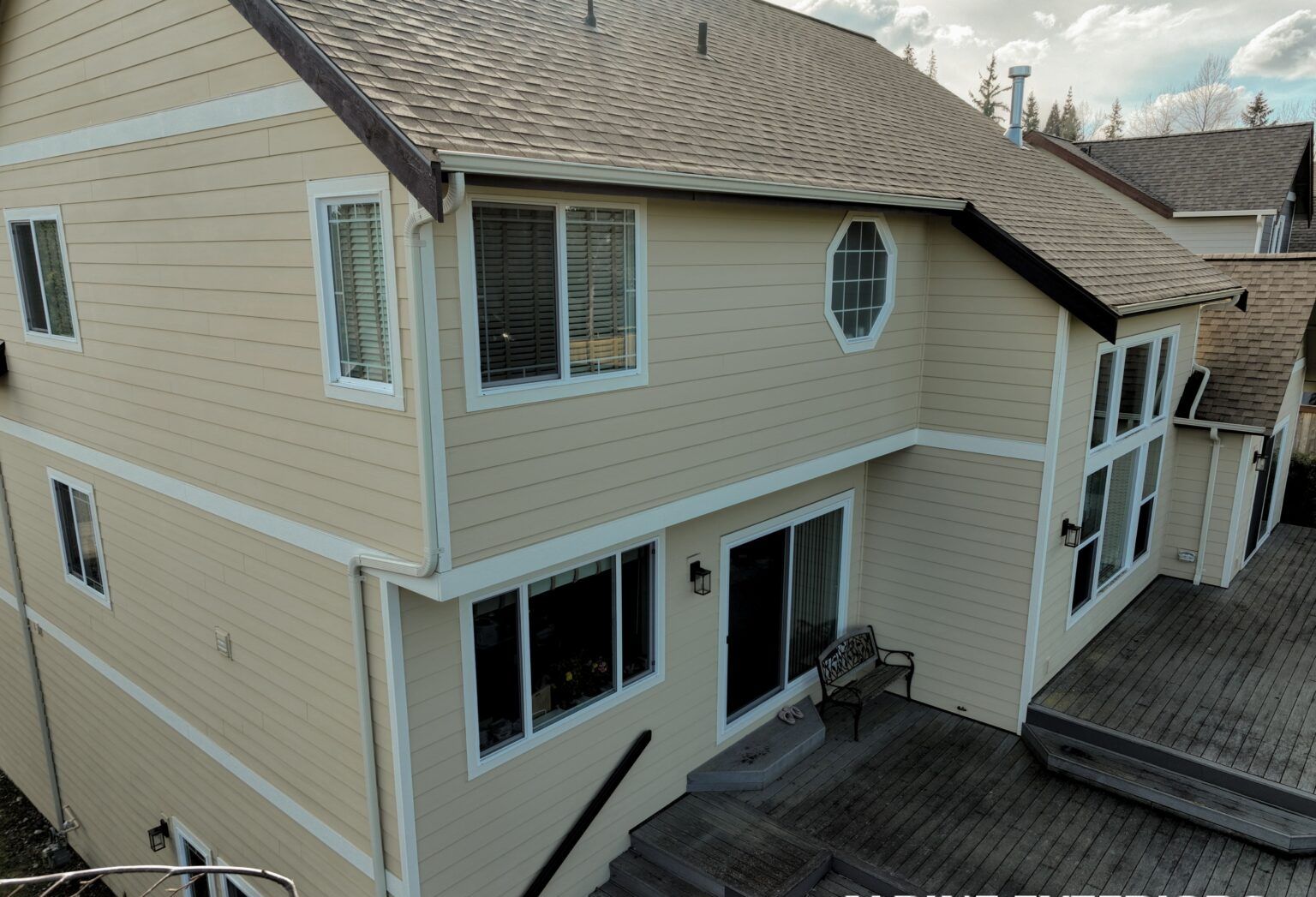
Most localized siding damage in Semiahmoo and the surrounding Whatcom County shoreline can be repaired if it is caught before rot spreads into the wall sheathing. Once moisture has traveled behind the siding into framing or insulation, replacement of that section, and sometimes the whole wall, is usually the more honest recommendation.
The right call depends less on how bad a single board looks from the driveway and more on what is happening underneath it. A homeowner in Semiahmoo, Blaine, Birch Bay, or anywhere along the Whatcom County waterfront is dealing with a different siding environment than someone forty miles inland. Wind-driven rain off Semiahmoo Bay and the Strait of Georgia pushes moisture sideways under laps and around trim in a way that vertical rain never does, and it happens for months at a stretch rather than in isolated storms. That is the starting point for almost every repair-versus-replace decision we make on this stretch of coastline. Alpine Exteriors has looked at enough of these homes to know the difference between siding that looks rough and siding that has actually failed, and the two are not the same thing.
The damage we see repeatedly along this part of Whatcom County falls into a fairly short list, and almost all of it traces back to water finding a path it should not have.
A repair makes sense when the damage is contained to a few boards or panels, the sheathing behind it is dry and solid when probed, and the rest of the wall's siding is in reasonably sound condition. In that scenario, cutting out the damaged section, replacing it with matched material, resealing the seams, and repainting or refinishing to blend is a legitimate, lasting fix, not a stopgap. It is also the more affordable route, generally running in the low hundreds to low thousands of dollars depending on how many boards are involved, and there is no reason to replace an entire elevation of siding that is otherwise doing its job.
Replacement becomes the honest recommendation once we find soft or delaminated sheathing behind the siding, rot that has traveled into window or door framing, siding that has already been patched multiple times in the same spots, or damage spread across enough of a wall that patching would leave a visibly uneven, short-lived repair. It is also worth considering replacement, at least for that elevation, when the existing siding is an older or discontinued product line, because matching it convincingly gets harder every year that passes. Full-wall or whole-house replacement costs vary widely with material and square footage, so a real number only comes from an in-person look rather than a rule of thumb. We will always tell a homeowner plainly which category their siding falls into rather than defaulting to the larger job.
Matching existing siding is its own challenge here, separate from the repair-or-replace decision. Cedar lap and shingle siding weathers unevenly depending on sun exposure, so a brand-new board dropped into a fifteen-year-old wall will look noticeably different in color and grain until it weathers in, which can take a full season or more. Fiber-cement siding is trickier in a specific way: manufacturers change plank profiles, exposure widths, and colorways over time, so a product installed a decade ago may no longer be sold in the same reveal or finish. That forces a choice between hunting down old stock, blending in a visually similar profile, or repainting a larger section so the seam between old and new is less obvious. Vinyl siding fades from UV exposure over years, and new panels, even in the same nominal color, can read visibly whiter or brighter next to sun-faded originals.
None of this is a reason to avoid a repair. It is a reason to have a frank conversation about expectations before the work starts, including whether the whole wall or elevation should be repainted to even things out, rather than discovering the mismatch after the crew has already left.
The conditions that drive siding failure here are specific to this corner of Washington, and they are not the same conditions a contractor would plan around in a drier climate. Persistent rain across fall, winter, and spring means siding here spends far more of the year wet than siding in most of the country, so any gap in the water-resistive barrier, flashing, or caulk has more opportunity to do damage before it is caught. Wind-driven rain off Bellingham Bay and the Strait adds a lateral component to that moisture, pushing water into laps and seams that would stay dry in calmer weather, which is why proper flashing and shingled overlaps matter more here than the visual grade of the siding material itself.
Moss and algae are effectively a permanent condition on shaded, north-facing walls in this region, not an occasional nuisance, and any repair plan that ignores the tree cover and drainage around a house is treating a symptom instead of the cause. Homes up in the foothills toward Sudden Valley and the Mount Baker corridor see freeze-thaw cycling that coastal Semiahmoo mostly avoids, where water that gets behind siding can freeze, expand, and pry panels or trim loose over a winter, a different failure mechanism than the rot-driven damage more typical right on the water. And any new siding or full-wall replacement on a home in this county has to meet the Washington State Energy Code, which governs the wall assembly's insulation and air-sealing performance, not just the visible siding product, so a replacement project is also a chance to correct any gaps in the water-resistive barrier or insulation that contributed to the failure in the first place.
Start by looking at the siding from a few feet away in daylight, ideally after a dry stretch, and note where boards look swollen, where paint is bubbling or peeling in a way that suggests moisture underneath rather than simple weathering, and where moss or algae has built up thickly rather than just staining the surface.
Alpine Exteriors, working under Washington contractor license ALPINI751OW, walks a wall section by section, checks for softness and moisture at the vulnerable points listed above, and gives a straight answer on whether a section is a repair, a partial replacement, or worth reconsidering as a full elevation replacement, along with what that means for matching the rest of the house.
The clearest sign is whether the wood or sheathing behind the visible damage is still solid. If a board looks weathered or lightly stained but feels firm when pressed, a localized repair is usually enough. If it feels soft, spongy, or crumbles at an edge, or if the same spot has already been patched once before, the damage has likely traveled further into the wall than the surface suggests, and it is worth having someone check what is happening underneath before deciding.
It usually comes down to sun exposure and airflow rather than the siding material itself. North-facing and heavily shaded walls, common on lots with mature trees around Semiahmoo, Birch Bay, and Sudden Valley, stay damp far longer after rain than walls that get afternoon sun, and that extra moisture is exactly what moss and algae need to establish. Trimming back overhanging branches and improving airflow near the wall helps more than any cleaning product on its own.
It depends on the material and how long the original siding has been on the house. Cedar and fiber-cement both weather and fade over years, so a newly installed section will look different for a season or more until it settles in, and older fiber-cement profiles are sometimes no longer manufactured, which can mean blending in a similar profile or repainting a broader section to even out the transition. Vinyl is usually the hardest to match invisibly because sun-fading is permanent and a new panel will read brighter next to older ones. We will tell you upfront which situation applies before any work starts.
Any wall assembly that gets opened up for a substantial siding replacement in Washington needs to meet the applicable requirements of the Washington State Energy Code for that scope of work, which covers insulation and air-sealing at the wall, not just the exterior product. In practice this is usually a benefit rather than a burden, since it is the natural point to correct any gaps in the water-resistive barrier or insulation that likely contributed to the original damage.
If you are looking at damaged, stained, or aging siding anywhere from Semiahmoo down through Blaine, Birch Bay, Bellingham, Ferndale, Lynden, Sudden Valley, or the islands, the fastest way to know what you are actually dealing with is to have it looked at in person. Alpine Exteriors, licensed in Washington as ALPINI751OW, will check what is happening behind the siding, not just the surface, and give you a clear repair-or-replace recommendation along with realistic expectations on matching before any work begins. Contact Alpine Exteriors to schedule an inspection of your home's siding.