
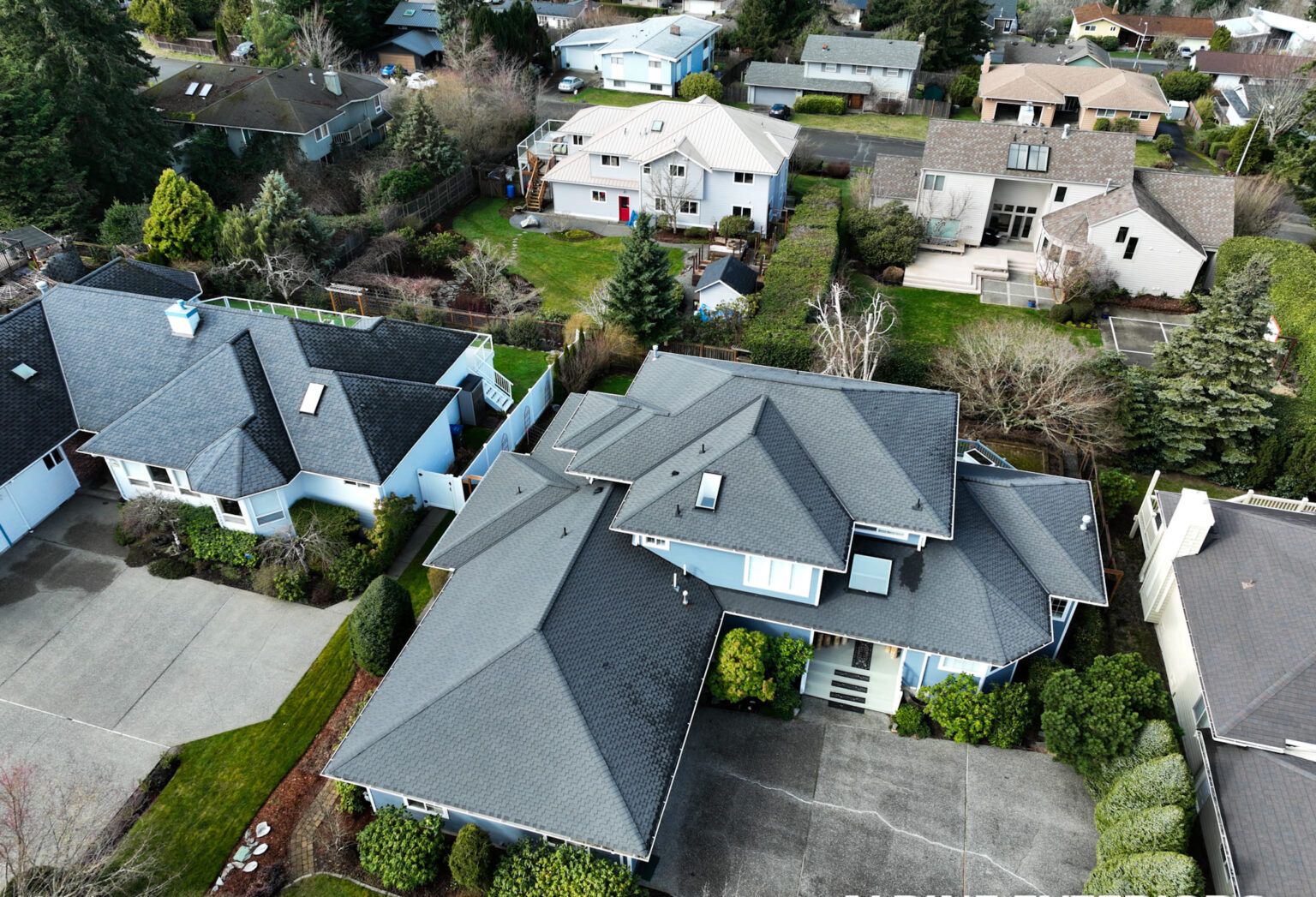
In Whatcom County, siding near Samish has to satisfy two code systems at the same time: the wind-resistance and fastening provisions of the International Residential Code as adopted in Washington, and the insulation and air-barrier requirements of the Washington State Energy Code. Get either one wrong — a fastening schedule that's too loose, or a water-resistive barrier that isn't detailed correctly at seams and openings — and the siding will fail well before its expected service life, regardless of how good the product itself is.
That's the short version. The longer version is that "code compliant" isn't one checklist applied the same way to every house in the county. A house on Lake Samish Drive with open southwest exposure up the valley is a different wind and moisture situation than a shaded, tree-covered lot half a mile back from the water. The code accounts for that through exposure category and design wind speed built into the IRC's tables, and a competent installer adjusts the fastening pattern, corner treatment, and water management to match instead of installing every house the same way.
On the product side, Washington doesn't run a statewide product-approval list the way some coastal states do. Instead, siding products are expected to carry a current ICC-ES evaluation report, or equivalent testing to the relevant ASTM standard — ASTM D3679 for vinyl siding, ASTM C1186 for fiber-cement sheet products — and to be installed per the manufacturer's published instructions, which the code treats as enforceable once referenced. Inspectors in Whatcom County will ask for that documentation on anything unusual, and a manufacturer's installation manual that calls for a tighter nailing pattern in high-wind zones is a requirement, not a suggestion.
| Siding Material | Wind & Fastening Notes | Moisture & Moss Behavior Here | Typical Installed Cost Range |
|---|---|---|---|
| Fiber cement (plank or panel) | Needs corrosion-resistant fasteners driven to the depth the manufacturer specifies, with tighter spacing at corners and eaves per the ICC-ES report | Handles standing moisture well but can spall or crack if fasteners are overdriven or caulk joints fail under freeze-thaw | $9 to $16 per sq. ft. installed |
| Vinyl (standard and insulated) | Wind rating varies widely by panel gauge and nail-hem design; lower-cost vinyl often carries a lower published wind rating | Sheds water well but grows moss and algae quickly on shaded, north-facing walls without periodic rinsing | $6 to $11 per sq. ft. installed |
| Engineered wood / wood composite | Fastening logic is similar to fiber cement; sealing cut ends at install is critical to the warranty | More vulnerable to rot at end cuts and butt joints if the factory seal is broken during installation | $8 to $14 per sq. ft. installed |
Samish sits inland from Bellingham in the foothills around Lake Samish, and that geography changes the wind and moisture picture from what you'd see on a flat, in-town lot. Homes at this elevation see more freeze-thaw cycling through the winter than houses closer to sea level in Fairhaven or downtown Bellingham. Water that finds its way into a caulk joint or a gap behind a butt seam can freeze, expand, and reopen that joint within a single winter — sealants and trim details that hold up fine on a lowland lot need to be rated for that cycling, and they're worth a second look after the first hard freeze, not just at install.
The tree cover that makes Samish appealing also works against siding. Heavily wooded lots and north-facing walls under a full canopy stay damp far longer after a rain event than an open lot does, and that's exactly the condition moss and algae need to take hold. It isn't just cosmetic — moss holds moisture against the siding surface, and on wood or engineered-wood products that trapped moisture is what eventually turns into rot at seams and fastener penetrations. A ventilated rainscreen gap behind the siding, even a basic furring-strip version, drains and dries that surface far faster than siding installed tight to the wall, and on a shaded lot it's usually worth the added cost.
Wind here doesn't behave the way it does right on the water in Blaine or Birch Bay, where wind-driven rain comes off Bellingham Bay and the Strait of Georgia with almost nothing to slow it down first. Samish is more sheltered by terrain, but the valley around Lake Samish and the surrounding foothills still funnel gusts during fall and winter storm systems, and mature trees on most lots mean falling limbs and wind-thrown debris are a real risk to siding and trim in a way that open waterfront lots don't deal with as much. The practical takeaway is the same either way: exposure category, not just the general area's wind speed, should drive the fastening schedule on a given lot, and a lot with a clear line to open water or open field gets treated differently than one buried in trees.
None of this is hurricane-country engineering, and Whatcom County isn't rated for that — no contractor should be pricing a Samish job as though it were. What matters here is sustained, repeated exposure: rain that lasts for days rather than hours, humidity that doesn't fully dry out between storms, and a freeze-thaw cycle that shows up every winter whether or not the original install was done carefully.
Most of the risk on a siding project isn't the product — it's what happens (or doesn't happen) behind it, and whether the contract reflects the specific lot rather than a generic bid. A few concrete steps make a real difference:
It's worth being honest about the trade-offs, too. A ventilated rainscreen and an upgraded fastening pattern add real labor and material cost, and on a tight budget it's tempting to skip both in favor of a cheaper vinyl product with a lower wind rating. On a sheltered, tree-covered lot, that's a reasonable place to save money. On a lot with real exposure — open frontage toward the lake, a cleared view corridor, or a history of storm damage to the roofline or fencing — it's the wrong place to cut, because the failure shows up years later as blown panels or hidden rot, not as an obvious problem on install day.
In most cases, yes, particularly if the work involves removing sheathing, changing the type of cladding, or repairing damage found behind the old siding. If the lot is in unincorporated Whatcom County, the permit goes through Whatcom County Planning and Development Services; if the home is inside Bellingham city limits, it goes through the City of Bellingham instead. A straightforward like-for-like recover over sound, intact sheathing sometimes qualifies for a lighter review, but that call should come from the jurisdiction, not from an assumption made on the job site.
There's no single number that applies to every lot in the area. The IRC's wind provisions tie back to exposure category as well as the general design wind speed, so a sheltered, tree-lined lot and an open lot with a clear line down the valley can have different practical requirements even though they're a short drive apart. The right approach is to have the installer document the exposure category for your specific site and match the product's tested wind rating and fastening schedule to that, rather than assuming a generic county-wide number is good enough.
Moss and algae growth is a moisture and shade problem, not something the building code directly regulates — code governs the water-resistive barrier and drainage behind the siding, not what grows on the surface. Shaded, north-facing walls under tree cover stay damp longest and will grow moss fastest no matter what siding material is used. A ventilated rainscreen helps the wall assembly dry out faster and reduces how much moisture stays trapped against the surface, but periodic cleaning is still normal maintenance on a heavily shaded lot.
Both can perform well here when installed correctly, and the honest answer depends more on the specific lot and budget than on one product being universally better. Fiber cement tends to hold up better over time on more exposed lots because of how it's fastened and its resistance to wind-driven moisture at the seams, but it costs more and is heavier to install correctly. Vinyl performs fine on sheltered lots and costs less, but wind rating varies significantly between product lines, so a budget vinyl panel on an exposed lot is a real risk in a way it usually isn't on a tree-sheltered one.
If you're planning a siding project near Samish, Lake Samish, or anywhere else in Whatcom County, it's worth getting a site-specific look before committing to a product or a price. Alpine Exteriors works throughout Whatcom County — Bellingham, Ferndale, Lynden, Blaine, Birch Bay, Sudden Valley, and the surrounding communities — and can walk your specific lot, talk through exposure and drainage, and put the fastening schedule and product documentation in writing before any work starts. Alpine Exteriors holds Washington contractor license ALPINI751OW; reach out for a straightforward look at what your home actually needs.