
Sehome will never see a hurricane, but the wind that funnels down Bellingham Bay and across the Strait of Georgia during a November or January storm is strong enough to strip loose siding off a wall in a single night. Under the Washington State Building Code, siding on a Sehome home has to be installed to the manufacturer's approved instructions for the local wind exposure, using the fastening pattern and materials those instructions specify — not whatever a crew happens to have on the truck.
That distinction matters because most siding failures Alpine Exteriors gets called out for in this neighborhood aren't dramatic blow-offs during a big storm. They're slow: a panel that was hand-nailed instead of properly seated, a corner post that was never flashed, or a house wrap lap installed backward so that wind-driven rain gets pushed uphill under the cladding every time the wind comes off the water. Code compliance is less about surviving one big event and more about the installation holding up to years of repeated wetting.
Washington doesn't write its own wind-speed maps or invent its own siding rules from scratch. The state adopts the International Residential Code (IRC) with Washington-specific amendments, and Whatcom County jurisdictions — the City of Bellingham for a Sehome address, unincorporated Whatcom County for the rural fringe — enforce that code through their own permitting and inspection process. For siding specifically, the code doesn't hand a contractor a single fastening schedule; it requires the product to be installed per the manufacturer's written instructions, and those instructions have to be backed by testing and, for most manufactured siding products, an ICC-ES evaluation report or equivalent listing that ties the product to a wind-resistance rating.
In practice, that means the fastening schedule a crew uses — nail or screw type, spacing along the panel, penetration depth into the sheathing or stud, whether the fastener is driven snug or left with a small gap for panel movement — comes from the specific product's installation manual, not from habit. Vinyl siding, for example, has to be face-nailed loosely enough to allow for thermal expansion but still meet the manufacturer's wind-load rating; over-driving the nail is one of the most common defects an inspector or a follow-up crew finds on this stretch of coast, because a tightly nailed panel can't expand and contract normally and eventually buckles or pulls loose in wind. Fiber cement siding uses a different logic entirely — it's dimensionally stable, so it's typically face-nailed or screwed tight, but it requires corrosion-resistant fasteners (stainless or hot-dip galvanized, not electro-galvanized) because Whatcom County's rain frequency will find and rust anything less over a decade or two.
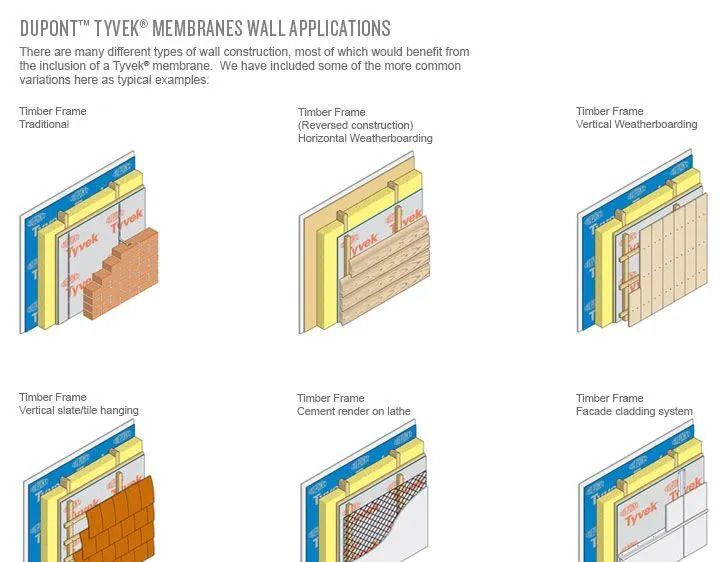
Beneath the visible siding, code also governs the water-resistive barrier (WRB) — the house wrap or building paper — and how its seams and laps are oriented and taped. The IRC requires laps to shed water downward and outward, and in a wind-driven-rain climate like Bellingham Bay's, an inspector checking a re-side or new build will look specifically at whether the WRB integrates correctly with window and door flashing, not just whether wrap is present. A siding job can look flawless from the street and still fail this part of an inspection if the flashing sequence behind it is wrong.
None of this is generic code trivia — it's shaped by conditions that are specific to this part of Washington. A few stand out for homes in Sehome and the surrounding Bellingham area:
Most homeowners can't verify a fastening schedule themselves, and that's fine — the point isn't to become an inspector, it's to ask the right questions and confirm the right paperwork exists before the wall is closed up.
Not a special product category, but the installation does need to match the wind exposure that comes with being on a hill near Bellingham Bay. In practice this means confirming the siding is installed per its manufacturer's tested wind rating for the applicable exposure, with the correct fastening pattern — the material itself (vinyl, fiber cement, or engineered wood) can generally handle local wind loads when it's installed correctly; most failures trace back to installation shortcuts rather than the product being wrong for the area.
On a permitted job, an inspector typically checks that the water-resistive barrier is installed with correct lap direction and integrates properly with window and door flashing, that fasteners are the type and spacing called for in the manufacturer's instructions, and that the siding maintains proper clearance from grade, decks, and roof surfaces. They're generally not re-deriving wind-load calculations on-site — they're confirming the installation matches the approved product instructions and the basic moisture-management details that keep the wall assembly dry.
Both can work here and both are common on Bellingham homes; the honest tradeoff is upfront cost versus long-term rigidity and moisture tolerance. Vinyl is less expensive and holds up fine when it's installed with the correct nailing allowance for expansion, but it can look and perform worse over time in shaded, damp spots where algae and moss take hold. Fiber cement costs more and is heavier to install, but it's more dimensionally stable and generally more resistant to the slow moisture exposure that's common in this climate. Neither choice gets you out of doing the fastening and flashing correctly — that part matters more than the material choice.
It can, depending on the scope of the project and how much of the wall assembly is being opened up — a full re-side that exposes the sheathing is more likely to trigger energy code review than a small patch repair. Where it applies, the energy code's continuous insulation and air-sealing provisions can add rigid foam or furring strips under the new siding, which changes the fastener length and the rainscreen gap needed behind the cladding. This is worth asking about early, since it affects both the cost and the fastening details, not just the finished look.
If you're planning a re-side, a repair, or you just want a second opinion on whether an existing installation was done to code, Alpine Exteriors serves Sehome and the rest of Whatcom County — Bellingham, Ferndale, Lynden, Blaine, Birch Bay, Sudden Valley, and the islands — under Washington contractor license ALPINI751OW. We'll walk the wall assembly with you, explain what the manufacturer instructions and local code actually call for on your specific home, and give you a straightforward assessment of what it would take to get it right, including the honest tradeoffs between a like-for-like re-side and a more complete moisture-management upgrade. Reach out to schedule a walkthrough.