
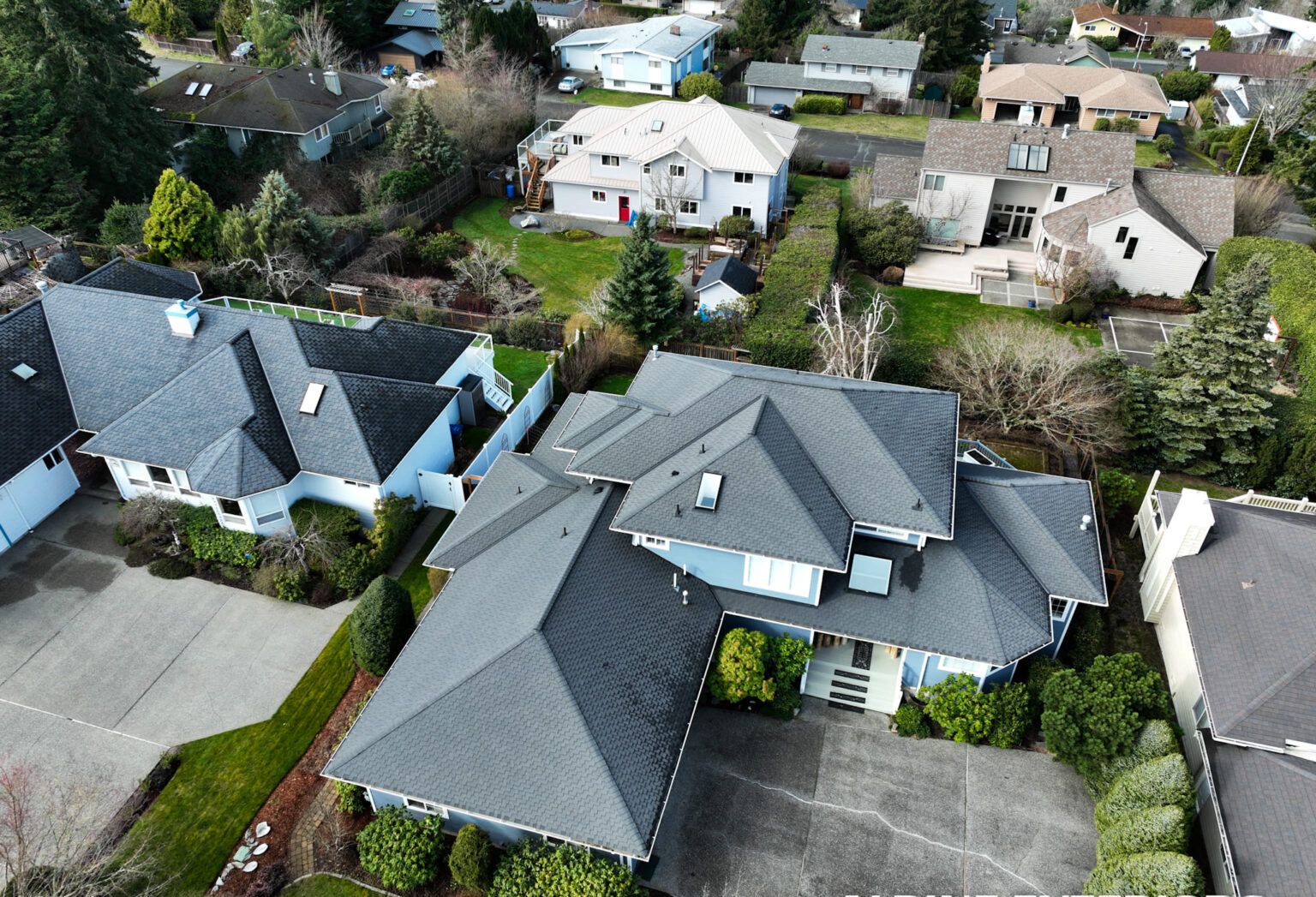
Sehome sits close to downtown Bellingham and Western Washington University, on tree-shaded streets with a mix of early-1900s bungalows, mid-century ramblers, and newer infill homes. That mix of age and exposure means no two houses in the neighborhood age the same way. A checklist like this one gives you a repeatable way to catch small siding problems before Whatcom County's wet season turns them into expensive ones.
Bellingham averages well over 100 days of measurable rain a year, and Sehome's older tree canopy keeps north- and west-facing walls damp and shaded for long stretches between storms. That combination is exactly what moss, algae, and mildew need to take hold on siding, trim, and fascia boards. Add in wind-driven rain that comes off Bellingham Bay and the Strait of Georgia during fall and winter storms, and water gets pushed sideways into laps, seams, and corner boards that would stay dry in a calmer climate. Once water finds a way behind the siding, wood-based products and even the sheathing underneath can start to rot, often invisibly, since the damage happens between the siding face and the wall.
Elevation matters too. Sehome itself is close to sea level, but many Whatcom County properties climb into the foothills toward Lake Whatcom and Sudden Valley, where nighttime temperatures drop enough for freeze-thaw cycling in late fall and winter. Water that has soaked into a crack or a failed caulk joint can freeze, expand, and widen that crack, which is why small gaps tend to get worse fast once the weather turns cold. Finally, any time siding comes off for repair or replacement, the work has to account for the Washington State Energy Code, which sets requirements for continuous insulation and the weather-resistive barrier behind the cladding on most remodel and re-side projects. A qualified contractor factors that in during the repair, not as an afterthought.
Not every failed item means a full re-side. If you find isolated moss or algae staining with no soft spots underneath, a gentle wash with a soft-bristle brush and a cleaner made for exterior siding is often enough; avoid high-pressure washing, which can force water behind laps and seams and create the very problem you're trying to prevent. If caulk has cracked or pulled away but the substrate underneath is still solid, re-caulking that joint with an exterior-grade sealant is a reasonable homeowner-level fix.
If you find soft, spongy wood, active leaks, or staining that traces back to a specific point like a flashing gap or a butt joint, that's a sign moisture has already gotten past the surface. Cutting out and patching that section without addressing what let water in will likely fail again within a season or two. Be honest with yourself about scope: a single rotted board near a downspout might be a straightforward repair, but rot that shows up in multiple locations, or staining that reappears after cleaning, usually points to a broader moisture path that needs a more thorough look, and possibly opening up the wall to check the sheathing and weather-resistive barrier.
Call a professional if you find soft or spongy siding in more than one area, if you can see daylight or feel airflow through a gap, if flashing is visibly rusted or detached, or if you're not comfortable getting on a ladder to check upper stories, roof-to-wall intersections, or gutter lines safely. A contractor can also use a moisture meter to check readings behind the siding face, which isn't something you can assess with a visual inspection alone. If any repair involves removing siding down to the sheathing, that work needs to account for the Washington State Energy Code's continuous insulation and weather-resistive barrier requirements, which is a good reason to bring in a licensed contractor rather than patch it yourself. Alpine Exteriors, licensed in Washington under contractor license ALPINI751OW, inspects siding throughout Bellingham, Ferndale, Lynden, Blaine, Birch Bay, Sudden Valley, and the surrounding islands, and can tell you honestly whether a section needs a patch, a partial re-side, or nothing more than a wash and re-caulk.
A walk-around twice a year, once in late summer before the fall storms arrive and once in early spring after winter, catches most developing issues while they're still small. Homes under heavy tree cover or close to the bay may benefit from an extra check after a particularly windy or wet storm season.
Not always. Surface moss and algae on shaded siding are common in Sehome simply because of the climate and tree cover, and by themselves they don't mean the siding has failed. The concern is when growth is paired with soft wood, staining that returns quickly after cleaning, or growth concentrated at a specific joint or flashing point, since that combination suggests moisture is getting trapped rather than just sitting on the surface.
Low-pressure washing with a fan tip and the nozzle held at a safe distance can work for some materials, but high-pressure washing risks driving water behind laps, seams, and around fasteners, especially on older siding with worn caulk joints. A soft wash approach with an appropriate cleaner and a brush is generally lower risk, and if you're unsure what your siding material can tolerate, it's worth asking a contractor before you start.
Re-siding a wall section, especially if it involves removing the existing weather-resistive barrier, generally needs to comply with the Washington State Energy Code's insulation and moisture-barrier provisions for the affected area, not just match the old material. This is one of the reasons a larger repair is worth having a licensed contractor evaluate rather than treating it as a like-for-like swap.
If your walk-around turned up soft spots, failed caulk, or growth that keeps coming back, it's worth getting a second set of eyes on it before the next storm season. Alpine Exteriors serves homeowners throughout Whatcom County, including Sehome, Bellingham, Ferndale, Lynden, Blaine, Birch Bay, and Sudden Valley, and can walk your property with you, point out what's cosmetic versus what needs attention, and give you a straightforward assessment of your options and approximate cost range before any work begins.