
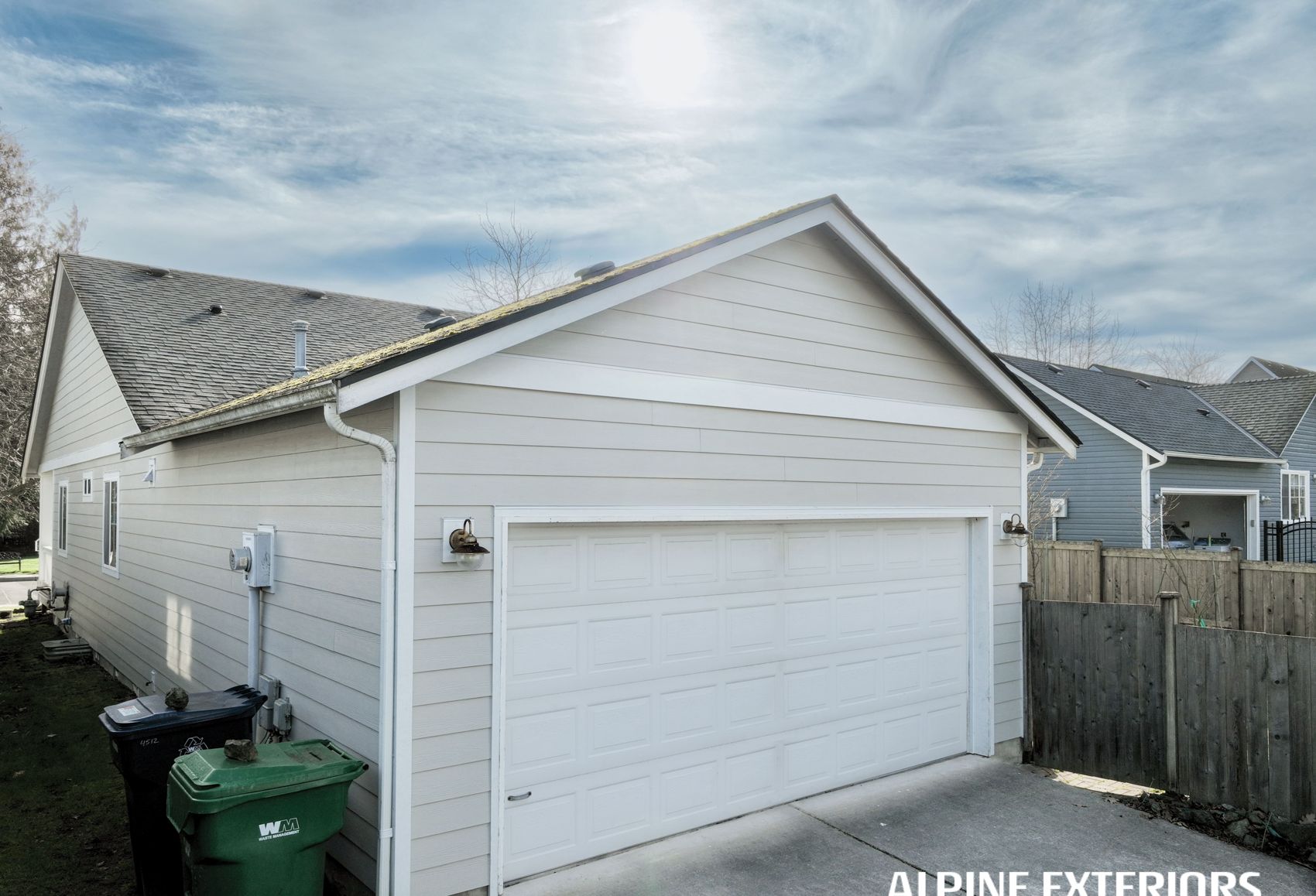
In most cases, straightforward siding replacement on an existing Sehome home — pulling off old lap siding or T1-11 and putting up new material in the same configuration — does not require a separate building permit from the City of Bellingham. A permit becomes necessary the moment the job touches structural sheathing, the wall's water-resistive barrier assembly in a way that affects code compliance, or is bundled with other work (window changes, additions, structural repair) that already needs one.
That "usually no, sometimes yes" answer is the whole reason homeowners get tripped up. The line isn't about square footage or cost — it's about whether the work stays cosmetic or crosses into the building's structural and moisture-management systems. Alpine Exteriors pulls permits on a large share of Whatcom County siding jobs specifically because rot repair, not the siding itself, is what usually pushes a project over that line.
Jurisdiction in Whatcom County splits along city and county lines, and Sehome sits inside Bellingham city limits, so its permitting authority is the City of Bellingham's Permit Center, not the county. If your project is in Ferndale, Lynden, or Blaine, you're dealing with each town's own building department; if you're in an unincorporated area — Birch Bay, Sudden Valley, most of the county outside the incorporated cities — Whatcom County Planning & Development Services is the issuing agency. These offices don't share a permit database, so a contractor working across the county genuinely needs to know which desk to walk up to for each address.
All of these jurisdictions administer the same base codes: the Washington State Building Code (which adopts the International Residential Code with state amendments for one- and two-family dwellings) and the Washington State Energy Code (WSEC). Neither code cares what city issued the permit — the requirements are statewide. What differs locally is the permit application process, fee schedule, and how aggressively a given office enforces the line between "repair" and "alteration."
Here's what actually triggers a permit requirement on a siding job in this region:
If a permit is required, expect a plan review step (even if brief for a straightforward re-side), a fee based on job valuation, and at least one field inspection — sometimes more if sheathing or framing repair is part of the scope. Inspectors are checking that water-resistive barrier laps are correct, that any exposed sheathing was properly repaired before covering, and that the assembly meets the energy code where it applies.
Whatcom County's climate is the reason siding here fails in specific, predictable ways, and it's also why local building departments pay closer attention to what's happening behind the siding rather than the siding itself. Bellingham and the surrounding lowlands get a long, low-intensity rainy season rather than short bursts — moisture has months to work into any gap in the cladding, not hours. Combine that with wind-driven rain off Bellingham Bay and the Strait of Georgia, which pushes water sideways into laps, seams, and butt joints that would stay dry in a calmer climate, and you get chronic wall assembly problems that don't announce themselves until the siding comes off.
North-facing walls and anything shaded by mature evergreens — common throughout Sehome's older, tree-lined blocks — develop moss and algae growth that holds moisture against the siding surface far longer than sun-exposed walls. That sustained dampness is a major contributor to the wood rot Alpine Exteriors finds on original siding and trim during tear-off, especially on homes from the mid-20th century that never had a proper drainage plane behind the cladding.
Up toward the foothills — Lake Whatcom, Sudden Valley, and the higher elevations east of town — freeze-thaw cycling adds a second mechanism of damage. Water that gets into a crack or seam during a wet stretch, then freezes overnight, expands and widens that opening, so problems that start as a hairline gap grow season over season. None of this is hurricane country, and there's no wind-mitigation form or wind-uplift rating to chase here the way there would be on the Gulf Coast — the concerns in Whatcom County are moisture intrusion, rot, and long-term water management, not wind resistance.
The practical result: a siding job that looks purely cosmetic from the street — "just replace the siding" — very often turns into a permitted repair once the old cladding comes off and the sheathing underneath is exposed. That's not a sign of a bad contractor finding excuses to charge more; it's what actually happens to wood-framed walls after decades of this weather pattern.
Before signing a contract, ask your contractor directly whether they expect the job to require a permit, and ask them to confirm that expectation with the City of Bellingham Permit Center (or the relevant county or city office, if you're outside Bellingham) before work starts. Don't rely on a verbal "it usually doesn't need one" — get it in writing or at least documented in the estimate, because the answer can change once the crew opens up the wall.
Second, build a contingency into your budget and timeline for the possibility that sheathing repair is needed. On a lot of Sehome homes, especially those with original wood siding or old T1-11 panels, some amount of rotted sheathing is close to a certainty rather than a risk. A contractor who quotes a re-side job with zero allowance for sheathing repair is either working from an optimistic assumption or hasn't looked closely at comparable homes in the neighborhood.
Third, confirm your contractor is pulling the permit under their own license, not asking you to pull an owner permit for work they're performing. In Washington, a licensed contractor performing the work should generally be the one on record with the permitting agency. Alpine Exteriors, license ALPINI751OW, handles the permit application and inspection scheduling directly on jobs where the scope requires one, rather than leaving that step to the homeowner.
Finally, don't skip the inspection step even if it feels like a formality. The inspection is the point where an independent set of eyes verifies the water-resistive barrier is lapped correctly and that any structural repair meets code — both things that are effectively invisible once the new siding goes up. A signed-off inspection is also documentation you'll want if you ever sell the house or file an insurance claim related to water damage down the road.
Not automatically. A like-for-like siding replacement that doesn't touch structural sheathing or the wall's water-resistive barrier assembly typically doesn't require a separate permit from the City of Bellingham. The moment the scope includes sheathing repair, a change in wall assembly type, or bundled work like window replacement, a permit is generally required. Confirm your specific project with the Bellingham Permit Center rather than assuming either way.
A building inspector from the issuing jurisdiction — the City of Bellingham for Sehome addresses, or Whatcom County Planning & Development Services for unincorporated areas like Birch Bay or Sudden Valley — comes to the site to verify the work before it's covered up and again after completion. They're primarily checking water-resistive barrier lap direction and overlap, any structural sheathing repair, and, where it applies, energy code compliance for the wall assembly.
This is common enough in Whatcom County that a good contractor should expect it rather than treat it as a surprise change order out of nowhere. Once sheathing is exposed and needs replacement, the project generally shifts from a cosmetic re-side into permitted structural repair, which means a permit application (if one wasn't already pulled), an inspection of the repaired sheathing before new siding covers it, and likely additional cost and time. Ask upfront how your contractor prices and communicates this scenario.
Timelines vary with the Permit Center's current workload and the complexity of the scope — a simple re-side with minor sheathing repair moves faster than a project bundled with structural or window work. Rather than guessing, ask your contractor to give you a realistic range based on recent jobs and to flag early if a plan review is likely to add time, so the permit step doesn't catch you off guard partway through a project.
If you're planning a siding project in Sehome or anywhere else in Whatcom County and aren't sure whether it'll need a permit, Alpine Exteriors can walk the property, give you an honest read on what's likely hiding behind the existing siding, and handle the permit application and inspections if the scope requires it. Reach out to Alpine Exteriors, WA contractor license ALPINI751OW, for a straightforward assessment before you commit to a contract.