
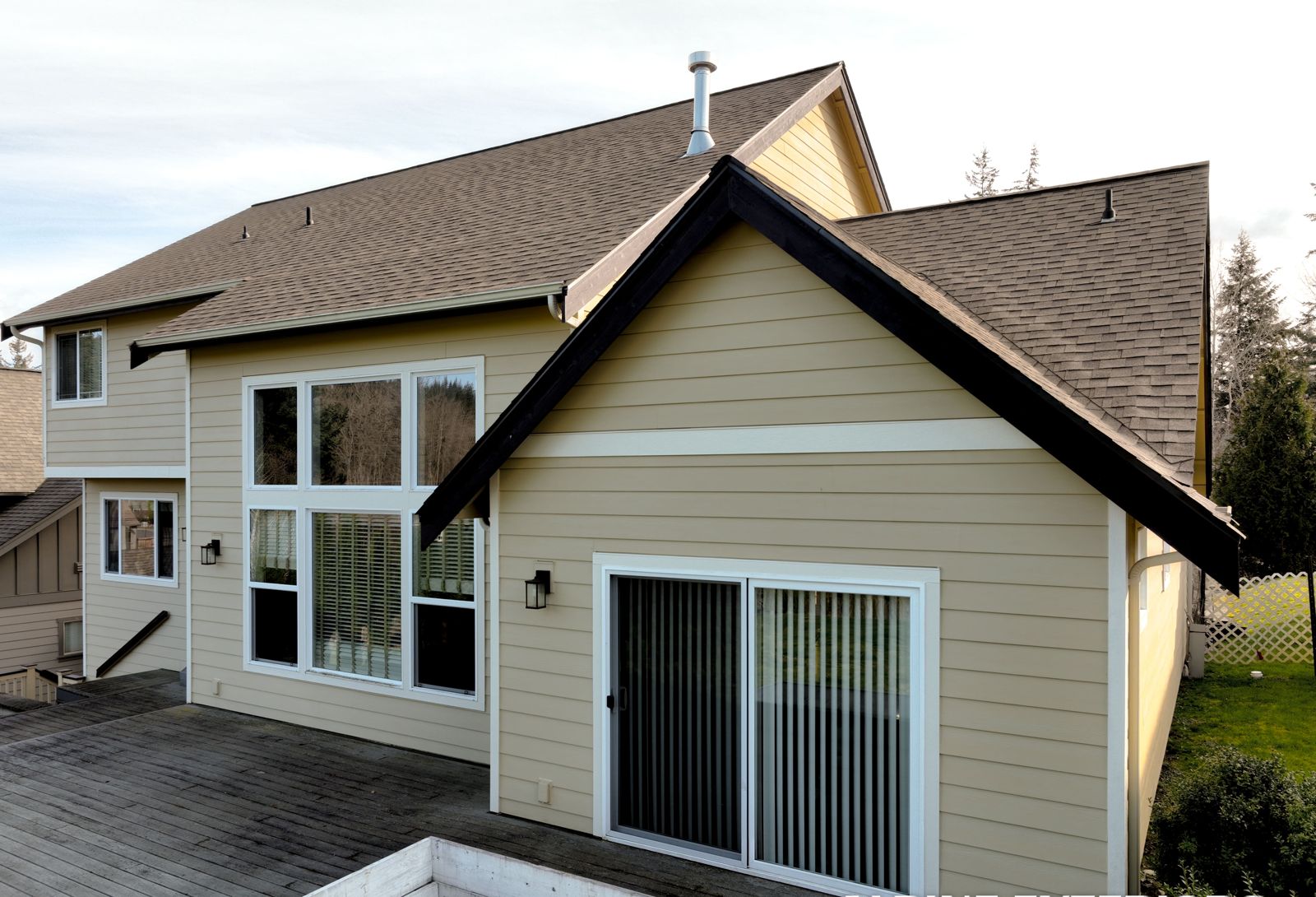
Homes along Chuckanut Drive and up the shoulder of Chuckanut Mountain sit in one of the more demanding microclimates in Whatcom County. Thick stands of Douglas fir and madrona shade entire walls for most of the day, steep lots channel runoff straight at foundations, and the exposure toward Bellingham Bay and Samish Bay means storms don't just fall on these houses, they get driven sideways into them. Siding here works harder than siding on an open lot in Ferndale or Lynden, and when it starts to fail, the damage is often further along than it looks from the driveway. This page walks through the warning signs we see most often on Chuckanut-area homes, what's actually causing them, and how to tell a cosmetic nuisance from a repair that shouldn't wait.
A thin green haze on siding that never sees direct sun isn't unusual anywhere west of the Cascades, but on a wooded Chuckanut lot it can turn into a thick, spongy mat within a couple of wet seasons. The issue isn't the moss itself so much as what it holds against the wall: a permanently damp layer that keeps wood, engineered wood, and even the paper-faced side of some fiber cement products wet for weeks longer than they'd otherwise stay. On lap siding, look closely at the underside of each board where it overlaps the one below — that's where moss packs in first and where rot tends to start.
Push a thumb into a suspicious board, especially near the bottom courses, around window sills, and at any spot where a deck or porch roof ties into the wall. If it gives like wet cardboard instead of feeling solid, moisture has already gotten past the surface and into the substrate. This is the single most reliable sign of active wood rot, and on shaded Chuckanut walls it often shows up first on the north and west elevations, where morning dew and driving rain linger longest before anything dries out.
Paint failure on its own can just mean the last paint job is past its service life. But paint that's bubbling in discrete patches, or cracking in a pattern that follows board seams, usually means water is trapped underneath and pushing the finish off from behind. On homes tucked into the hillside timber, that trapped moisture rarely gets the airflow or sun exposure it needs to evaporate before the next rain arrives, so a repaint alone won't hold for long if the underlying board is already wet.
Wood and wood-composite siding swells when it absorbs water and shrinks as it dries, and repeated cycles of that eventually leave boards that no longer sit flat — they cup, bow outward at the middle, or pull loose from their fasteners. On the higher shoulders of Chuckanut Mountain, occasional winter freezes add another cycle to that stress: trapped moisture that hasn't had a chance to dry out expands as it freezes, which can force hairline cracks in paint and caulking to open wider each time it happens. Vinyl and some engineered panels can also buckle where they've been face-nailed too tightly or where they've expanded against a corner post with no room to move. Either way, a wavy or rippled wall usually means the material has been cycling wet-to-dry — or freeze-to-thaw — longer than it was designed to.
Wind-driven rain off Bellingham Bay and the Strait doesn't fall straight down — in a southwesterly blow it gets pushed horizontally and even upward under eaves and around corner boards. Small gaps that would shed vertical rain just fine become entry points once wind pressure is added. Check outside corners, window and door trim, and anywhere two pieces of siding butt together. A gap you can slide a business card into is a channel for wind-driven moisture to get behind the cladding.
Rust-colored streaks below fasteners, or darker vertical stripes running down from a seam, usually point to water working its way out from behind the siding rather than just running off the surface. On older homes in the area this sometimes traces back to fasteners that weren't set to the right depth or weren't corrosion-resistant to begin with — a common shortcut on houses built before the region's building departments tightened up on fastener schedules.
Siding is the outermost layer of a wall assembly, but it's not just cosmetic — once it's cracked, gapped, or saturated, it stops doing its share of managing air and moisture movement through the wall. Homeowners often notice this first as a room that never feels quite warm in January or a heating bill that's climbed without an obvious reason. If a re-side is on the table anyway, it's worth having the contractor confirm the replacement assembly meets current Washington State Energy Code requirements for continuous insulation and air sealing, since a failing wall is also an opportunity to close that gap.
By the time moisture shows up inside — a musty smell in a closet on an exterior wall, faint bubbling in drywall texture, or a spot of mold near a baseboard — the siding failure behind it has usually been developing for a while. This is the sign homeowners are most likely to miss, because it doesn't look like an exterior problem at all. It's also the one most worth acting on quickly, since sheathing and framing repairs cost more than siding repairs, and get worse the longer they sit.
Not every warning sign means the same thing on the calendar. Some are worth watching through a season; others should get a call out this week.
| Urgent — schedule an inspection soon | Can wait for routine maintenance |
|---|---|
| Soft or spongy boards, especially near grade or under a deck ledger | Light surface moss on a shaded wall with firm, sound boards underneath |
| Interior musty smell, staining, or bubbling drywall on an exterior wall | Faded or chalking paint on siding that's still solid to the touch |
| Visible gaps or separation at corners and trim after a windstorm | Minor hairline cracks in caulking that haven't opened into gaps |
| Panels that are visibly bowed, buckled, or pulling away from the wall | General weathering consistent with the siding's age and known lifespan |
| A sudden jump in heating cost paired with any of the above | Cosmetic algae staining on trim that a wash would address |
The general rule for a Chuckanut property: if you can find the sign from the ground and it involves texture — soft, spongy, bowed, gapping — treat it as urgent. If it's purely a color or surface issue and the board underneath is firm, it can go on the list for the next dry stretch.
Start with a basic walk-around on a dry day. Bring a garden hose (for a light spray test near suspect seams, not a pressure washer, which can force water further into already-compromised siding), a flashlight for looking under eaves and behind shrubs, and your thumb for pressing on anything that looks discolored or swollen. Pay particular attention to the north and west walls, the areas under large fir branches, and anywhere a roof, deck, or chimney penetrates the siding — these are the spots that stay wet longest on a shaded hillside lot.
If you find one or two soft spots, don't assume the rest of the wall is fine just because it looks okay from a few feet away — rot travels along the grain and behind the surface well before it shows on the face of the board. This is where a written inspection from a siding contractor is worth more than a guess: it tells you whether you're looking at a patch repair, a section replacement, or a full re-side, and it should note the condition of the sheathing underneath, not just the siding itself.
Alpine Exteriors inspects Chuckanut-area homes for exactly this kind of moisture damage and gives homeowners a straightforward read on what's cosmetic, what's structural, and what a repair or replacement would realistically cost — costs vary quite a bit depending on how much sheathing needs to come out, so a fair estimate always follows an actual look at the wall, not a phone quote. Alpine Exteriors holds Washington contractor license ALPINI751OW and works throughout Whatcom County, including Bellingham, Ferndale, Lynden, Blaine, Birch Bay, Sudden Valley, and the islands, so a Chuckanut inspection can usually be scheduled without a long wait.
It's mostly about sun and airflow. A lot on Chuckanut Drive or up the mountain is often shaded most of the day by fir canopy, so walls that get soaked in a storm don't get the same drying window a house on an open lot in Ferndale or Blaine would get. Add wind-driven rain funneling in off Bellingham Bay and the Strait, and the same amount of rainfall does more damage to a shaded, sheltered wall than it would to one with regular sun and wind exposure.
It depends on how thick it is and what's underneath. A light green tint on shaded trim that wipes off with a soft wash usually isn't doing much harm. A thick, spongy mat that's been building for a couple of seasons is a different story — it holds moisture against the board around the clock, and if the siding underneath has gone soft when you press on it, the moss is a symptom of rot that's already started, not just a stain to clean.
If the project is a full re-side rather than a like-for-like patch, yes — the work typically needs to meet the current Washington State Energy Code requirements for the wall assembly, which cover things like continuous insulation and air sealing at the sheathing. It's worth asking your contractor to confirm how the proposed assembly meets code before work starts, since this affects both the permit and how the wall performs afterward.
It depends on how far the moisture has traveled. If the rot is contained to a board or two and the sheathing behind it tests dry and solid, a section repair is often reasonable. If several boards on the same wall are affected, or if the sheathing itself is soft, patch repairs tend to be a short-term fix — the same conditions that caused the first failure are still in place for the rest of that wall. An inspection that includes probing the sheathing, not just the visible siding, is the only reliable way to know which situation you're in.
If any of these signs sound familiar on your Chuckanut home, it's worth getting a second set of eyes on it before another wet season adds to the damage. Alpine Exteriors will walk the exterior with you, check the spots that tend to fail first on shaded, wind-exposed Chuckanut lots, and lay out honest options — repair, section replacement, or full re-side — along with a realistic cost range for each. Reach out to schedule an inspection anywhere in Whatcom County, from Bellingham and Chuckanut Drive out to Ferndale, Lynden, Blaine, Birch Bay, Sudden Valley, and the islands.