
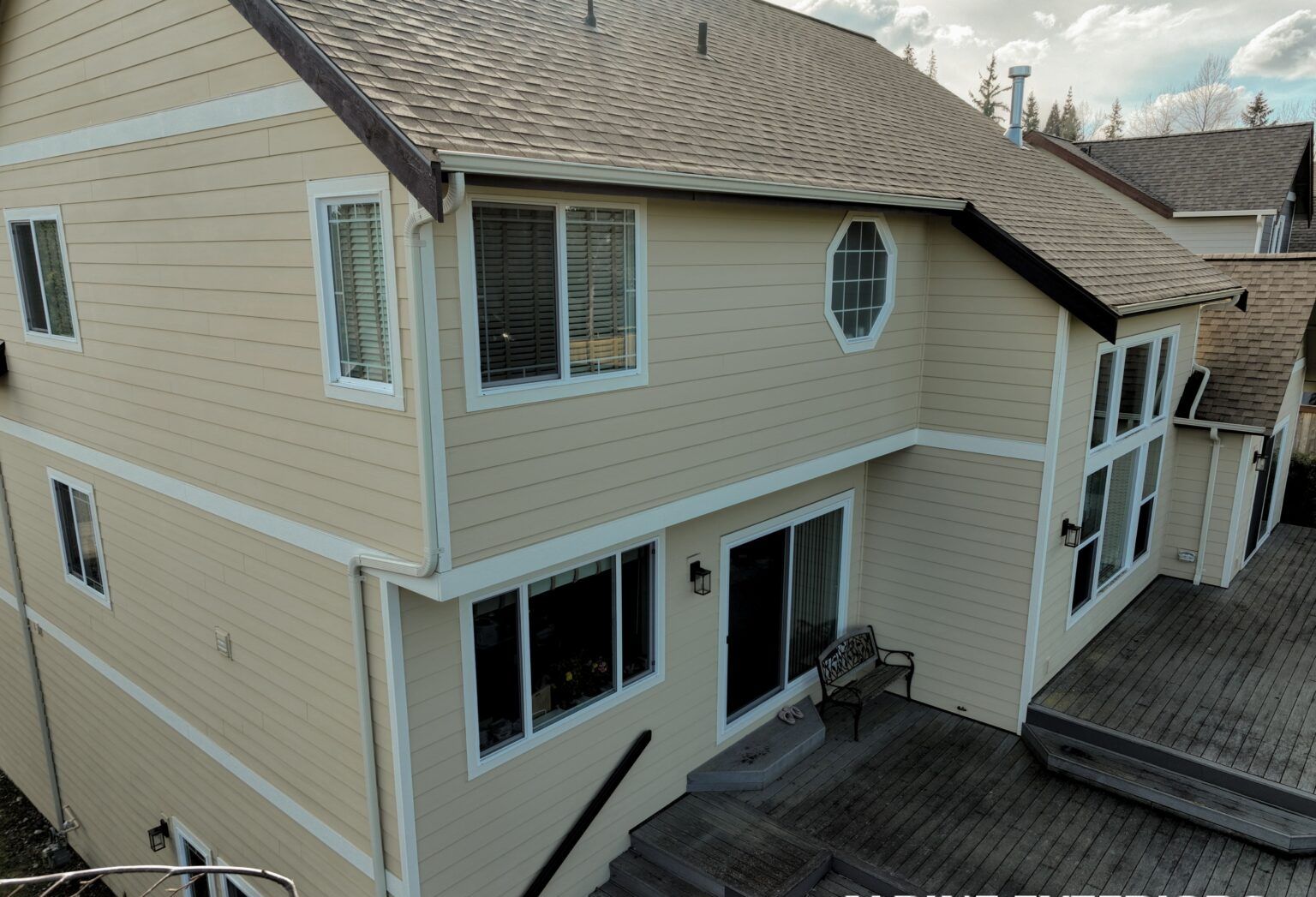
Kendall sits well up the Mt. Baker Highway corridor, tucked into the Whatcom County foothills along the North Fork Nooksack, surrounded by second-growth conifer that keeps most yards in shade for a good part of the day. That setting is part of why people live out here, but it is hard on exterior siding. Walls stay damp longer after a storm than they would in open sun, winter cold air pooling in the river valley brings freeze-thaw cycling that Bellingham and the lowlands rarely see, and the rain itself is simply relentless from October through May. Siding that would coast through a mild, dry decade elsewhere can start failing quietly out here, often behind a coat of paint that still looks presentable from the road. Alpine Exteriors has walked enough siding inspections in this part of the county to recognize the pattern: small, easy-to-dismiss signs usually show up a year or more before a wall assembly actually gives out. Below is what those signs look like on a Kendall home, why they happen here specifically, and how to tell which ones need attention now versus which ones can wait for drier weather.
Press a fingertip or the flat of a screwdriver into the siding near the bottom of a wall, under a window sill, or anywhere gutters have overflowed in the past. If it gives way, feels spongy, or the screwdriver sinks in without much resistance, there is rot underneath, whether the siding itself is wood, hardboard, or an older engineered wood product. Many homes out toward Kendall were built or sided in the 1980s and 90s with wood or hardboard lap siding, both of which absorb and hold water far more readily than fiber cement or vinyl. Add in the shade from surrounding trees, plus needles and leaf litter that pile up against the wall and hold moisture against it for days, and you get exactly the conditions wood rot needs. Ground contact at the bottom course, and areas behind unpruned shrubs, are the two spots we find it most often.
Paint that is lifting in sheets, bubbling, or leaving a chalky white residue on your hand when you wipe the wall is telling you something about moisture, not just about the paint job. Chalking on its own can just mean an older finish coat reaching the end of its service life. Bubbling and peeling, especially in patches rather than across the whole wall, usually mean moisture is trying to escape from behind the siding and pushing the paint film off from underneath as it does. In a climate where the siding rarely gets a long stretch of dry, sunny weather to fully release trapped moisture, that failure mode shows up here more than it would in a drier part of the state.
A little green tint on the north side of a house is normal almost everywhere in Western Washington and is mostly cosmetic. What is worth a closer look is moss actually rooting into horizontal seams and lap joints, or dark, almost black streaking that keeps coming back within weeks of a wash. On a heavily shaded Kendall lot, walls under overhanging conifers or on the north and east elevations may get only an hour or two of direct sun even in summer, so they never fully dry out between rain events. That constant dampness is what lets moss establish a root structure in the seams rather than just growing on the surface, and once it does, it is holding water directly against the siding and any fasteners underneath.
Look down the length of a wall in low, raking light. Waviness, boards that no longer sit flat, or gaps opening up between courses that were not there when the house was built are all signs of movement in the siding. Out in the foothills, freeze-thaw cycling is a real factor that the coastal parts of the county deal with far less. Water gets into a seam or a crack, and on a cold clear night the temperature drops enough for that water to freeze and expand, prying the seam open a little wider. Repeat that over a winter and boards that started with a hairline gap end up visibly separated. Wood and hardboard siding can also swell when saturated and shrink again as they dry, and repeated cycles of that eventually leave boards permanently warped or cupped.
Cracks tend to show up first at the ends of boards, at corner trim, and around nail heads, since those are the places water finds a way in and the places most exposed to flexing from wind and temperature swings. On fiber cement siding, hairline cracking at butt joints is often an installation issue rather than a product failure, most commonly boards installed tight against each other with no expansion gap. On older wood or hardboard siding, rust streaks bleeding down from a nail head mean the fastener is corroding, which usually means it has been sitting wet, and a corroded nail loses its grip on the board over time. None of this is unique to Kendall, but the freeze-thaw cycling and the long wet season both make small cracks worse faster than they would in a milder, drier climate.
Siding failure does not always announce itself on the exterior first. A musty smell in a closet on an exterior wall, a soft or discolored patch of drywall, or a heating bill that keeps climbing even though nothing else has changed can all be early indicators that the wall assembly behind the siding is compromised. This connects directly to the Washington State Energy Code, which governs the insulation and weather-resistive barrier details required in the wall assembly. That code assumes a continuous, intact water-resistive barrier and dry insulation to hit its performance targets. Once rot or persistent moisture gets past the siding and into that assembly, you are not just losing siding, you are losing the insulation performance and moisture protection the wall was built to provide, and that often shows up first as a comfort or utility bill problem rather than a visible exterior one.
| Urgent — schedule an inspection soon | Can generally wait for a drier stretch |
|---|---|
| Siding that is soft or spongy over a wide area, or sheathing visible underneath | Light surface chalking on older paint with no bubbling |
| Active water intrusion, staining, or a musty smell inside on an exterior wall | Cosmetic moss or algae staining that has not penetrated seams |
| Boards visibly buckled, separated, or missing across more than one elevation | A single small hairline crack that is still sealed and not spreading |
| Rot found near window and door openings, where water can reach framing | Minor color fading or dirt buildup that a wash would resolve |
The general rule: anything that suggests water is already inside the wall assembly, or that a board has lost its structural integrity, deserves a look before the next heavy rain. Cosmetic issues that are still on the surface can reasonably wait for a scheduling window, though they are worth monitoring so they do not turn into the first category.
Start with a walk around the exterior after a few dry days, since damp siding can hide a soft spot that would be obvious when dry. Press on suspect areas, check the bottom courses and anywhere gutters have overflowed, and take a look in the attic and crawlspace for staining or damp insulation near the exterior walls. Photograph anything questionable so a contractor has a starting point. From there, it is worth having a licensed contractor take moisture readings and open up a small section if rot is suspected, rather than guessing from the outside. Alpine Exteriors, WA contractor license ALPINI751OW, inspects homes throughout Whatcom County, including the Kendall and Mt. Baker Highway corridor, and can tell you honestly whether a section can be repaired or whether the pattern of damage points to a full re-side. Not every home with one or two warning signs needs all-new siding, and it is worth getting that distinction from someone who has to stand behind the answer, not just from a quick look at the outside.
Cost depends heavily on the siding material chosen, the size and complexity of the home, and whether any rotted sheathing or framing needs to be repaired before new siding goes on. As a rough range, a straightforward re-side on an average single-family home in this area often falls somewhere between $9,000 and $25,000, with larger homes, extensive trim work, or hidden rot repair pushing costs higher. Getting a written estimate after an actual inspection is the only reliable way to know where a specific project will land.
If the rot or damage is isolated to one small area, such as a single section near a downspout that has been overflowing, a spot repair can be a reasonable and less expensive option, provided the rest of the siding is sound. When warning signs are showing up in multiple places across different walls, that usually points to a broader moisture problem in the wall assembly rather than one bad spot, and in that case a full re-side tends to be the more honest recommendation, even though it costs more up front.
Generally, no. Most homeowners policies treat gradual moisture damage and rot as a maintenance issue rather than a sudden, covered event, so routine siding failure from age and weather exposure typically is not covered. There are exceptions if the damage can be tied to a specific, sudden event like a storm that caused an obvious impact or opening, but that is decided case by case by the insurer, not guaranteed. It is worth a call to your agent before assuming either way.
Most single-family re-sides in this area run somewhere from one to three weeks of active work, depending on the size of the home, the siding material, and how much trim and detail work is involved. Weather is the biggest variable given how much of the year is wet here, so a contractor familiar with the area will usually try to schedule the tear-off and weather barrier work for the driest window available rather than starting mid-storm.
If any of these signs sound familiar, it is worth getting a second set of eyes on the siding before another wet season passes. Alpine Exteriors serves homeowners throughout Whatcom County, from Bellingham and Ferndale to Kendall and the rest of the Mt. Baker Highway corridor, and can walk your property, point out what is cosmetic versus what needs attention, and give you a straightforward repair or re-side recommendation under WA contractor license ALPINI751OW.