
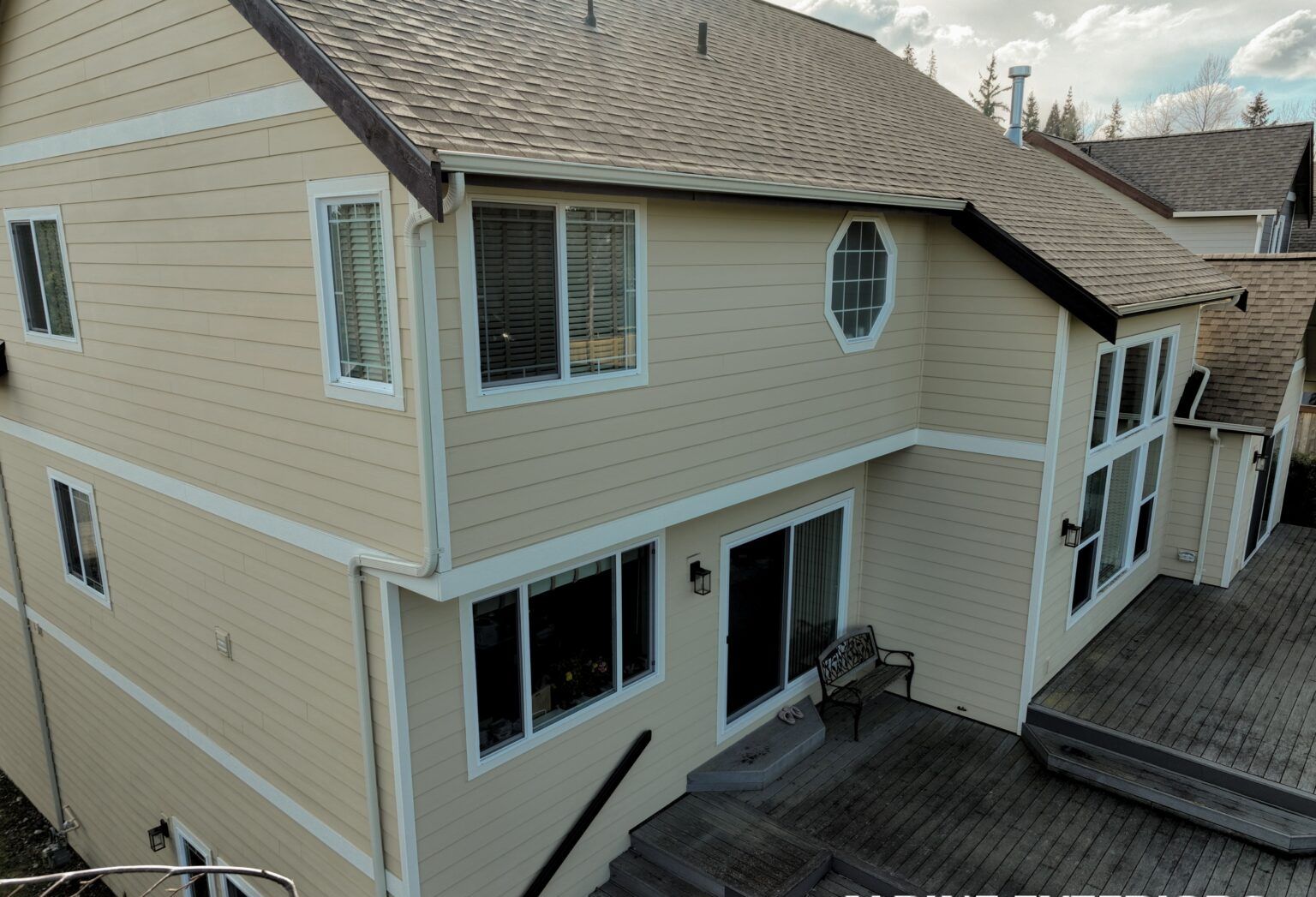
If you live in the Columbia neighborhood of Bellingham, or anywhere else around Whatcom County — Ferndale, Lynden, Blaine, Birch Bay, Sudden Valley, or the islands — your siding does more than hold paint. It's the single layer standing between your framing and a climate that rains for months at a stretch, blows moisture sideways off Bellingham Bay and the Strait of Georgia, and grows moss on nearly anything that sits still long enough. Siding here doesn't usually fail all at once. It fails slowly, behind the surface, and by the time it's obvious from the sidewalk, there's often already water damage underneath. This guide walks through the warning signs worth knowing, what causes each one in our climate specifically, and how to tell the difference between something you can watch for a season and something that needs a contractor now.
Press on a section of siding, especially near the bottom of a wall or under a window, and if it gives like wet cardboard instead of feeling solid, water has already gotten behind it. In Whatcom County this is one of the most common calls we see, and it's almost always tied to the same pattern: wind-driven rain off the bay pushes moisture past a failed caulk joint or an old flashing detail, and because our weather rarely gives a wall the chance to fully dry between storms, that moisture just sits there. Wood siding and even some fiber cement products can hold water for weeks at a time during a wet November-through-March stretch, and the sheathing behind them starts to soften long before anything shows on the outside. By the time a panel feels soft to the touch, the damage usually goes deeper than that one board.
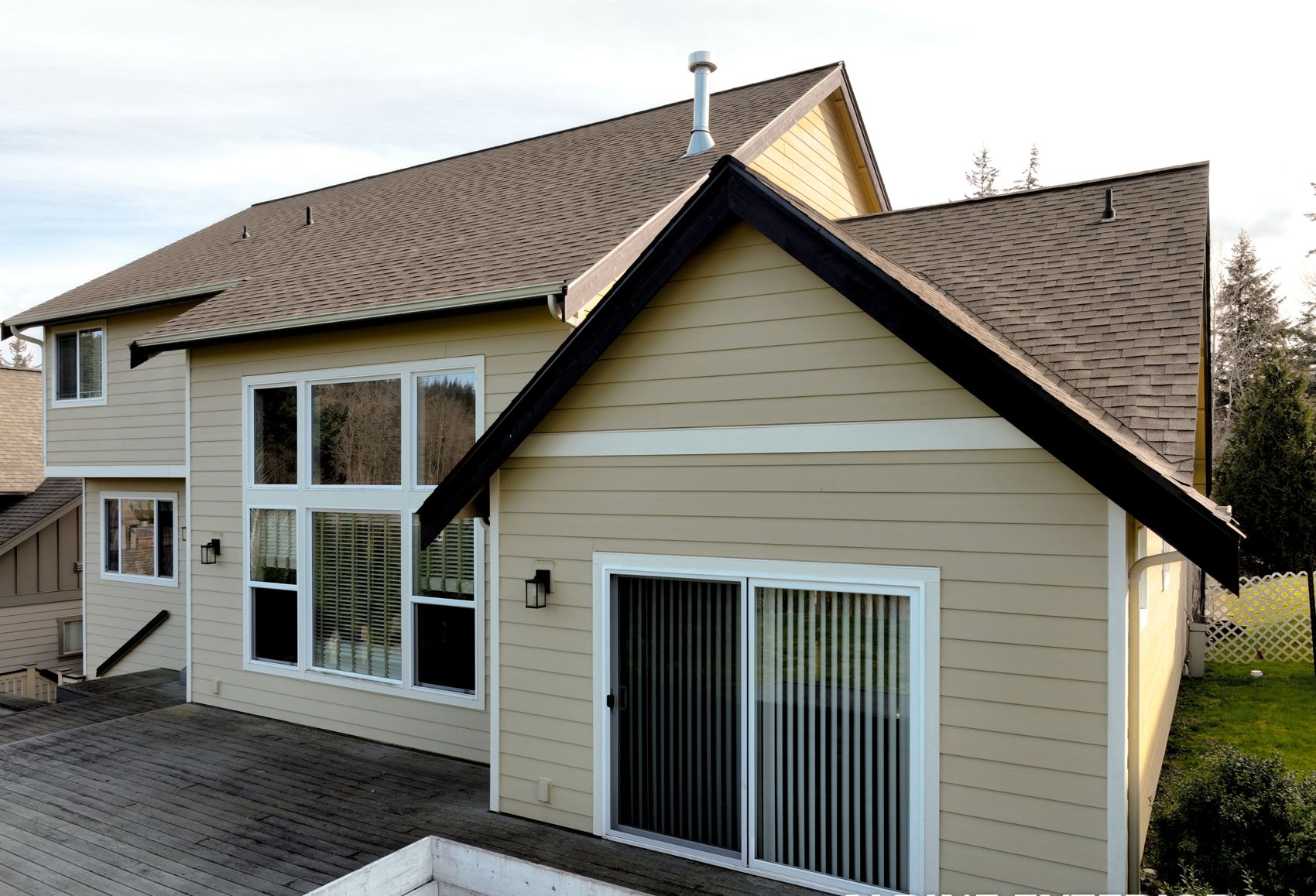
A single repaint job that peels again within a year or two isn't a paint problem — it's a moisture problem the paint is trying and failing to cover up. Paint needs a dry substrate to bond to, and if water is migrating through the siding from behind, it will push the new coat off again regardless of how good the paint or the application was. This shows up a lot on the west- and southwest-facing walls of homes that catch the brunt of storms coming off the Strait, and on older wood siding where the original caulking and finish have simply worn past their service life. Repainting over a wet or failing substrate is a common way homeowners spend money without fixing anything, so if a wall has failed paint twice in a short span, it's worth checking what's happening underneath before reaching for another gallon.
Wood and engineered wood siding absorb moisture and swell, then dry out and shrink, and repeating that cycle enough times causes cracking, cupping, and boards that no longer lie flat against the wall. In the foothills around Sudden Valley and other elevated parts of the county, freeze-thaw cycles add another layer to this: water that's soaked into a crack or a cut end can freeze on a cold night, expand, and widen the damage a little more each time. Vinyl siding has its own failure mode — it can crack or become brittle where it's been stressed by wind, and once a crack starts, wind-driven rain finds its way behind the panel through it. Warped or buckled panels aren't just cosmetic; each one is a new entry point for water, and they tend to multiply once a wall's fasteners or seams start losing their grip.
Some green or black staining is just part of living somewhere this wet — moss and algae grow on siding, roofs, and decks all over Whatcom County, and a little surface growth on a north-facing wall that gets cleaned periodically isn't a structural red flag by itself. What is worth paying attention to is staining that returns fast after cleaning, or moss that's established itself in the seams and laps between boards rather than just on the surface. Moss holds moisture directly against the siding and the fasteners, and once it's growing in the joints, it's usually a sign the caulking or flashing that should be shedding water there has already broken down. Persistent algae streaking below windows or under roof lines can also point to a gutter or downspout that's overflowing and soaking one section of wall far more than the rest of the house.
Walk the perimeter of the house and look at how the siding meets itself at seams, corners, and around windows and doors. Gaps that have opened up, panels that flex or rattle when you push on them, and nail or fastener heads that have worked their way out are all signs the siding has been through enough expansion and contraction — or enough wind loading — that it's no longer sitting tight. Once a gap opens, it doesn't close itself; it collects more water every storm and tends to get worse through the wet season rather than better. This is especially common on walls that take direct wind off Bellingham Bay, where gusts during winter storms put real lateral pressure on loose panels.
Sometimes the clearest sign isn't visible from outside at all. A musty smell near an exterior wall, a closet that always feels damp, or insulation you can see is discolored or compressed when you open up an outlet cover can all point to moisture that's made it past the siding and the weather-resistive barrier behind it. Wet insulation loses much of its R-value, and the Washington State Energy Code sets minimum insulation and air-sealing standards for exactly this reason — when siding fails and water gets into the wall assembly, the home stops performing the way it was built to, and heating bills climb even though nothing about the thermostat setting changed. If a room has started to feel drafty or noticeably harder to heat than it used to, and there's no obvious cause like an old window, it's worth having the exterior wall checked before assuming it's just an aging furnace.
The most reliable test for wood rot doesn't require any special tools. Press the tip of a flathead screwdriver into the bottom edge of a board, into a corner post, or into trim near a downspout or a roof-to-wall junction — these are the spots where water lingers longest. Solid wood resists the point; rotten wood lets it sink in with little resistance, sometimes crumbling. Rot in Whatcom County tends to start at these low, shaded, slow-to-dry spots rather than spreading evenly across a wall, which is part of why it can go unnoticed for a while — the front of the house might look fine while a north-facing corner behind a shrub has been soaking for years. Once rot is confirmed in one spot, it's worth checking the surrounding boards and the framing behind them, since rot rarely stays contained to the piece where it started.
Not every sign on this list means calling someone today. Light surface algae on a shaded wall, minor paint fading, or a single loose fastener are things you can reasonably keep an eye on and address during a normal maintenance cycle. What does need prompt attention is anything involving soft or spongy wood, a confirmed rot pocket, water stains on interior walls or ceilings near an exterior wall, or siding that's visibly separated from the wall in a way that's exposing the sheathing to open weather. Heading into another wet Whatcom County winter with an open gap or known soft spot generally turns a repair job into a bigger one, because every storm between now and a fix adds more water to whatever's already damaged. As a rough guide, a handful of soft panels or a bad section of trim is often a spot repair; once rot has spread across multiple walls or into structural framing, it usually points toward a larger re-siding project instead.
Start with a visual walk around the house on a dry day, checking the low corners, the areas under windows, anywhere a downspout empties near a wall, and any spot where two different siding sections or materials meet. Note anything soft, cracked, stained, or gapped, and take a few photos so you have a record if the problem is progressing over the following weeks. For anything beyond light surface cleaning, it's worth having a contractor open up a small section to look at the sheathing and framing before deciding on a repair scope — what looks like a minor exterior issue can sometimes be hiding a larger moisture problem, and the reverse is also true, where a rough-looking spot turns out to be cosmetic. Alpine Exteriors, WA contractor license ALPINI751OW, does this kind of assessment for homeowners throughout Whatcom County and can walk a property with you to sort out which items are cosmetic, which are worth monitoring, and which need to be addressed before the next round of winter storms. Getting a second opinion before committing to either a spot repair or a full re-side is reasonable, and a straightforward assessment shouldn't feel like a sales pitch.
It depends heavily on how much of the wall assembly is affected. A localized repair — a few boards, a section of trim, or resealing a compromised joint — might run somewhere in the low thousands of dollars, while a full re-side of a house, especially if sheathing or framing needs to be replaced along with it, can run well into the tens of thousands. The only way to get an accurate number is to have someone open up the affected area and see how far the damage extends, since pricing a job from the outside alone tends to underestimate what's actually needed.
You can, but if the underlying cause is moisture intrusion, a new coat of paint won't stop it and typically won't last. Paint applied over a damp or deteriorating substrate tends to bubble or peel again quickly, and in the meantime the wood or sheathing underneath keeps deteriorating unseen. Painting is a reasonable step once the moisture source is actually addressed, but on its own it's a cosmetic fix for a structural problem.
In Whatcom County, walls facing west and southwest toward Bellingham Bay and the Strait of Georgia usually take the most direct wind-driven rain, so they tend to show wear first — cracked caulk, worn paint, and loosened panels. North-facing walls, meanwhile, often stay damp longer because they get less sun and drying wind, which makes them more prone to moss, algae, and slow-developing rot even though they take less direct storm impact. It's common for one side of a house to need attention years before the others.
It can, particularly if the current siding is failing and has let moisture into the wall's insulation, since wet insulation performs far below its rated value. Installing new siding correctly — with an intact weather-resistive barrier and insulation that meets Washington State Energy Code requirements — restores the wall assembly to the performance it was designed for. That said, siding alone isn't a substitute for adequate attic insulation or air sealing elsewhere in the home, so it's one piece of a home's overall energy performance rather than the whole picture.
If any of these signs sound familiar — soft spots, paint that won't hold, moss that keeps coming back, or a wall that just feels off — it's worth having someone look before another wet season adds to the damage. Alpine Exteriors has worked on homes throughout Bellingham's neighborhoods, including Columbia, as well as Ferndale, Lynden, Blaine, Birch Bay, Sudden Valley, and the islands, and can give you a clear, no-pressure read on whether you're looking at a minor repair or something bigger. Reach out to schedule a walk-through and get an honest assessment of what your siding needs.