
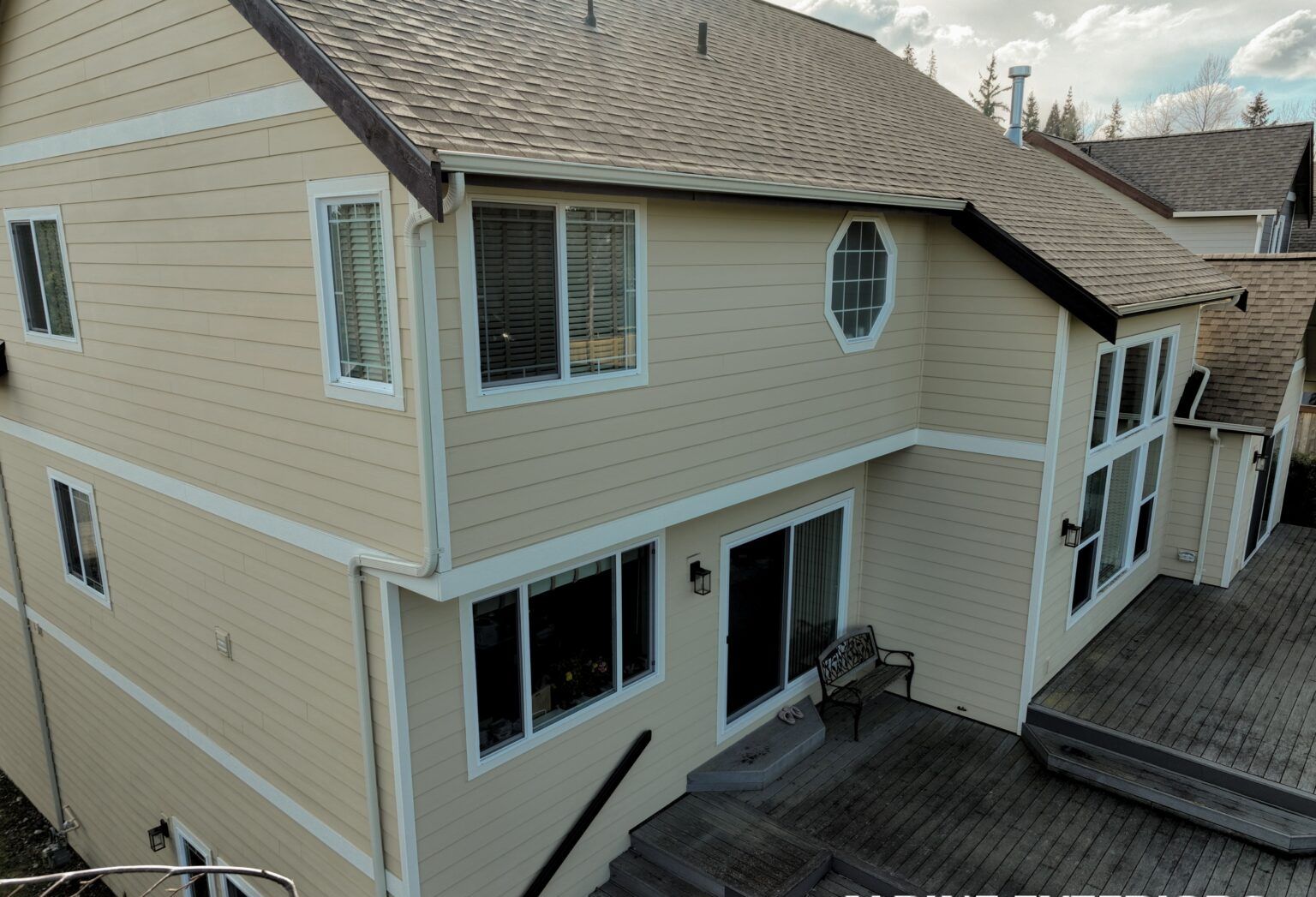
Fairhaven's older homes and craftsman-style bungalows sit close to Bellingham Bay, which means they take a steady beating from wind-driven rain, salt-tinged air, and the kind of gray, drawn-out wet season that Whatcom County is known for. Siding here doesn't usually fail all at once. It fails slowly, one soft spot or one hairline gap at a time, until a homeowner notices a stain on a bedroom ceiling and realizes the problem has been building for years. This guide walks through the warning signs we see most often on Fairhaven homes, what's actually causing them, and how to tell the difference between a repair that can wait for a dry stretch and one that needs attention now.
A dark green film or black streaking on siding is one of the most common things we see on a walk-around inspection in Fairhaven, and it's not just cosmetic. Whatcom County's persistent drizzle keeps north- and west-facing walls damp for days at a stretch, especially on lots shaded by mature evergreens, which describes a lot of the older streets near the Fairhaven Historic District. Moss and algae hold moisture against the surface longer than bare siding would on its own, and over time that trapped moisture works into seams, nail holes, and any spot where the protective coating has thinned. On wood and fiber cement siding, sustained dampness under a moss mat is often the first step toward rot underneath. On vinyl, staining is mostly cosmetic, but heavy growth can hide cracks or gaps behind it.
If you press on a wall and it flexes, dents, or feels spongy instead of solid, water has likely gotten behind the siding and is saturating the wood sheathing, trim, or the siding material itself. This shows up most on the bottom two or three courses near grade, under window sills, and around old deck ledgers or porch attachments where flashing is often missing or was never installed correctly on homes built before modern flashing standards became routine. Wind-driven rain off the bay pushes water sideways into these joints far more aggressively than a straight-down rain would, which is part of why homes on Fairhaven's western-facing bluffs season faster than similar homes a few blocks inland.
A wall that looks wavy from an angle, with panels bowing out or rippling along their length, usually means moisture has cycled in and out of the material enough times to distort it permanently. Wood siding swells when wet and shrinks as it dries, and after enough of these cycles through a Whatcom County winter, the boards can cup, crack, or pull away from the wall. In the foothill neighborhoods and areas like Sudden Valley, freeze-thaw adds another layer: water that's soaked into a seam or a crack expands when it freezes overnight, widening the opening a little more each time. Vinyl siding can also buckle if it was installed too tightly with no room to expand and contract with temperature swings, which is a common installation error rather than a material defect.
Fasteners that have backed out, panels that rattle in the wind, or boards that have visibly shifted out of alignment are a sign the wall assembly is losing its grip. This can come from wood shrinkage, from sheathing underneath that has softened due to trapped moisture, or simply from age. Loose panels are more than a noise problem: every gap behind a fastener head or a lifted panel edge is a new entry point for wind-driven rain, and Fairhaven's exposure to weather rolling in off the Strait of Georgia means those gaps get tested often.
Look closely at inside and outside corners, the seams where panels butt together, and the trim around windows and doors. Caulking that has shrunk, cracked, or pulled away leaves a direct path for water to reach the sheathing behind the siding. This is especially common on homes that have been repainted or recaulked over the years without removing the old failed caulk first, which just traps moisture rather than keeping it out. On older Fairhaven homes with original wood trim, these gaps are often where rot starts, quietly, behind a coat of paint that still looks fine from the sidewalk.
If a wall needs repainting every few years, or new paint bubbles and peels within a season or two of being applied, that's usually a moisture problem being masked rather than solved. Paint failing from underneath, in sheets or blisters rather than a slow fade, points to water vapor pushing out through the siding from inside the wall assembly. This is one of the clearer signals that a wall isn't just cosmetically tired but functionally compromised.
Sometimes the siding itself doesn't look that bad from the street, but the tell is on the inside: a musty smell in a closet on an exterior wall, a soft or discolored patch of drywall, or a stain that shows up after a heavy wind-and-rain event. By the time water is visible inside, it has usually been getting behind the siding for a while, following studs or sheathing down to a lower point before it shows itself. This is common enough in older Bellingham Bay-adjacent homes that we treat any new interior stain on an exterior wall as a reason to check the siding outside, not just the roof.
Not every sign on this list means a crew needs to be out this week. Here's roughly how we'd triage a Fairhaven home based on what we typically find.
| Situation | Urgency | Why |
|---|---|---|
| Soft, spongy panels or visible rot near grade | Urgent | Active moisture intrusion into sheathing; delay lets rot spread to framing |
| Interior stains, musty smell, or bubbling interior paint | Urgent | Water has already reached the wall cavity; source needs to be found before drywall or insulation is affected further |
| Large gaps or separated seams facing prevailing wind and rain | Urgent to near-term | These are the entry points wind-driven rain off the bay will exploit hardest during the next storm cycle |
| Nail pops and loose panels | Near-term | Not an emergency alone, but each storm works fasteners looser and widens gaps behind them |
| Surface moss and algae staining, no softness underneath | Can wait, monitor | Mostly cosmetic if the substrate is still sound; still worth cleaning gently so it doesn't progress |
| Recurring paint failure with a firm substrate | Can wait, but investigate | Sign of trapped moisture vapor; worth a closer look before the next repaint cycle |
The honest caveat: you often can't tell from the outside alone whether a soft-looking spot is a small patch of surface rot or something that's already reached the studs. That's the main reason we recommend a hands-on inspection rather than guessing off a description or a photo.
If you're seeing one or two of the milder signs, like moss staining or a little chalking paint, a good first step is a gentle exterior wash (avoid high-pressure washing on wood or aging fiber cement, since it can force water into seams rather than just cleaning the surface) and a closer look at caulking around trim and corners. If you're seeing softness, buckling, interior stains, or rot near the base of the wall, the right move is a physical inspection, ideally one that includes probing suspect areas with a moisture meter or an awl rather than just a visual walk-around, since surface paint can look intact over wood that's already compromised underneath.
When Alpine Exteriors inspects a Fairhaven home, we're checking not just the siding surface but the flashing details around windows, doors, and roof-to-wall transitions, since those are the spots wind-driven rain off Bellingham Bay finds first. If a re-side ends up being the right call rather than a repair, it's also worth knowing that any full re-side triggers Washington State Energy Code requirements around wall insulation and moisture management, which usually means adding a code-compliant weather-resistive barrier and, depending on the wall assembly, continuous insulation. That adds some cost up front, but it's not optional on a permitted re-side, and it does meaningfully improve how the wall performs against our climate going forward.
Cost is worth being realistic about. A localized repair, replacing a few damaged boards or panels and re-flashing a trouble spot, is a modest expense, often in the few-hundred to low-thousands range depending on how much has to come apart to fix it right. A full re-side of a typical Fairhaven home is a much larger investment, commonly landing somewhere in the mid-five to low-six figures depending on square footage, siding material chosen, and how much trim and detail work the home has. We'd rather give you an honest number after seeing the actual wall than a figure that doesn't hold up once we're up on a ladder.
It varies a lot by material, installation quality, and how exposed the wall is to wind-driven rain. Wood siding on a well-shaded, poorly ventilated wall can show rot in well under two decades, while the same wood siding on a well-flashed, sun-exposed wall can last considerably longer. Vinyl and fiber cement generally hold up longer against moisture, but poor original installation, missing flashing, or gaps that were never sealed properly can shorten the life of any material regardless of what it's made from.
Often, yes, if the siding underneath is still solid. A gentle wash with a mild cleaning solution and a soft brush, rather than a pressure washer, removes surface growth without forcing water into seams. The catch is that moss and algae tend to come back on shaded, damp walls unless something changes, like trimming back overhanging branches or improving airflow along that wall. If probing under the moss reveals soft wood, cleaning alone won't fix the underlying problem.
Usually not, and this catches people off guard. Most homeowners policies treat gradual water intrusion and rot as a maintenance issue rather than a covered sudden loss, since the damage builds up over time rather than happening in a single event. Coverage is more likely if the damage traces back to a specific, sudden cause, like a storm that tore off a section of siding. It's worth reading your policy's exclusions section or asking your agent directly, since language varies by carrier.
In most cases, yes, particularly if the work involves more than a small patch repair, since a full re-side typically also touches the weather-resistive barrier and may affect insulation, both of which fall under Washington State Energy Code review. Requirements and review timelines differ a little between the City of Bellingham and unincorporated Whatcom County areas like Birch Bay or the islands, so it's worth confirming with the local building department, or having your contractor pull the permit as part of the job, before work starts.
If your Fairhaven home is showing any of the signs above, whether it's a suspicious soft spot near a downspout or a ceiling stain that showed up after last winter's storms, it's worth getting a straight answer before another wet season sets in. Alpine Exteriors is a Washington-licensed contractor (license ALPINI751OW) serving Bellingham, Ferndale, Lynden, Blaine, Birch Bay, Sudden Valley, and the islands, and we're happy to walk your walls with you, point out what we find, and tell you plainly whether you're looking at a repair or a re-side. No pressure, no invented urgency, just an honest look at what your siding is telling you.