
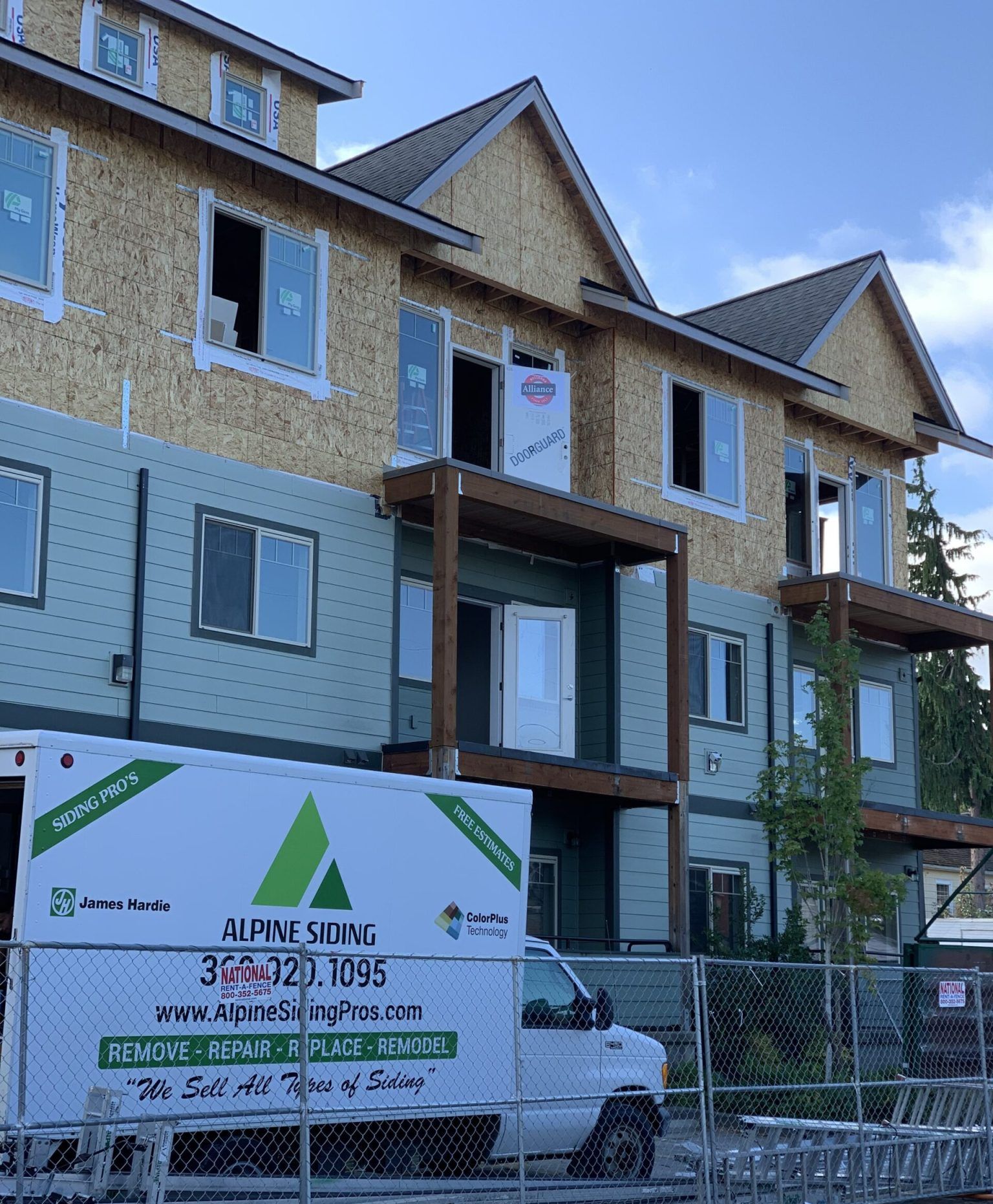
Most siding damage in Custer can be repaired if it is limited to a single cracked or impact-damaged board, the sheathing behind it is still dry and solid, and the siding itself is under roughly 10 to 15 years old. Once soft, spongy siding shows up across whole sections of a wall, or the product is old enough that matching it is no longer realistic, full replacement is usually the more honest recommendation, even though it costs more up front.
That two-sentence answer holds up in the majority of cases we see between Custer, Ferndale and the county line, but it is not the whole story. The right call depends on what is happening behind the siding, not just what you can see from the driveway, and that is where homeowners get tripped up.
A homeowner in Custer will usually notice one obvious problem first: a cracked panel near a downspout, a soft spot below a window, a stretch of siding that looks stained after a wet winter. The instinct is to treat that as the whole problem and ask for a patch. Sometimes that instinct is right. Often it is not, because the visible damage is just where the moisture finally broke through, not necessarily where the moisture originally got in.
This is also where incentives get muddled. Some contractors lean toward recommending a full replacement on every job because it is a bigger, more profitable project, even when a targeted repair would hold up fine. Others quote a cheap patch job without ever pulling a board to look at what is underneath, which can leave a homeowner paying twice: once for the patch, and again a year or two later when the real problem resurfaces. Neither extreme serves the homeowner. The only way to make a good decision is to actually look behind the siding before recommending anything, which is the standard we hold ourselves to at Alpine Exteriors.
Repair makes sense when the damage is contained and the framing behind it is unaffected. In practice, that covers a fairly specific set of situations:
If your situation matches most of that list, a repair is a reasonable fix, and there is no reason to spend money replacing siding that still has years of service life left.
Repair stops being the smart move once the damage is a symptom of a bigger, ongoing problem rather than a one-time event. Signs you are past patching include:
When two or more of these are present, a repair is really just delaying a full replacement while the damage keeps spreading underneath.
Siding is the outer layer of a system, not a standalone shell. Behind it sits a water-resistive barrier, then the wood sheathing behind that, then wall framing. Flashing and drainage details at windows, doors, and horizontal trim are supposed to route water that gets past the siding back out before it reaches the sheathing. When flashing is missing, undersized, or was installed incorrectly during the original build, water works its way in slowly, often for years, before a homeowner sees any exterior sign of it.
Once moisture reaches the sheathing, it does several things at once. It softens the wood, which is what produces that soft, spongy feeling when you press on damaged siding. It also accelerates corrosion of fasteners and trim, so the nails and screws holding the siding on start to weaken exactly where you need them to hold. And it creates the conditions for rot fungus to spread laterally along the sheathing, well past the boundaries of the board that first showed damage. This is why a contractor who only replaces the one board you pointed to, without opening up the wall to check the sheathing, can leave hidden rot to keep spreading under a brand-new-looking patch.
Cost is a big part of this decision, and the honest picture is that repair and replacement solve different problems at different price points. The table below is a general guide, not a quote; actual numbers depend on square footage, siding material, and what a crew finds once the wall is open.
| Factor | Targeted Repair | Full Replacement |
|---|---|---|
| Typical cost range | Roughly a few hundred to a few thousand dollars, depending on how many boards and what's behind them | Several thousand to well into five figures for a full house, depending on size and material |
| Timeline | Often one day to a few days | Usually one to two-plus weeks, weather dependent |
| Risk of hidden problems resurfacing | Higher, unless sheathing was inspected | Low, since the whole wall assembly is exposed and corrected |
| Energy code impact | None, no code trigger | May require bringing the wall assembly up to current Washington State Energy Code insulation standards |
| Best for | Isolated, recent, well-contained damage | Widespread rot, aging or discontinued siding, or repeated repair failures |
The cheapest option in year one is not always the cheapest option over five years. A twelve-hundred-dollar patch that fails again in eighteen months because it never addressed the flashing behind it costs more in the end than doing the job right the first time.
Matching existing siding is its own challenge, and it depends heavily on what you already have. Since James Hardie standardized its fiber cement product lines and lap profiles years ago, matching a damaged section of Hardie fiber cement siding is usually more straightforward than it used to be, especially if the home was sided within the last decade or so with a factory-applied ColorPlus finish, which is engineered to hold color consistency better than field-applied paint. Even so, a repair panel from a newer batch can still show a subtle sheen or color difference next to sun-faded original boards, particularly on south- and west-facing walls that take the brunt of our summer light.
Vinyl siding is a tougher match. Vinyl fades unevenly over time, colors are frequently discontinued or reformulated, and even a same-brand replacement panel bought a few years after the original installation can look noticeably different once it is up next to weathered siding. Cedar and other wood siding sit somewhere in between: a new board can be stained to blend in reasonably well, but grain and weathering patterns are never identical.
The practical implication is that repair vs. replacement is not just a structural question, it is also a cosmetic one. If an exact match is not realistic, some homeowners choose to reside the whole elevation facing the street even if the rest of the house could technically be patched, purely so the repair does not stand out. That is a legitimate call, but it should be made with full knowledge of the trade-off, not discovered after the fact.
Custer sits close enough to Bellingham Bay and the Strait of Georgia that wind-driven rain is a routine part of fall and winter storms here, not an occasional event. That driving rain pushes water sideways into laps, seams, and trim joints that would stay dry in a calmer climate, which is exactly why flashing and drainage details matter more here than in drier parts of the state.
A long moss season is the other defining local factor. Whatcom County's combination of shade, humidity, and mild temperatures keeps moss and algae actively growing on north- and east-facing walls for much of the year, not just a few weeks in spring. Moss holds moisture against the siding surface far longer than open air would, and once it establishes itself in a lap joint, it keeps that joint damp long after the rain has stopped, which is a common early driver of the rot we find when we open up a wall.
Homes closer to Birch Bay, Blaine, and the islands add a salt air component. Salt-laden air off the water accelerates corrosion on fasteners, flashing, and trim faster than it corrodes the same materials further inland, which shortens the useful life of exposed hardware even when the siding material itself is holding up fine. And in the foothill areas around Sudden Valley, freeze-thaw cycles through the colder months can widen small cracks that started as minor cosmetic damage, turning what would have been a simple caulk-and-paint fix into an actual repair job by the following spring.
None of these factors are unique to any one property, but together they mean siding in Custer and the surrounding county ages differently than siding in a drier, calmer climate, and repair decisions need to account for that rather than following a generic national rule of thumb.
Before calling anyone, or before signing off on whatever a contractor first proposes, walk the exterior and work through this list:
The only reliable way to settle repair versus replacement is to physically remove the damaged section, look at the sheathing behind it, and go from there. If the sheathing is dry and solid, a repair with proper flashing correction is a legitimate long-term fix. If it is soft, discolored, or shows rot spreading past the original damage, that changes the recommendation, and a good contractor should be able to show you what they found, not just tell you.
Alpine Exteriors has worked on siding throughout Whatcom County, including Custer, Ferndale, Lynden, Blaine, Birch Bay, and Sudden Valley, and we open the wall before we quote a repair or a full replacement rather than guessing from the outside. We hold Washington contractor license ALPINI751OW, and every recommendation we give is based on what we actually find once a board comes off, not on which option happens to be more profitable for us. If a repair genuinely solves the problem, that is what we recommend; if the damage has moved past that point, we will tell you why and show you the evidence.
Press on the damaged board and the siding around it. If it feels dry and solid and the damage is limited to a single cracked or impact-damaged board with no interior staining, it is likely a straightforward repair. If it feels soft or spongy, or the problem seems to spread across a wider section than what you can see, there is a good chance moisture has already reached the sheathing behind it, and the fix needs to start with opening the wall rather than just patching the surface.
Often yes, since James Hardie standardized its lap profiles and offers factory-applied ColorPlus finishes that hold their color more consistently than field paint. A repair board from current stock will usually blend reasonably well, though some color difference can still show on heavily sun-exposed walls where the original siding has faded more than a new panel. Older, pre-standardization Hardie products or discontinued colors are harder to match and may push the decision toward replacing the full elevation instead of a single damaged section.
Repair costs tend to range from a few hundred to a few thousand dollars depending on how many boards are affected and what condition the sheathing is in once it is exposed. Full replacement runs into several thousand dollars and up for an entire home, depending on square footage and material choice. These are general ranges, not quotes; the only way to get real numbers for your home is an in-person inspection.
Wind-driven rain off Bellingham Bay and the Strait, a long moss season on shaded walls, and salt air near Blaine, Birch Bay, and the islands all put more sustained moisture stress on siding and fasteners than a drier inland climate would. Add freeze-thaw cycling in the foothills around Sudden Valley, and small issues like a gap in flashing or a missed caulk joint tend to turn into real repair-or-replace decisions faster in Whatcom County than they would somewhere with a milder, drier year-round climate.
If you're weighing siding repair against full replacement anywhere in Custer or the surrounding Whatcom County communities, the fastest way to get a real answer is to have someone open the wall and look, not guess from the driveway. Alpine Exteriors, WA contractor license ALPINI751OW, inspects the sheathing before recommending a repair or a replacement, and we'll walk you through exactly what we find so you can make the call with full information. Reach out to schedule an inspection before the wet season makes the damage harder to assess and repair.