
Yes. Every home built or re-sided in Whatcom County, including the properties tucked into the timber and pasture around Toad Lake north of Bellingham, has to meet the wind-resistance provisions of the state-adopted building code. That means the siding material, the fasteners holding it to the wall, and the water-resistive barrier underneath all have to work together as a tested system, not just look good from the road.
Homeowners rarely think about wind load until a storm peels a panel off a gable end or a contractor's bid mentions "code-compliant fastening" without explaining what that means. The short version: Washington uses the International Residential Code with Washington State Amendments, and the wind provisions in that code set minimum requirements for how siding is attached based on wind exposure, wall height, and the product's own tested rating. Toad Lake sits in a transition zone — open enough to catch real wind, sheltered enough that many installers underestimate it.
Siding products don't get a blanket "approved for Washington" stamp. Instead, each product line — vinyl, fiber cement, engineered wood, metal panel — carries its own manufacturer installation instructions, and those instructions are usually backed by an ICC-ES evaluation report or testing to the relevant ASTM standard (vinyl siding is commonly tested under ASTM D3679 and D5206; fiber cement lap siding under ASTM C1186). Under the IRC, when a product has manufacturer instructions that meet or exceed the code's baseline, those instructions become the enforceable installation standard. That's why two houses on the same street can have different nailing patterns and both be correct — they're different products with different tested limits.
In practice, that translates into a handful of things a Whatcom County building inspector or a competent siding crew actually checks:
None of this is exotic engineering. It's mostly discipline — using the fastener schedule the manufacturer actually published for that product, rather than whatever the crew used on the last job. The Washington State Energy Code also comes into play indirectly: the continuous insulation, air-sealing, and vapor-permeance choices made under WSEC affect how the wall assembly behind the siding dries out, and a wall that can't dry is a wall where fasteners eventually lose their grip in the wood.
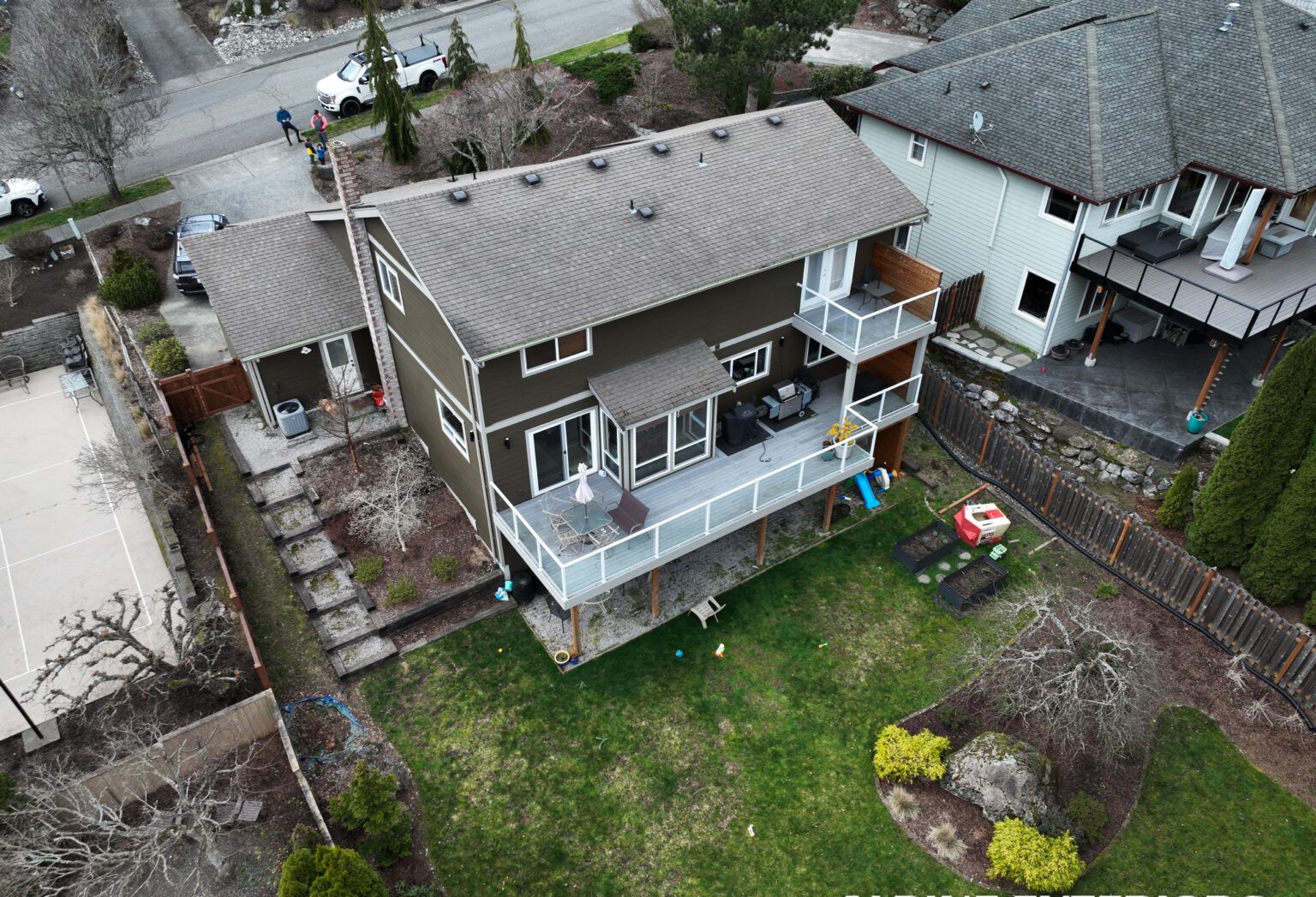
Toad Lake itself sits in the foothill country north of Bellingham, above the lake basin and closer to the Lake Whatcom watershed than to open water on Bellingham Bay. That geography changes the risk profile compared to a waterfront lot in Fairhaven or Birch Bay. A few things stand out:
Tree canopy and shade, not direct bay wind. Most Toad Lake properties are wooded or partially wooded, second-growth fir and cedar close to the house. That canopy blocks a lot of straight-line wind but funnels gusts unpredictably through gaps and clearings, and it keeps siding, especially north- and east-facing walls, shaded and damp far longer after a rain than an open lot would. That combination is exactly what grows moss and algae on siding, and it's exactly what accelerates wood rot on any trim or fascia that isn't detailed to shed water.
Elevation and freeze-thaw. The foothill lots around Toad Lake sit noticeably higher than downtown Bellingham or the waterfront neighborhoods, and that extra elevation means more mornings below freezing in winter. Freeze-thaw cycling doesn't care what your wind rating is — it works on caulk joints, fastener holes, and any spot where trapped moisture can expand as ice. A fastening job that's technically within code spacing but sealed with the wrong caulk, or missing a drip cap over a window, will fail here faster than the same detail would on a milder lot closer to the water.
Persistent rain over raw wind speed. Whatcom County doesn't see hurricane-force wind, and Toad Lake specifically doesn't take the direct wind-driven rain that a Blaine or Birch Bay waterfront property gets off the Strait. The bigger threat here is the sheer duration of the wet season — long stretches of steady drizzle that find every gap in flashing, every under-caulked seam, every place housewrap wasn't lapped correctly. Wind matters for fastening, but water intrusion is what actually damages these homes over time.
Mixed lot access and older housing stock. Some Toad Lake-area homes sit on gravel or unpaved private roads and were built decades ago under earlier code cycles. A re-side project on one of these houses often surfaces sheathing rot or undersized flashing that was never brought up to current standard, which changes the scope of the job well beyond swapping siding panels.
Start with the wall, not the color chart. Before choosing a siding product, ask whoever is bidding the job to walk you through the manufacturer's published wind rating for the specific product and profile you're considering, and how that rating compares to the wind exposure at your lot — a clearing near the lake behaves differently than a house buried in fir trees fifty yards back. A reputable contractor should be able to explain fastener type and spacing in plain language, not just say "we'll pull a permit and the inspector will check it."
Get a permit even if a smaller job feels like it doesn't need one. Whatcom County requires permits for most siding replacement, and the inspection is a free second set of eyes checking fastening, flashing, and water-resistive barrier continuity — the exact items that cause callbacks two or three winters later. Skipping the permit doesn't just create legal risk; it removes the built-in quality check that catches problems while they're still cheap to fix.
Ask about the water-resistive barrier and flashing details specifically, not just the siding brand. On a shaded, moisture-heavy lot like Toad Lake, the barrier system behind the siding often matters more for long-term durability than which cladding material sits on top of it. If a bid doesn't mention housewrap, taping, or window flashing integration, ask why.
Budget for some rot repair contingency on older homes. It's honest to say that on a re-side of an older Toad Lake property, finding some degree of sheathing or trim rot behind the old siding is common rather than rare, given the shade and moisture in that area. A fair contract should spell out how that's priced if it's discovered, rather than leaving it as a surprise change order.
Alpine Exteriors has worked on homes throughout Whatcom County, from the open, wind-exposed lots along Birch Bay to the shaded, foothill properties around Toad Lake and Sudden Valley, and the fastening and flashing approach genuinely changes based on which of those conditions a house actually faces. We hold Washington contractor license ALPINI751OW and pull permits as a standard part of a re-side, not an upsell.
In most cases, yes. Whatcom County requires a building permit for siding replacement, and that permit is what triggers the inspection checking fastener spacing, flashing, and water-resistive barrier continuity discussed above. Some very small repair jobs may fall under different thresholds, so it's worth confirming scope with the local building department or your contractor before work starts.
Vinyl siding can perform well here, but the wind rating depends entirely on which product and fastening pattern is used — not all vinyl siding is rated the same. A heavier-gauge panel installed with the manufacturer's tighter fastening schedule and correctly lapped starter strips holds up fine on most Toad Lake lots; the failures we see usually trace back to over-driven nails or shortcuts in fastener spacing, not the material itself being wrong for the area.
Shade and airflow, more than wind, drive moss and algae growth. A home tucked under second-growth fir and cedar near Toad Lake stays damp longer after rain than an open, sun-exposed lot, which is exactly the environment moss needs. Siding profile, color, and how far the cladding is held off the wall (for drainage and airflow) all affect how fast that growth shows up, independent of the product's wind rating.
The Washington State Energy Code governs the insulation and air-sealing choices in the wall assembly behind the siding, including how much continuous exterior insulation is required in some assemblies. Those choices affect how the wall dries after it gets wet, which in turn affects how long fasteners and sheathing hold up. It's not a siding-specific code, but a re-side project is often the point where those wall-assembly upgrades get made, since the wall is already opened up.
If you're weighing a siding replacement on a Toad Lake, Sudden Valley, or broader Whatcom County property and want a straight answer about wind exposure, fastening, and what your specific lot actually needs, Alpine Exteriors can walk the property with you and explain the reasoning before any contract gets signed. Reach out for a consultation and we'll give you a clear, honest scope — including where an older home is likely to need more than just new panels.