
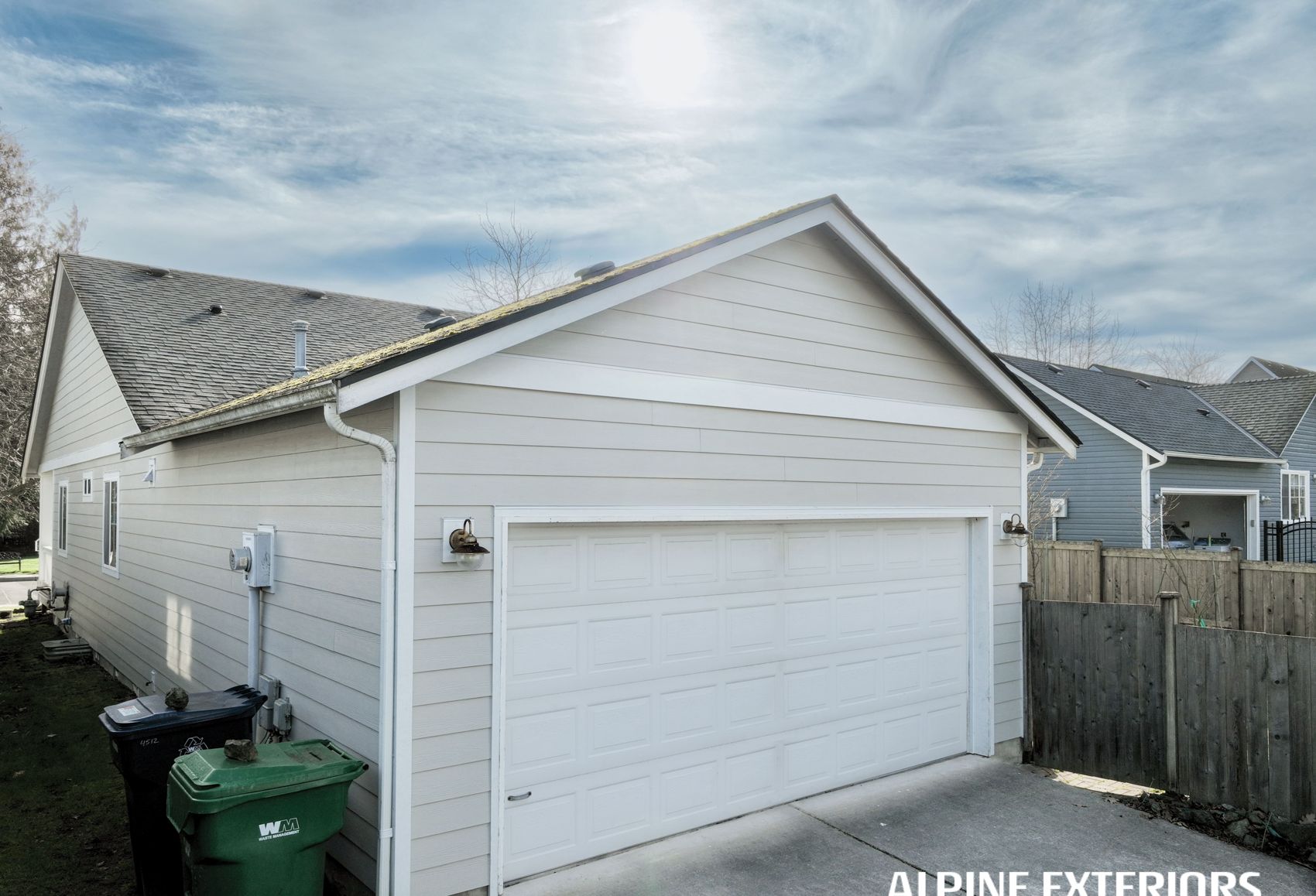
Kickout flashing is a small, angled piece of metal installed at the exact point where a sloped roof edge terminates against a wall running below it, and its job is to kick water away from the siding instead of letting it run straight down behind it. It looks minor, but that one piece of metal is often the only thing standing between a roof-wall intersection and years of hidden rot in the wall framing underneath.
Anywhere a roof slope meets a vertical wall, builders install step flashing: a series of small, overlapping metal pieces woven in with each course of roofing and siding so water sheds down and out instead of soaking into the wall. Step flashing works well along the run of the intersection, but at the bottom, where the roof edge stops and the wall keeps going, the water collected by that whole run of step flashing has to go somewhere. If nothing redirects it, it dumps straight down the face of the wall, right behind the siding, at a single concentrated point rather than spreading out over the roof surface the way it would if there were no wall in the way at all.
A kickout flashing is the piece that solves that specific problem. It's bent or diverted outward at the base of the step flashing run so the water collected along the roof-wall junction is thrown clear of the siding and directed into the gutter below, rather than being funneled into the wall cavity. It's a small detail, usually a few inches of formed metal, but it sits at a spot where three vulnerable transitions meet at once: roof to wall, siding to trim, and horizontal to vertical drainage. That combination is exactly why it's one of the more commonly missed details in residential construction, and why it shows up so often in moisture investigations when a wall has failed near a roof line.
When a kickout is missing, the damage doesn't announce itself right away. Water tends to migrate behind the siding and down into the wall cavity, soaking sheathing and framing from the inside while the exterior finish still looks fine. By the time staining, soft siding, or a musty smell shows up on the interior wall, the rot has usually been developing for a while. It's a slow failure, which is part of what makes it worth understanding rather than assuming it's someone else's problem.

Whatcom County doesn't get dramatic storms very often, but it gets a lot of water, and that changes which construction details actually matter here. Bellingham, Ferndale, Lynden, Blaine, and the communities around Birch Bay and Sudden Valley all sit through long stretches of persistent, low-intensity rain that can last for days without a real break. A single heavy downpour is less punishing on a wall than months of steady drizzle finding every gap, because the drizzle has time to work its way into small openings that a hard, fast storm might just run off of. A missing kickout flashing is exactly the kind of detail that punishes slow, sustained moisture rather than sudden volume, which is why it tends to matter more here than in drier climates.
Wind direction adds to it. Homes closer to Bellingham Bay and the Strait of Georgia, including much of Blaine and Birch Bay, take wind-driven rain that comes in at an angle rather than falling straight down. That angled rain pushes water sideways into wall-roof junctions and up under trim and flashing laps that were designed with mostly vertical drainage in mind, which is precisely the kind of pressure a properly diverted kickout flashing is built to handle and a missing one fails at quickly.
Constant moisture also means constant biological growth. Moss and algae are a fact of life on roofs and siding throughout Whatcom County, and they don't just look bad, they hold water against the roofing and siding surfaces long after a dry spell elsewhere would have let everything shed off. That extended contact time at a roof-wall junction gives water more opportunity to find its way past a flashing detail that isn't sealed or lapped correctly, and it accelerates wood rot once moisture does get behind the cladding, since damp wood in a shaded, moss-covered corner rarely gets a chance to dry out between rain events.
Up toward the foothills and higher elevations around Sudden Valley and the Mount Baker corridor, freeze-thaw cycling adds another layer. Water that's worked its way into a wall cavity through a bad flashing detail can freeze, expand, and crack surrounding wood fibers and finishes, then thaw and let more water in behind the damage on the next cycle. It's a slower process than the coastal wind-driven rain problem, but it compounds the same underlying issue: any water that gets past the kickout has more time and more freeze cycles to do damage before anyone notices.
One more regional factor worth mentioning, even though it's less obvious: the Washington State Energy Code has pushed many newer builds and remodels toward continuous exterior rigid insulation over the sheathing, which changes how thick the wall assembly is at trim and flashing lines. When a wall gets furred out for continuous insulation, the kickout flashing and the trim it ties into need to be resized and re-detailed to match, not just reused from a standard framing depth. It's a detail that's easy to get wrong on an energy-code-driven remodel if the person doing the work isn't thinking about how the added insulation layer changes the flashing geometry.
Start by looking at your own roofline from the ground. Anywhere a roof section ends against a wall that continues upward, whether that's a garage roof meeting the main house wall, a porch roof tucking into a gable end, or a dormer, walk the base of that intersection and look for a small diverter piece of metal kicking outward, away from the wall, right where the roof edge stops. If you can't see any diverted metal at all and the siding just runs straight down past the roof line, there's a decent chance the kickout was never installed, which is common on homes built or re-roofed before this detail became standard practice.
Inside, check the wall on the other side of any suspect junction, especially in garages, closets, or unfinished spaces where the back of an exterior wall is exposed. Staining, dark streaks, a soft or spongy feel to drywall near the ceiling line, or a persistent musty smell near a roof-wall corner are all signs worth taking seriously rather than painting over.
The timing that matters most is any time you're re-roofing or re-siding. Both projects open up the wall assembly at these junctions anyway, and it's a fraction of the cost to add or correct a kickout flashing while everything's already exposed compared to opening the wall back up later specifically to fix it. If you're planning either project on a Whatcom County home, it's worth asking directly whether the roof-wall intersections will get kickout flashing as part of the scope, because it's easy for it to get skipped on a straightforward re-roof if nobody raises it.
If you're not doing a full re-roof or re-side and you just suspect a missing kickout at one or two locations, a retrofit is usually possible without tearing off the whole wall, though the cost depends heavily on how much siding has to come off to do it right and whether there's already hidden rot to repair underneath. A clean retrofit at a single junction is a modest repair; a retrofit that uncovers rotted sheathing behind it is a bigger job, and it's better to find that out and address it than to leave it. Alpine Exteriors inspects roof-wall junctions as a standard part of siding and exterior evaluations across Bellingham, Ferndale, Lynden, Blaine, Birch Bay, and Sudden Valley, and can tell you honestly whether a given spot needs a new kickout, a repair to an existing one, or is fine as-is.
Not always. Kickout flashing became a more consistent part of standard construction practice over time, so plenty of older homes in Bellingham and the surrounding towns were built or re-roofed before it was routinely included, and it's genuinely common to find the detail missing at one or more roof-wall junctions on a home from that era.
Often, yes, at least at an individual junction. Adding a kickout typically means pulling back a limited section of siding and trim near the roof line rather than removing the whole wall, though the honest scope depends on what's found once that area is opened up, including whether any rot has already developed behind it.
A straightforward retrofit at a single junction with no hidden damage tends to run a few hundred dollars in materials and labor, while a repair that uncovers rotted sheathing or framing behind the siding costs more because that damaged material has to be replaced before the new flashing goes in. The only honest way to know is to have the specific spot inspected.
No. It's most often found missing on older construction, but it can also be installed incorrectly or sized wrong on newer builds and remodels, particularly when a wall assembly has been thickened for continuous exterior insulation and the flashing detail wasn't adjusted to match the new depth.
If you've got a spot on your home where a roof edge meets a wall and you're not sure whether it's properly flashed, it's worth a direct look rather than a guess. Alpine Exteriors, WA contractor license ALPINI751OW, works on siding and exterior water-management details throughout Whatcom County, including Bellingham, Ferndale, Lynden, Blaine, Birch Bay, and Sudden Valley, and can walk your roofline with you, point out what's there and what isn't, and lay out honest options if a kickout needs to be added or repaired.