
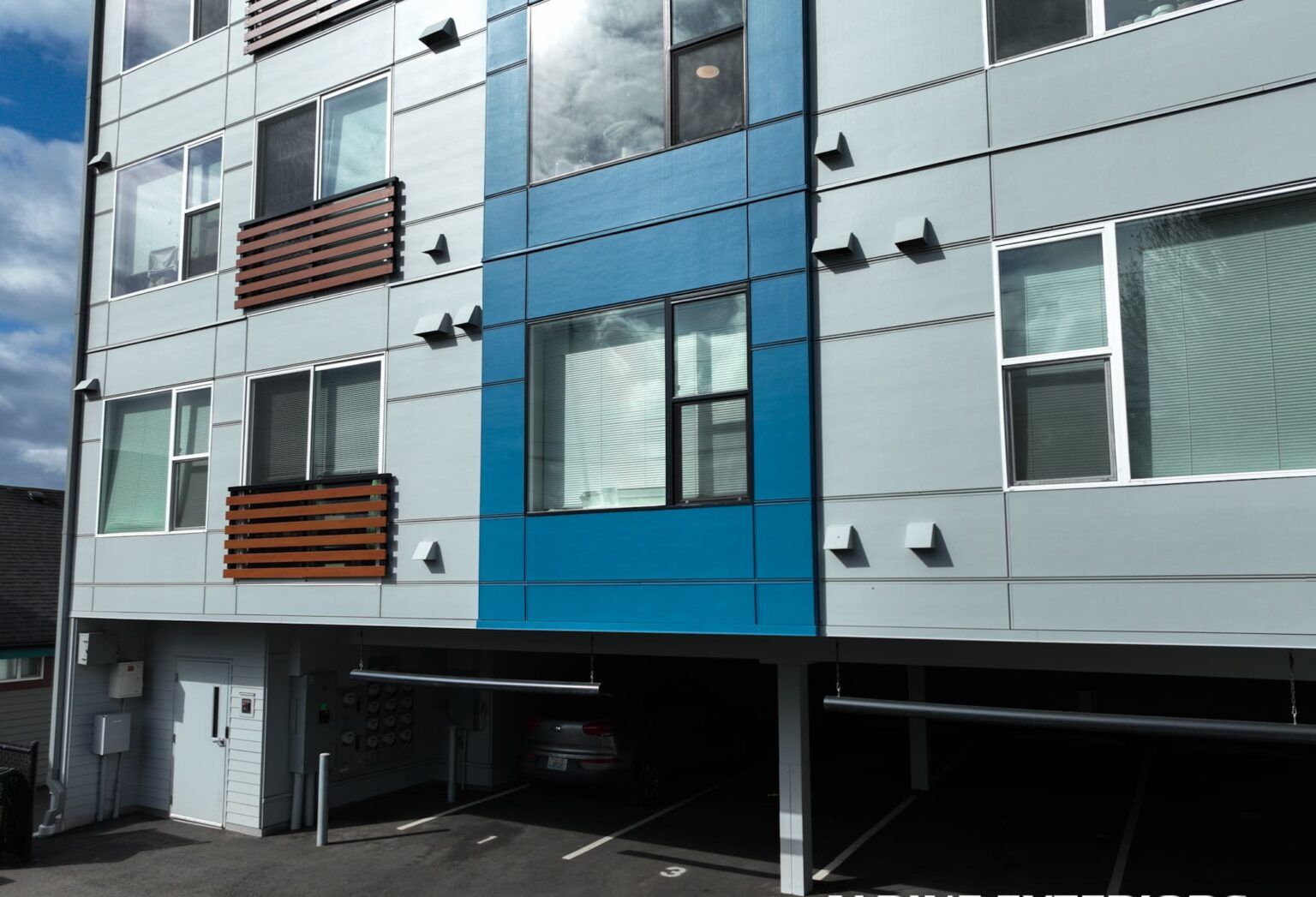
If your Birchwood home takes direct wind-driven rain off Bellingham Bay or sits under fir and cedar canopy where moss and algae never quite dry out, James Hardie fiber cement is the siding that holds up best over the long run. If you're working with a tighter renovation budget, need a fast turnaround before the fall rains set in, or you're re-siding a rental or secondary property where every extra dollar has to be justified, vinyl remains a defensible, lower-cost option — as long as you go into it with realistic expectations about its lifespan and appearance in our climate. Neither product is universally the "correct" choice. The right pick depends on how long you plan to own the house, how exposed the walls are to the Strait of Georgia weather pattern, and what you're willing to spend up front versus over time.
James Hardie fiber cement is a blend of Portland cement, sand, and cellulose fiber, pressed into planks or panels and factory-finished with baked-on color (Hardie's ColorPlus finish) or left primed for field painting. In Whatcom County, the appeal of fiber cement comes down almost entirely to how it handles moisture. Birchwood and the surrounding Bellingham neighborhoods get a long, wet shoulder season — not a single dramatic storm event to design against, but months of low-intensity rain, fog off the bay, and shaded, damp siding that never fully dries between storms. That's the exact environment where wood-fiber composite and cheaper OSB-based sidings have historically failed here, and it's the environment fiber cement was engineered to resist. It doesn't absorb water the way wood or engineered wood products do, it doesn't provide the same food source for the moss and algae that colonize shaded north- and west-facing walls in this part of the county, and it holds paint and factory finish far longer than vinyl holds its color.
Fiber cement is also heavier and more rigid than vinyl, which matters when wind-driven rain off the bay pushes water sideways against a wall — a stiffer plank with tighter, better-flashed joints resists that intrusion better than a flexible panel system. On the downside, fiber cement costs more to install, it has to be cut with the right blades and dust controls (silica dust is a real jobsite hazard, not a marketing footnote), and while the material itself doesn't rot, poor flashing or caulking behind it can still let water reach the wall sheathing — the siding is only as good as the install underneath it. It's also heavier to handle and slower to install than vinyl, which extends labor time and, on a home with a lot of dormers, gables, or trim detail, adds up in labor cost more than in material cost.
Vinyl siding is extruded PVC formed into interlocking panels that hang on the wall rather than fastening rigidly to it, which lets the material expand and contract with temperature swings. It's lighter, faster to install, and typically less expensive up front than fiber cement — for a straightforward rectangular home without a lot of custom trim, that labor savings is real. Vinyl also never needs painting, which some owners value simply for the maintenance-free promise, and modern vinyl profiles have gotten better at mimicking traditional lap siding proportions from a distance.
The tradeoffs show up over time in our specific climate. Vinyl's factory color fades with UV exposure, and because the color runs through the material rather than sitting on top as a finish coat, faded vinyl can't be touched up or repainted the way fiber cement can — once it fades or chalks, the only fix is replacement. In the cooler, wetter stretches of the year common to Whatcom County, vinyl can also become brittle in the cold; on the coldest nights that reach the foothills toward Sudden Valley and the freeze-thaw cycles that come with them, older or lower-gauge vinyl is more prone to cracking on impact than in milder regions. Vinyl doesn't feed algae growth the way wood does, but the panel seams and slight give in the material create more opportunities for moss and windborne organic debris to collect at laps and J-channels, especially on shaded walls — a problem that shows up cosmetically even when the wall assembly behind it is fine. And because vinyl panels rely on ventilation gaps and careful flashing at every penetration to shed wind-driven rain, a rushed or undersized install is more likely to let water track behind the panels in our sideways-rain conditions than a well-installed fiber cement wall.
| Factor | James Hardie Fiber Cement | Vinyl Siding |
|---|---|---|
| Installed cost | Higher material and labor cost; typically the larger up-front investment for a full re-side | Lower material and labor cost; often the more affordable option for a fast, budget-driven project |
| Lifespan in this climate | Long service life when properly flashed and maintained; resists the constant damp that shortens the life of lesser sidings here | Moderate service life; UV fading and cold-weather brittleness tend to show up sooner in Whatcom County's wet, cool climate than in warmer regions |
| Maintenance | Occasional repainting if using primed (non-ColorPlus) boards; periodic washing to keep moss and algae from taking hold, same as any exterior surface here | Low maintenance day to day, but no repainting option once color fades — replacement is the only fix for chalked or discolored panels |
| Appearance | Crisp lap lines, holds paint/finish well, accepts a wide range of trim and color combinations that read as traditional wood siding | Improved profiles look decent from the street, but seams, panel flex, and fading are more noticeable up close over time |
For most owners planning to stay in their Birchwood or wider Bellingham-area home for the long haul, we lean toward recommending James Hardie fiber cement, and it's the product Alpine Exteriors installs most often on full re-sides in this part of Whatcom County. The reasoning isn't about brand preference — it's about matching the material to what actually degrades siding here. Birchwood sits close enough to Bellingham Bay that wind-driven rain is a genuine factor on west- and southwest-facing walls, and the tree cover common in this neighborhood keeps north-facing walls shaded and damp for extended stretches, which is exactly the environment where moss, algae, and moisture intrusion do their worst work over a decade or two. Fiber cement's resistance to water absorption and its ability to hold a factory or field-applied finish gives it a real durability edge under those specific conditions, and it also aligns well with the insulation and air-sealing detailing called for under the Washington State Energy Code, since a rigid, well-flashed cladding system makes it easier to maintain a continuous water-resistive barrier behind the siding.
That said, we don't think vinyl is the wrong answer for every situation. If you're re-siding a rental property, working with a firm timeline before winter, or the home is a smaller, simpler structure without much architectural detail, vinyl can still deliver a reasonable result at a lower cost — you just need to go in clear-eyed that its color and physical condition won't hold up as long here as it might in a drier, milder climate, and that a quality install with proper house wrap and flashing matters just as much with vinyl as with any other siding. Alpine Exteriors installs both systems and will walk your specific walls, exposures, and budget with you before recommending one over the other; we'd rather steer you to the right product for your situation than sell you the more expensive one by default. Our crews carry Washington contractor license ALPINI751OW, and every proposal spells out the flashing and moisture-barrier details regardless of which siding you choose, because in this climate that underlying work matters as much as the cladding itself.
Fiber cement itself doesn't provide the organic food source that wood and some wood-composite sidings do, so it's less hospitable to moss and algae growth than those materials. It isn't immune, though — any shaded, damp wall in Birchwood or elsewhere in the county can still develop surface growth over time, and periodic washing is still a normal part of upkeep no matter what siding is on the house.
Vinyl becomes more brittle as temperatures drop, and in the freeze-thaw swings that reach areas like Sudden Valley and the foothills east of Bellingham, older or thinner-gauge vinyl panels are more susceptible to cracking from impact — a thrown rock, a ladder bump, hail — than they would be in a milder climate. Thicker, higher-grade vinyl performs better in this regard, but it's a real tradeoff worth discussing before you choose it for a home in a colder microclimate.
If a wall is well-protected by roof overhangs, faces away from the prevailing wind and rain off the bay, and doesn't sit under heavy tree shade, the moisture-resistance advantage of fiber cement matters less on that particular elevation. Some homeowners choose a mixed approach — fiber cement on the most exposed walls and a lower-cost option elsewhere — though most full re-sides in this area end up using one material throughout for a consistent look and simpler long-term maintenance.
The energy code addresses the wall assembly's insulation and air-sealing performance rather than mandating a specific cladding brand, so both fiber cement and vinyl can be installed as part of a code-compliant wall system. What matters is that the continuous insulation, air barrier, and water-resistive barrier behind the siding are detailed correctly — Alpine Exteriors accounts for those layers in every proposal regardless of which siding you select.
If you're weighing James Hardie fiber cement against vinyl for a home in Birchwood or anywhere else in Whatcom County — Bellingham, Ferndale, Lynden, Blaine, Birch Bay, Sudden Valley, or the islands — Alpine Exteriors can walk your specific walls and exposures with you and give you a straightforward recommendation, not a sales pitch. Reach out for an on-site look and a written estimate that spells out the materials, flashing details, and timeline for your project.