
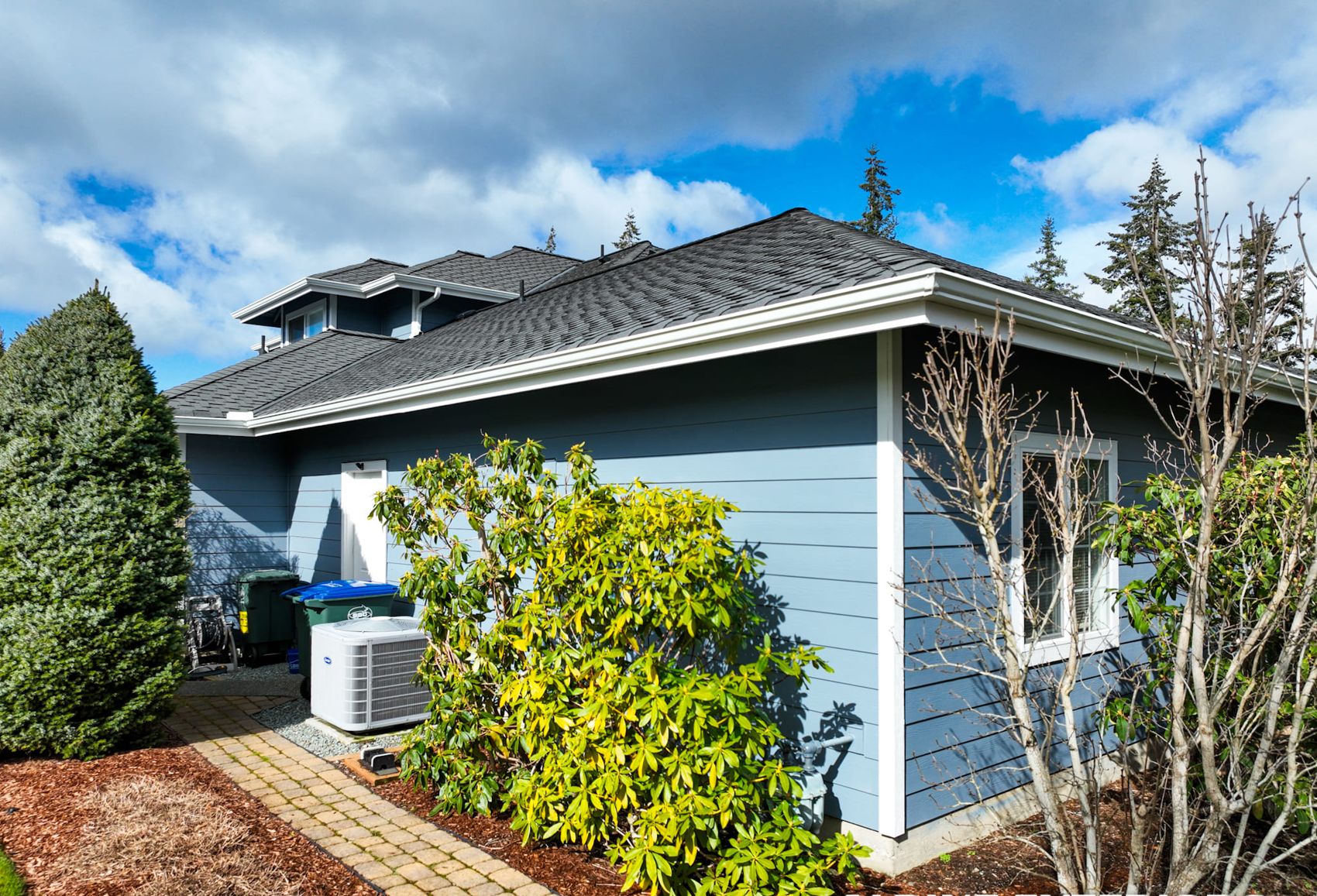
Edgemoor sits right on Bellingham Bay, and that location shapes almost every siding decision homeowners here make. The bluff-top and waterfront lots along Chuckanut Drive and the neighborhood's interior streets get more direct exposure to wind-driven rain coming off the bay and the Strait of Georgia than homes just a mile inland in Fairhaven or the Puget neighborhood. Add in the mature fir and cedar canopy that shades a lot of Edgemoor's older lots, and you get the two forces that drive most siding failures in this part of Whatcom County: moisture that gets pushed sideways into wall assemblies during a southwesterly storm, and shaded, damp surfaces that grow moss and algae faster than they can dry. Homeowners comparing James Hardie fiber cement and vinyl siding are really asking one question: which material handles that combination better, and for how long, before it needs real money spent on it again.
If your Edgemoor home faces the bay directly, sits under heavy tree cover, or is an older structure with a history of wood rot at the trim and butt joints, James Hardie fiber cement is the more defensible choice long-term. It resists moisture intrusion better, holds paint and color longer under the region's UV-filtered but persistent gray light, and doesn't soften or warp the way some vinyl profiles can after two or three decades of freeze-thaw cycling during a cold snap. If your home is more sheltered, you're working with a tighter renovation budget, or you're prepping a rental or spec property where lowest-cost exterior durability is the priority, vinyl siding is still a legitimate option in this climate, as long as it's installed with proper flashing and a rainscreen gap rather than nailed flush to the sheathing. Neither material is wrong here. The mismatch happens when the wrong one gets installed on the wrong exposure.
James Hardie's HardiePlank and HardieShingle products are cement, sand, and cellulose fiber pressed into lap boards or shingle panels, then kiln-cured. Because the material is inorganic at its core, it doesn't absorb bulk water the way wood does, and it doesn't provide the cellulose food source that moss and algae spores need to establish a foothold as readily as raw wood or some vinyl caulk lines can. That matters on Edgemoor's north- and west-facing walls, where tree shade keeps siding damp for days after a Pacific frontal system moves through.
Vinyl siding is an extruded PVC panel, typically installed over a weather-resistive barrier with a degree of designed movement to handle thermal expansion. Modern insulated vinyl and thicker-gauge double-4 or double-5 profiles have closed a lot of the performance gap with fiber cement, particularly on walls that aren't taking direct weather.
| James Hardie Fiber Cement | Vinyl Siding | |
|---|---|---|
| Installed cost range | Higher — roughly $10–$18+ per square foot installed, depending on profile, color program, and prep work | Lower — roughly $5–$11 per square foot installed for standard double-4/double-5 profiles |
| Typical service life | 30–50+ years with proper installation and periodic caulk/paint maintenance | 20–30+ years, with performance and color retention varying widely by panel thickness and grade |
| Moss/algae resistance | Better on shaded, damp Edgemoor elevations; smooth ColorPlus finishes shed organic growth more easily | More prone to green staining at seams and low panel edges in shaded, tree-covered lots |
| Wind-driven rain performance | Strong when flashed and lapped per manufacturer spec; rigid board resists flexing under gusts off the bay | Adequate on sheltered walls; seams and corner posts are the vulnerable points on direct-exposure elevations |
| Cold-snap durability | Not prone to brittleness; holds up through Fraser outflow cold events | Can become brittle and crack on impact during hard freezes, especially with older or thinner panels |
| Maintenance | Periodic caulk inspection, occasional repainting on field-cut edges or after many years | Occasional washing to remove algae/pollen; essentially no repainting |
| Appearance/resale | Wood-grain and shingle textures read as higher-end; often expected on Edgemoor's larger and historic homes | Wide color and profile range; can look plasticky up close on premium homes, less of a factor on modest or rental properties |
Edgemoor is not a uniform neighborhood from a weather-exposure standpoint, and that's the piece homeowners often miss when they compare these two products in the abstract. A home perched above the bay on Chuckanut Drive or one of the bluff streets with a clear westward view is taking direct wind-driven rain during winter storms, salt-tinged air off the water, and full UV exposure in summer. On that kind of lot, we lean toward recommending James Hardie for Alpine Exteriors clients, specifically because the rigidity of the board resists flexing under gusts, the factory finish holds color through more UV cycles, and the material simply doesn't feed moss the way an exposed, damp seam in vinyl can over a couple of decades.
A block or two inland, tucked under mature fir canopy on a quieter Edgemoor street, the equation shifts. Wind exposure is lower, but shade and moisture dwell time go up — moss and algae become the bigger threat, not driving rain. Fiber cement still wins on that front, but a well-installed, quality-grade vinyl product with a proper rainscreen gap behind it can perform acceptably there for a homeowner who wants to control renovation cost, particularly on a detached garage, ADU, or secondary structure where the exterior finish doesn't carry the same expectations as the main house.
The Washington State Energy Code also plays into this decision more than people expect. Under the code's prescriptive path, many Whatcom County re-siding and new-build projects need continuous insulation at the wall assembly to hit required R-values, and that continuous insulation layer changes how both siding types get furred out, flashed, and fastened. Fiber cement accepts continuous exterior insulation and the resulting furring strategy cleanly, and it's a detail Alpine Exteriors builds into the estimate up front rather than treating as a change order. Vinyl can also be installed over continuous insulation, but the window and door flashing details need to be planned even more carefully, since vinyl's inherent flexibility gives less margin for error at those transitions when there's an added inch or more of rigid insulation to bridge.
Age of the existing structure matters too. A lot of Edgemoor's housing stock dates to the 1920s through the 1960s, and it's common to find original cedar siding underneath a later vinyl overlay, with hidden wood rot at the sills, corner boards, or window trim that only shows up once the old siding comes off. When Alpine Exteriors opens up a wall on one of these homes and finds rot, we'd rather have that conversation honestly before ordering material than after — it usually means budget goes toward sistering or replacing damaged framing and sheathing first, and that repair cost is the same regardless of which siding goes back on. It does, however, make the case for fiber cement stronger, since you're already investing in the substrate repair and want a cladding that won't reintroduce the same moisture problem in another twenty years.
It generally does, mainly because of surface texture and how the two materials shed water. A smooth, factory-finished fiber cement board with tight, well-caulked joints gives algae and moss spores less to grip than a vinyl panel's overlapping seams and lower edge, which stays damp longer under tree cover. Neither material is immune — any shaded, poorly ventilated wall will eventually show some growth — but fiber cement tends to need pressure washing or gentle cleaning less often on Edgemoor's tree-shaded lots.
On sheltered walls, yes, as long as it's installed with the correct nailing allowance for expansion and proper flashing at every penetration. On a directly exposed bayfront or bluff elevation taking sustained gusts and driving rain, vinyl's seams and corner posts are more likely to be the point where water eventually finds its way behind the panel over many years, which is why we usually steer fully exposed elevations toward fiber cement instead.
Depending on the scope of the project and the compliance path chosen, a re-siding job in Whatcom County may need to add continuous insulation at the wall to meet the Washington State Energy Code's prescriptive requirements. Both fiber cement and vinyl can be installed over that continuous insulation layer, but it changes the furring, fastening, and flashing details at windows and doors, and it's worth confirming with your contractor before the estimate is finalized rather than after the walls are open.
It depends on the condition of what's underneath. If the original cedar and sheathing are sound, siding over it with either product can work. If there's hidden wood rot, which shows up fairly often on Edgemoor's older homes, that damaged material needs to come off and be repaired regardless of which new siding goes back on, and at that point many homeowners choose fiber cement since they're already paying for the substrate work and want a cladding less likely to trap moisture against it again.
Every Edgemoor lot handles bay wind, rain, and shade a little differently, and the right siding choice really does depend on which elevation is taking the weather. Alpine Exteriors, licensed in Washington under contractor number ALPINI751OW, walks the property with you, checks for existing rot or moisture damage before quoting anything, and gives you a straight comparison between James Hardie and vinyl for your specific home rather than a one-size-fits-all pitch. If you're weighing this decision for a home in Edgemoor or elsewhere in Whatcom County, reach out to Alpine Exteriors for a site visit and a written estimate that spells out the real trade-offs for your address.